
Skip to content
OriBridge东方桥

Product Validation

When a China Training Brief Buys a Service, Not Just Your Course

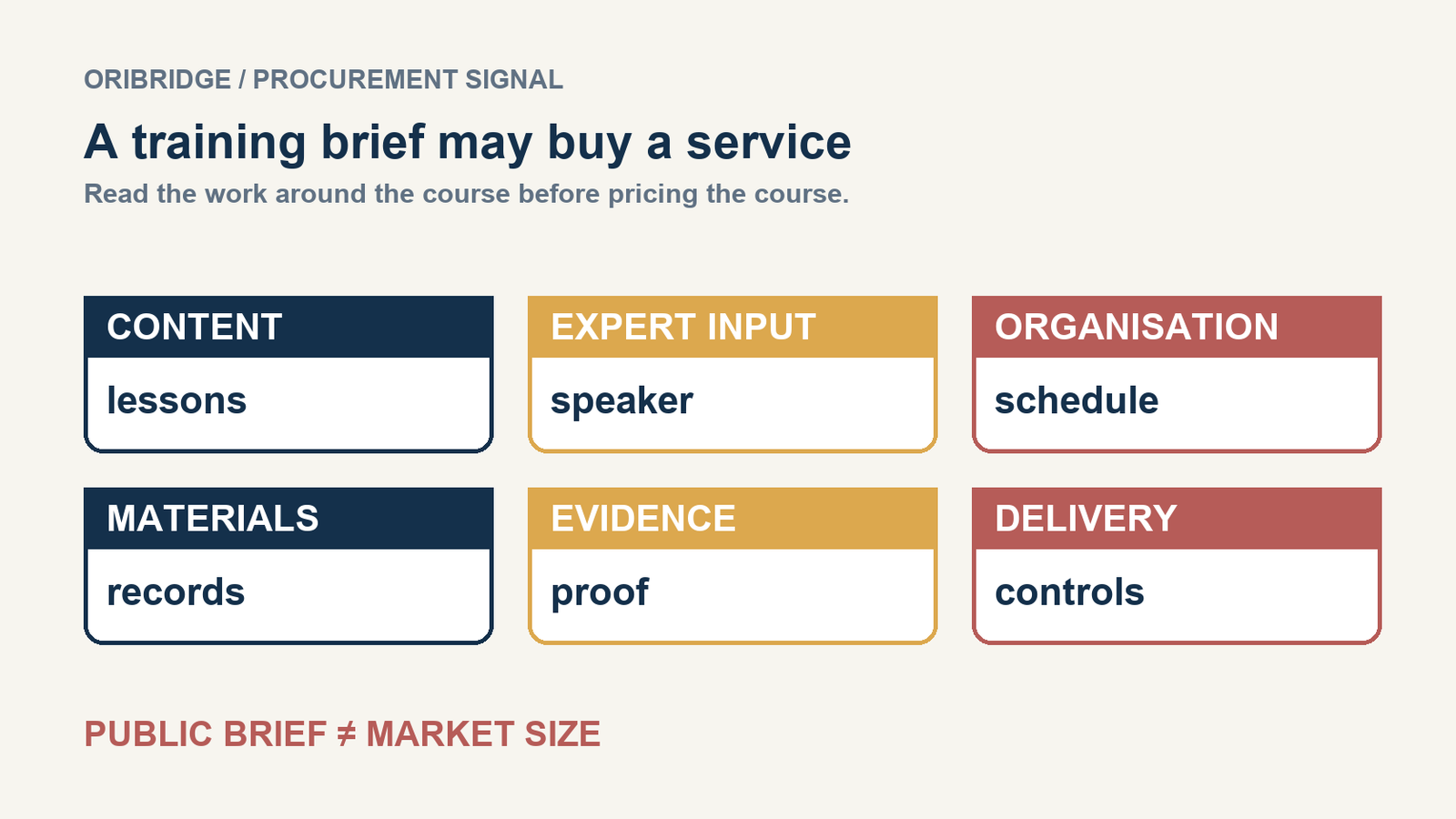
A service-package map separating course content, expert input, organisation, materials, evidence and delivery in a China training procurement brief.

A public training notice can be useful evidence that one named organisation is looking for a defined set of services. It is not proof that your existing course is ready to sell, that you can bid, or that China has a broad market for the topic. In the two public notices reviewed here, the brief reaches beyond content: it also asks for expert input, organisation, materials, evidence and delivery controls.

The course creator’s first misread

Imagine finding a Chinese training notice that mentions a subject close to your expertise. The instinct is familiar: translate the course page, attach a price, and ask whether the buyer wants the curriculum.

That instinct skips the part the notice is actually buying.

One notice may be asking for a speaker and a four-hour session. Another may ask a service provider to recruit or manage instructors, arrange a venue, keep attendance, produce certificates, organise travel, and submit a report. Both contain the word “training”. They are not the same product.

This distinction matters before anyone discusses a China route. A course can be valuable content input while still being only one component of the requested service.

What the two notices actually say

The examples below are not a market survey. They are two dated, public procurement notices used to demonstrate how to read a brief.

The Hengqin Economic Development Bureau’s notice for 2026 training services sets a budget ceiling of RMB 300,000 and a 12-month service period. Its scope includes expert lectures, organised research visits and internal-trainer development. The lecture service asks for at least nine sessions, each with a course outline and instructor information submitted in advance. The research component includes coordination, routes, a handbook and a results-transformation report. The response package includes qualification documents, a detailed price and evidence of similar work.1

The Xi’an Postal Administration’s notice is narrower in subject but broader in logistics. It describes a three-day programme for 45 participants and lists curriculum design, instructor hiring and management, venue, accommodation, on-site organisation, teaching materials, completion certificates, attendance, participant management and training records. The response must include a curriculum plan, instructor configuration, service safeguards, a detailed quotation and a performance commitment.2

The safe conclusion is limited but useful: in these two particular public notices, “training” is a service surface with several attached obligations. It is not simply a file containing lessons.

The six surfaces hidden inside a training brief

Before deciding what your asset is worth, mark each requirement in the brief against six surfaces:

Surface What the notice may be asking for What your existing course may provide
Content A syllabus, lesson, case or learning path Lessons, exercises, examples and teaching assets
Expert input A named speaker, specialist or instructor profile Subject expertise and permitted appearances
Organisation Scheduling, participants, venues, travel or session operations Usually not included in a self-paced course
Materials Handbooks, slides, attendance records, certificates or local working documents Some reusable material, subject to permission and adaptation
Evidence Similar-project records, reports, outcomes or response documents Only evidence you can actually substantiate
Delivery Safeguards, communications, support, records and a defined handoff Depends on the operating partner and authorised scope

This is a reading tool, not a universal Chinese procurement model. Its value is that it stops one word—“course”—from hiding five other responsibilities.

The question to ask after a public signal

Do not ask first, “Can we sell this course in China?” Ask three smaller questions:

  1. Is the brief looking for content input? A bounded lecture or curriculum contribution may be the relevant unit.
  2. Is it looking for expert input? The buyer may need a person with a particular profile, schedule and documented experience, not a translated catalogue.
  3. Is it looking for a complete operator? If the brief includes venue, participant management, certificates, records, reports and response evidence, the course is one ingredient inside a service package.

The third answer changes the commercial conversation. You may need a qualified local service provider to own the delivery layer, while an authorised expert supplies content or instruction. That is a possible operating hypothesis—not a conclusion that any particular partnership, entity or bid is permitted.

A concrete example of the difference

Suppose a foreign expert has a four-module leadership course. A four-hour invited talk might use one module and a speaker biography. A three-day programme with attendance, certificates, accommodation and archived records needs a different plan: who coordinates the class, who confirms the instructor, who owns the materials, who handles participant information, and who signs the delivery record?

The course has not become less valuable. It has become more accurately located in the service map.

That is the decision a public brief can support. It cannot tell you, without further work, whether the course is authorised for reuse, whether a provider meets every requirement, or whether a buyer will accept a proposed arrangement.

The tempting leap from signal to opportunity

Leap: “There is a budget and the subject matches my course, so this is evidence of a China sales opportunity.”

Why it fails: the notice describes one buyer’s scope, date, conditions and response process. It does not establish national demand, private-company behaviour, overseas eligibility, award probability or the suitability of your course. Even the budget is a boundary for that notice, not a price list for your product.

The reverse error is possible too. If your course is not a complete service package, that does not mean it has no role. It may be a content input, a speaker resource or a starting point for a bounded test—provided the permissions, operator responsibilities and actual procurement conditions are separately verified.

What this article cannot prove

This article does not provide tendering, legal, tax, licensing, entity, payment, foreign-exchange, data-protection or intellectual-property advice. It does not say that an overseas expert, company or OriBridge can participate in either notice, satisfy its requirements or win work. It does not generalise these two public-sector examples to Chinese private companies or to the whole market.

It also does not prove that either notice was awarded, that its budget was spent, that the named services produced a result, or that a similar brief will appear again.

If you have found a specific public brief, the useful next step is to preserve the exact notice, mark its service surfaces, and list which assets you are authorised to contribute. You can then request a bounded validation review rather than treating a keyword match as a sales plan.

For the difference between attention and an actionable buyer signal, read when topic popularity is not buyer demand. For choosing the smallest testable commercial route, see choosing a China business model. If the request is specifically a short learning event, a workshop is not a short course explains why the promised work result matters.

A wider evidence box: scope is not qualification

Four additional public notices reviewed after this article was published point in the same narrow direction. In specific public-sector projects, a training response may include a needs assessment, course plan, named instructors, organisation, participant records, evaluation, reports, archives, or an acceptance package. That makes the service map more concrete. It does not turn any of these notices into a general Chinese procurement rule, an eligibility opinion, or evidence that an overseas course will be bought.

  • What the notices can show: a named public buyer’s stated scope, response materials, team or evidence requirements on a particular date.
  • What they cannot show: private-company buying behaviour, overseas-subject eligibility, tax, contract, data, payment, or tender-law conclusions.
  • What to record next: separate course assets, speaker evidence, delivery capability, project records, and unresolved subject/permission questions before treating the notice as a route.

Sources and limits


  1. Hengqin Economic Development Bureau, “2026年度培训服务自主采购公告”, published 2026-01-23, verified 2026-08-16. The article uses the page only for the stated scope and response requirements; it does not reproduce contact details or attachments. 

  2. Shaanxi Provincial Postal Administration, “西安市邮政管理局落实县级邮政管理责任业务培训班服务项目自行采购公告”, published 2026-06-26, verified 2026-08-16. The article uses the page only for the stated scope and response requirements; it does not infer eligibility or procurement outcomes. 

  3. Xi’an Jiaotong University, non-degree continuing-education training service transaction notice, checked 2026-08-16. Supports only the stated scope and service standards in that public project, including research, instructors, organisation, records and reports; not overseas eligibility or general demand.

  4. Chongqing Shapingba District, training procurement notice for staff at key consumer venues, checked 2026-08-16. Supports only the listed response-plan, instructor, materials, schedule, confidentiality and team requirements in that project.

  5. Jiangmen, rural construction craftsperson training procurement notice, checked 2026-08-16. Supports only the specific course/instructor/organisation/quotation/evidence and acceptance-payment language in that notice.

  6. Wuchuan, transition training service procurement notice for retired service members, checked 2026-08-16. Supports only the stated qualification materials, instructor proof, outline, assessment mechanism and quotation requirements in that project.

Scroll to Top