
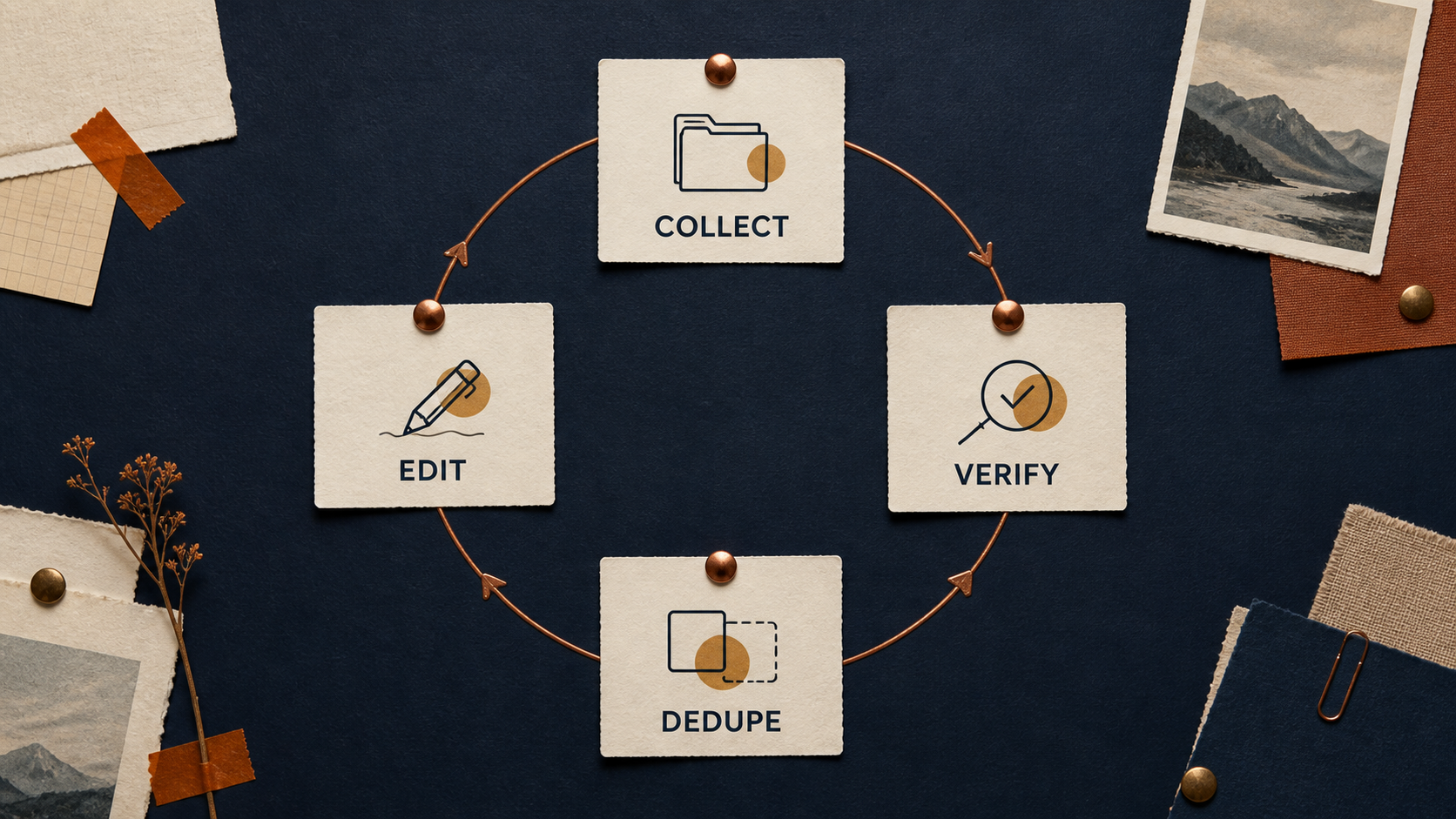
Multi-agent research looks persuasive on a diagram. One agent searches, another summarizes, a third compares tools, and a fourth writes the brief. The number of boxes can create an impression of independence. It is still possible for every agent to copy the same unsupported assumption from the same product page.
Concurrency is a production choice. Reliability is a governance choice. A China research workflow needs separate responsibilities for collection, source verification, canonical deduplication, editorial judgment and final approval. Adding more agents without those gates mostly adds more unverified text.
What the official workflow pages support
Alibaba Cloud’s workflow documentation describes batch and concurrency configuration and the dispatch of sub-agents through descriptions. Deep Writing documentation describes plans, activities, sources and intermediate files. These are useful capabilities for organizing work. They do not say that two agents reading the same page constitute two independent sources, or that a higher concurrency value improves factual accuracy.
Treat the pages as workflow evidence, not as proof that an output is reliable.
Five separate jobs
Collection finds candidate pages and records exact URLs. Verification checks whether the page supports the narrow claim and records what it cannot support. Deduplication compares the proposed topic with existing canonical pages. Editorial judgment decides whether a claim is worth publishing and how to frame uncertainty. Approval confirms that the draft may proceed to the next controlled stage.
One agent may perform more than one job in a small task, but the handoffs must remain visible. Ten agents all writing summaries are not a substitute for one reviewer checking the source sentence by sentence.
Illustrative scenario
Ten fictional agents inspect official AI product pages and independently report that “Chinese businesses are adopting agents.” The pages actually document workflow nodes, model configuration and tool calls. The safe merged finding is narrower: the cited products expose those capabilities. The demand statement remains unverified.
The research lead should create a source ledger, mark the broad claim as unsupported, and define the next evidence step. The result may be less exciting, but it is more reusable.
The counterexample
Controlled concurrency is useful for mechanical work: extracting fixed fields from a list of known URLs, checking whether a required field is present, or normalizing dates. The task has a defined schema and a deterministic review. More workers can reduce elapsed time without pretending to create independent evidence.
The problem begins when output volume is mistaken for triangulation. Different wording is not different evidence.
A simple gate table
| Gate | Required record | Failure action |
|---|---|---|
| collection | title, URL, date, source owner | hold incomplete item |
| verification | supported claim and non-claim | narrow or reject claim |
| deduplication | existing canonical comparison | merge or change intent |
| editorial | audience, scenario, boundary | revise framing |
| approval | named review state | do not advance |
This is a governance framework, not a China market statistic. It tells a team how to handle research, not what the market wants.
For demand boundaries, read When Topic Popularity Is Not Buyer Demand. For source and substitution analysis, see How to Map Local Alternatives Before Entering China. For the product-level decision, use Product Portability Audit.
What this cannot prove
The cited workflow pages do not prove that a model is more reliable, that a research brief is accurate, that buyers exist, that an account can be accessed, or that an overseas expert is authorized to publish or sell. They also do not prove content performance or compliance. Those are separate questions.
A useful stopping rule
Stop adding agents when the next bottleneck is not collection speed. If the unresolved issue is source interpretation, canonical overlap or a missing buyer signal, another summary agent will not solve it. Change the gate, assign a reviewer or collect the missing evidence.
If you need a scoped design review for a China research workflow, submit a validation request. It does not promise accuracy, access or commercial results.
Sources and evidence boundary
- Alibaba Cloud Workflow Application — checked 2026-08-24. Supports concurrency and workflow configuration; does not prove quality.
- Alibaba Cloud Model Studio Deep Writing — checked 2026-08-24. Supports plans, activities, sources and intermediate files; does not prove independent verification.
A bounded multi-agent run
Write the contract first: source domains, fields, date range, canonical pages and stop condition. Collection workers should return records, not polished conclusions. A verifier must be able to reject a record without editing persuasive prose. Preserve source owner and date, and keep product pages, government notices and public discussions as separate evidence classes. If a URL fails, record the failure rather than generating a substitute. The final brief should contain a claim ledger, canonical decision and unresolved questions. Agent count and token use are implementation details, not evidence of quality.
Assign work by evidence risk
Use one worker for bounded source discovery, another for exact-page reading and a reviewer for the claim ledger. The second role should receive the original URL and the proposed sentence, not only a generated summary. Ask it to quote the narrow observable fact in its own words, list the page’s limits and mark whether the source is first-party. A canonical reviewer then compares the proposed reader decision with existing pages. This prevents a new article from splitting an existing topic merely because several agents produced different headlines.
The Alibaba workflow page supports configurable batch and concurrency settings and descriptions for sub-agent dispatch. That is enough to design the run. It is not evidence that agents are independent. If every worker receives the same prompt and same source list, their agreement is correlated. Independence comes from different evidence routes, explicit challenge questions or a human check—not from a larger number in the concurrency field.
A complete China research scenario
Imagine a team asks whether to create a China course about AI agents. Collection workers find Alibaba workflow documentation, a government training notice and a public course page. Verification records three different facts: the product documents agent nodes; the notice covers a specified training project; the public page shows a course surface. None proves broad demand or overseas eligibility. The editor writes a narrow brief and sends the missing buyer question to validation. If another worker claims “the market is ready,” the claim is rejected unless it has a distinct source class.
Failure and stopping rules
Stop the run when the unresolved issue is interpretation rather than collection. Escalate a source whose wording is ambiguous. Hold a dynamic page that cannot be stably re-read. Merge a proposed page whose search intent is already owned by an existing canonical. These actions may reduce output count while improving the reliability of the remaining work. The framework remains a governance design, not a China market statistic, and it cannot prove demand, accuracy, access, authorization or outcomes.
– Three existing canonical links and one CTA included.
The reviewer’s minimum packet
Give the reviewer the source ledger, proposed claim, canonical comparison, unresolved questions and exact date checked. Do not provide only final prose. If a URL is unstable, mark it held rather than replacing it with a secondary summary. If agents disagree about a page’s meaning, preserve the disagreement until a human resolves it. This packet makes evidence reusable without pretending that fluent repetition is independent verification.
The final approval should record what was accepted, what was merged into an existing page and what remains unverified. That is a more useful measure of research quality than the number of generated drafts.
Review the disagreement, not just the majority
An agent that returns a different source, narrower claim or counterexample is doing useful work. Do not vote by text similarity. Put the disagreement in the verification queue and ask which page supports which sentence. A majority of agents repeating a product description is still one evidence class. One carefully checked exception can be more decision-relevant than nine fluent summaries.
The same principle applies to canonical review. If two proposed articles have different titles but the same reader decision and evidence boundary, merge them. The goal is a small set of durable pages with clear intent, not a large set of near-duplicates produced by parallel generation.