
Illustrative scenario: an expert is about to pay for a China market report. The brief sounds simple: find competitors, estimate demand, recommend a platform.
But the product is a leadership course, the presumed buyer is “Chinese managers,” the competitor list mixes free videos with enterprise training firms, and the suggested platform is doing the work of an answer before anyone has stated what the buyer is trying to fix. The report may look busy. It cannot yet support a decision.
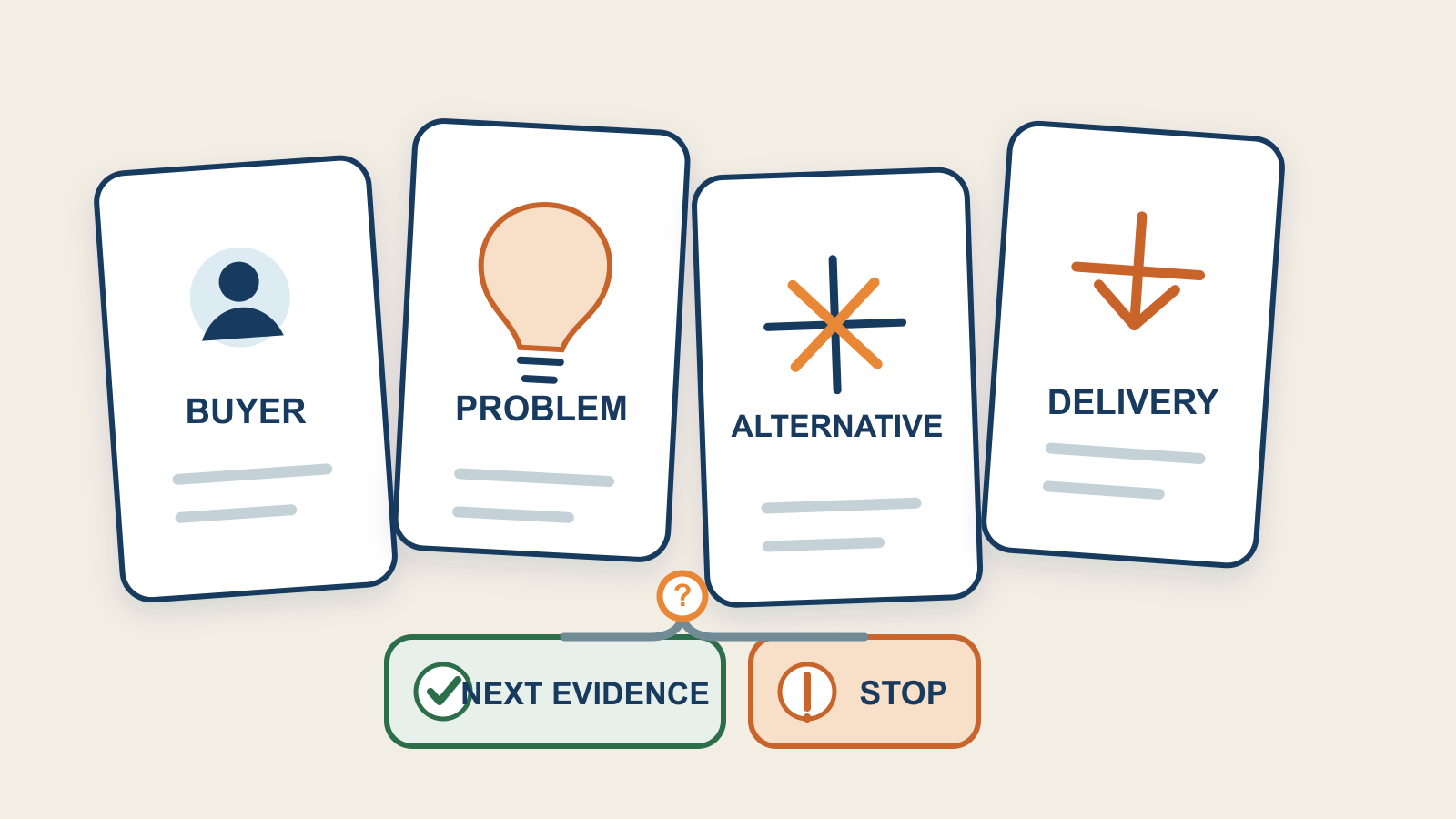
Before you investigate a China opportunity, record the buyer, the costly problem, the buyer’s current alternative, and the first delivery-route unknown as four separate evidence fields. A blank field should create a next question or a stop signal—not an opportunity score. This worksheet is a research tool. It does not establish demand, a viable platform, a qualified buyer, or permission to sell.
Why four fields are better than one confident score
Competitive analysis has always needed separate inputs. Shopify’s current guide distinguishes products, prices, marketing, distribution channels, and customer groups rather than treating a competitor name as a complete answer.1 That is a useful discipline for an overseas expert: a visible alternative cannot tell you by itself who buys, what problem matters, or how your product would reach and serve them.
The same separation matters on the China side. Xiaoe Tech publicly presents distinct product and use-case categories that include a mini-program store, public-to-private-domain tools, private-domain operations, training tools, and CRM.2 Those categories do not prove what a buyer wants, nor do they prove that a particular overseas seller can use the service. They do show why “the platform” should not become a catch-all column for discovery, conversion, training, delivery, and ongoing service.
The editorial judgment behind this worksheet is therefore simple: an opportunity is not a score assembled from partial facts. It is a chain of claims that must each survive their own evidence.
Fill the worksheet in the order a weak hypothesis breaks
The fields below are intentionally empty of market conclusions. Populate them only with the evidence you can reopen, the date you read it, and the conclusion it can actually support.
1. Buyer: who makes, sponsors, or feels the decision?
Name a role and a moment, not a country-sized audience. “Chinese creators” is a topic label. “An HR lead deciding how to help newly promoted managers run difficult feedback conversations before a quarterly review cycle” is a testable buyer hypothesis.
Record:
- the role and context;
- the evidence source and date;
- what that source actually says;
- what remains unknown, especially budget ownership and decision authority;
- the next evidence request; and
- a stop condition.
Stop condition: if you cannot identify a plausible role and a concrete moment of choice, do not begin pricing, translation, or channel selection. Keep the work as topic research.
2. Problem: what is costly enough to change behaviour?
Write the job in the buyer’s terms. A course topic is not automatically a problem. “Leadership” may be a category; it is not evidence that someone is losing time, money, trust, or performance in a way an external learning product could address.
Record the current workaround, the consequence of leaving it unresolved, and the condition under which the problem would no longer matter. This last field protects the team from treating every inconvenience as purchase intent.
Counterexample: a manager may say feedback skills are important while already receiving mandatory internal training that solves the immediate need well enough. That is not a failure of the overseas expert. It is a reason not to confuse general relevance with an open problem.
3. Alternative: what does the buyer do instead today?
Do not start with a brand list. Record the route that gets the buyer close enough to the desired outcome: an internal workshop, fragmented free material, a local facilitator, an enterprise learning route, a hosted learning product, or simply deferral.
The published local-alternatives map helps explore those routes in more detail. This worksheet has a smaller job: it captures what you know about one route, how you know it, and what the route does not prove.
Shopify’s separation of customer, product, channel, and pricing inputs is relevant here because a named provider alone is not a buyer alternative.1 A local course may be easy to find yet irrelevant to the moment of choice. An internal workaround may be invisible online yet be the strongest substitute.
Stop condition: if the proposed alternative is only a category name or a search result, mark it unknown. Do not use it to calculate market size, competitor strength, or a price gap.
4. Delivery: which first route is being assumed, and what is not known?
Delivery is not one thing. For a China-facing offer, the research record may need separate hypotheses about where a person discovers the offer, what happens between interest and conversion, how learning or training is delivered, and who handles the relationship after the first interaction.
Xiaoe Tech’s public categories are a useful prompt for that separation: its homepage presents distinct tools and scenarios around storefronts, public-to-private-domain movement, private-domain operations, training, and CRM.2 The worksheet should therefore state the assumed first route in plain language, then list its unknowns instead of assigning it a green tick.
For example, “use a creator-owned learning route” is not a route plan until discovery, conversion, learning delivery, and follow-up each have a named question. It may be the right direction. At this stage, it is still a hypothesis.
Stop condition: if the only reason to select a delivery route is that a platform category exists publicly, keep the delivery field open. Public product pages do not establish account eligibility, payment, access, delivery success, support capacity, or legal suitability for a particular entity.
The blank worksheet
Worksheet version: BPAD 1.0 (2026-08-13). Use one row for one opportunity hypothesis. Fill each of the four fields with a source, the date it was read, the evidence grade, the unknown, one next action, and a stop condition. Keep older versions when a material assumption changes; do not silently overwrite the decision trail.
Use these evidence grades: D — recorded hypothesis; C — re-openable public fact; B — attributable buyer/problem evidence; A — controlled test record for the named conditions. The grade describes the record, not the attractiveness of the opportunity. Do not promote a lower grade because it feels directionally persuasive.
| field | what to write | source, date and grade | unknown that still matters | next evidence action | stop condition |
|---|---|---|---|---|---|
| Buyer | named role + moment of choice | link, note, or permitted record; date; A–D | authority, urgency, budget, participant | ask one question that could disconfirm the role | no specific role/moment after defined research window |
| Problem | current job, workaround, and consequence | source; date; A–D | cost, frequency, whether an external solution is wanted | seek a concrete recent instance or decline signal | only broad interest; no consequential problem |
| Alternative | the route used now, not merely a company name | source; date; A–D | why it is chosen; switching trigger; actual user fit | map one route to the same buyer/problem | no attributable route evidence |
| Delivery | first assumed discovery-to-follow-up route | source; date; A–D | eligibility, access, payment, delivery, support, permissions | turn one unknown into a dated route-test question | route is a platform name with no accountable next question |
| Conclusion | OPEN / TEST / REVISE / STOP, with one reason | editor; sheet version; lowest critical grade | what this conclusion cannot prove | next smallest decision | do not use a numeric score to hide an empty column |
China route note: one platform name can hide several operating questions
Xiaoe Tech’s official Chinese homepage, rechecked on 2026-08-13, separately presents a mini-program storefront, tools for moving a public audience into an owned contact environment, private-audience operations, training tools, and CRM.2 In plain English, those labels point to different jobs: storefront, audience handoff, ongoing operations, learning delivery, and relationship management. BPAD 1.0 therefore records them as separate questions inside the Delivery field rather than treating “use Xiaoe Tech” as a completed route answer.
This is a source-bounded decomposition, not a verified Xiaoe Tech workflow or a universal China funnel. The public categories cannot prove that an overseas entity qualifies for an account, can accept payment, can deliver this product, or will achieve any commercial result.
The “source and date” cells are not decorative. Shopify and Xiaoe Tech can support a general research design, but they do not fill a buyer or problem cell for your product. A completed worksheet needs evidence about the named hypothesis, not evidence that competition and platform categories exist somewhere.
A deliberately incomplete illustrative row
The following is not a client record, market finding, or test result. It shows how to leave uncertainty visible.
| field | illustrative entry | evidence status | what it cannot prove |
|---|---|---|---|
| Buyer | Hypothesis: an HR lead preparing first-line managers for a near-term feedback cycle | recorded hypothesis | that such a buyer exists, owns a budget, or wants outside training |
| Problem | Hypothesis: managers lack a repeatable way to practice difficult feedback conversations | recorded hypothesis | frequency, business cost, or willingness to change behaviour |
| Alternative | Possible route: internal workshop or a local facilitated programme | unverified route hypothesis | that either route is used, preferred, successful, or competitive |
| Delivery | Unknown: how the first interested HR lead would discover, evaluate, receive, and be supported through a bounded offer | unknown by design | that any Chinese platform, payment route, or delivery configuration is available |
| Conclusion | OPEN: obtain one attributable buyer/problem observation before discussing full localization | editor decision | market demand, product fit, commercial viability, or a launch recommendation |
This is what an honest early-stage worksheet should look like: less satisfying than a score, but much harder to misread.
When the answer should be STOP, not “more research”
Research can become a way to postpone an uncomfortable conclusion. Stop the current hypothesis when its key terms stay generic, when the only evidence is topic visibility, when all observable alternatives solve a different job, or when the minimum path to learn more would require commitments the team cannot ethically or operationally support.
Stopping one hypothesis does not mean China is closed forever. It means the next question should change. That is the purpose of a worksheet: it keeps a team from pouring more detail into a premise that no longer has a decision to support.
For a further guardrail, read When Topic Popularity Is Not Buyer Demand. It separates attention from costly problem evidence and buyer commitment. Only after a buyer, product, and route can each be tested separately should the work progress to A Good Product, a Buyer, and a Channel Are Three Separate Tests.
If you have one public product link and a specific China decision to make, request a scoped validation review. Bring the blank cells. They are often the fastest route to the next useful question.
Sources, evidence boundary, and update note
- [S1] Shopify, Competitive Analysis Guide 2026: Free Template + AI Tools. Verified 2026-08-12. Supports the limited point that competitive analysis considers distinct inputs such as product, pricing, marketing, distribution channels, and customer groups. It does not establish Chinese buyer demand, a named alternative, or a recommended market-entry route.
- [S2] 小鹅通 / Xiaoe Tech, official homepage. Verified 2026-08-12. Supports its public description of separate product and use-case categories including mini-program storefront, public-to-private-domain tools, private-domain operations, training tools, and CRM. It does not establish suitability, eligibility, access, payment, delivery, service capacity, or legal status for a particular product or entity.
What this article cannot prove: that China has demand for a specific offer; that a named buyer has budget or authority; that an alternative is truly competitive or widely used; or that any platform is available, appropriate, or legally usable for a particular operator. This tool records questions and evidence boundaries. It does not replace buyer research, controlled testing, permission review, or route-specific verification.