
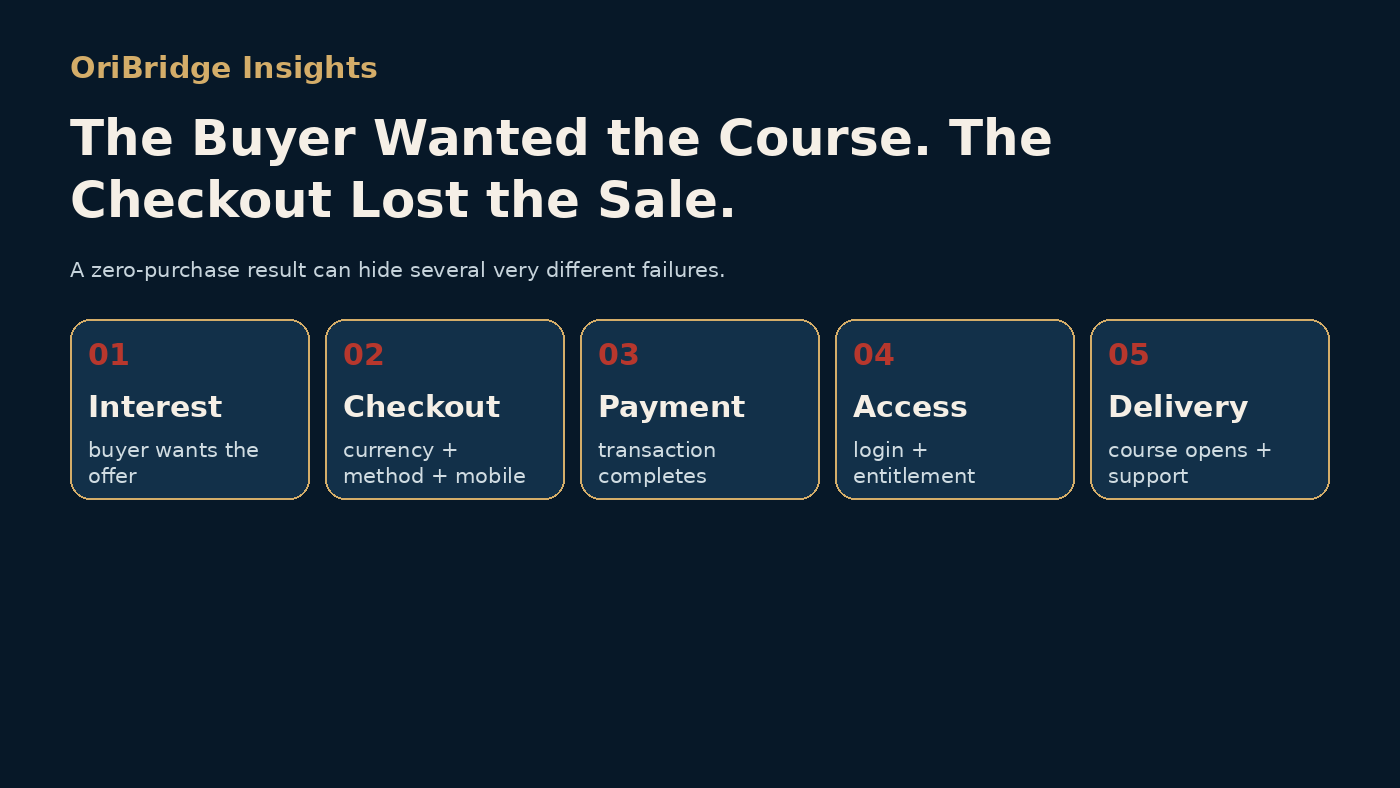
A person who reaches checkout and disappears has not told you why. Until you can name the last confirmed action, “no sale” is not evidence of weak course demand. It is an unresolved observation.
Consider an illustrative scenario, not an OriBridge customer case or a China-market result. An English-language course owner shares a short workshop clip with a Chinese-speaking professional audience. One visitor reads the course page, starts the checkout, and leaves. The team has a familiar impulse: change the price, rewrite the course, or conclude that the market does not care.
That may be the right conclusion. It may also be the wrong repair for an unobserved break between interest and access.
This article is deliberately narrower than a general China-entry guide. It does not tell a course owner which wallet, currency, platform, entity, or sales route to use. Its job is to make a checkout failure legible enough to choose the next test.
A checkout is not one event
“Abandoned checkout” compresses several different moments into one label. A visitor may never see the price. They may see it and stop. They may choose a method and encounter an error. They may pay but fail to receive access. Or the person may be asking for an invoice and team seats, which means a consumer checkout was never the right path to inspect.
The useful question is not, Does our course platform work in China? It is: Where did this defined buyer journey last produce evidence, and what is still unobserved?
That phrasing matters. It prevents a team from changing the lesson when the uncertain step is identity, payment, entitlement, or support. It also prevents the opposite mistake: treating a payment experiment as proof that people want the course.
The post-mortem starts with the last confirmed signal
Use a single named journey. Do not combine traffic from a social post, a partner referral, and a corporate inquiry into one conversion-rate figure.
| Last confirmed signal | What remains plausible | Next bounded observation | Do not conclude yet |
|---|---|---|---|
| The intended reader opened the offer but did not begin the next step | Relevance, message, proof, timing, or tracking may be weak | Check whether the key promise and next action were actually seen | “The course has no China demand” |
| They began checkout but no payment state was recorded | Method, currency display, mobile handoff, identity, trust, or an unrecorded technical error may be involved | Observe one consented journey from checkout start to the next visible state | “They rejected the price” |
| A payment attempt produced an explicit failure state | A route-specific integration or account condition may need investigation | Preserve the exact error category, method, route, device, and time; reproduce only under authorized conditions | “This payment method never works in China” |
| Payment is confirmed but access does not arrive | Entitlement, login, email, asset routing, or support handoff may be broken | Run a delivery-and-recovery check on the same defined order state | “The buyer changed their mind” |
| The person asks for a proposal, invoice, or seats before payment | The buyer may be following an organizational process rather than a self-serve one | Map the actual buying path and who must approve it | “Checkout needs better optimization” |
The table does not diagnose a real incident by itself. It tells the operator what evidence is missing. That is the point.
Do not repair the offer before preserving the trail
A team can lose the useful part of the signal by moving too quickly. If it changes the price, page, payment method and onboarding email at once, the next visit cannot tell it which change mattered. Preserve the original route, the offer version and the last observed state first. Then alter one decision-relevant element in a later, bounded observation.
This is deliberately less exciting than a conversion-rate dashboard. It is more useful when the sample is small. A single clear failure state can justify a technical investigation; several silent exits may still be only a question. The right record is short: journey version, entry source, device class, last confirmed state, recovery path and the decision the next observation is meant to change.
The counterexample is an inquiry that never attempts checkout because the reader asks for a proposal, seats and an invoice. Treating that as abandoned consumer checkout makes the team optimise the wrong system. It may be evidence of a different buying process, or simply a request that needs qualification; it is not proof that the course has enterprise demand.
Why a payment option is not a diagnosis
Stripe’s official pages describe Alipay and WeChat Pay integration contexts, while its payment-method support documentation shows that support depends on documented conditions rather than a simple universal switch.1 Those pages are useful when a team is checking a specific route. They are not evidence that a particular course, legal entity, currency, product category, buyer, or promotion route can transact successfully.
Nor do they tell us what feels natural to a particular Chinese buyer. That is a test hypothesis, not a vendor-document conclusion.
For example, a USD-denominated professional programme may be perfectly intelligible to an international audience. A mobile-first audience arriving from a social post may react differently. Both statements are reasons to observe the intended journey; neither gives permission to generalize from a payment logo on a page.
Platform documentation does not establish that a particular entity, course category, checkout, promotion route, or payment flow is available or compliant. Verify the actual route before launch.
A small observation is better than a large guess
Before buying more traffic or rebuilding content, a team can run a small, consented usability observation on the exact route it wants to understand. The appropriate sample, privacy basis, and risk controls depend on the decision; this is not a prescription to recruit a fixed number of people.
The observation should record only what is needed:
- the intended buyer type and the specific offer version;
- the entry route and device class;
- the last visible state before the journey stops;
- the selected method or error category, if the participant voluntarily reaches it;
- whether payment, entitlement, and first-course access are separate states; and
- the recovery instruction the participant can actually see.
Do not ask participants to share credentials, payment details, private messages, or screenshots containing personal data. Do not “repair” the path in a private chat and count the result as a healthy journey. If human help is the fallback, describe it as a fallback and record who owns it.
The most valuable result can be a stop decision: do not send more people into this route until the team can observe and recover a single defined break.
A counterexample: when checkout is not the bottleneck
Imagine a different hypothetical. A narrowly defined international professional cohort already has an authorized checkout route that its intended participants have successfully used under recorded conditions. The next inquiry asks for an organisational approval conversation and an invoice, not a payment-method change.
Here, polishing the self-serve checkout may be secondary. The missing evidence is the organizational buying process. Treating every non-purchase as wallet friction would be just as careless as treating every checkout exit as absent demand.
That is why checkout observability is a small part of a broader product, buyer, and channel evidence decision, not a replacement for it.
Use the end-to-end route test when the unknown extends beyond checkout, and the seven-link entry map when the whole buyer path is still undefined. Neither page turns an observation into proof of demand.
The boundary between a useful article and a false promise
This post can help an operator ask a better next question. It cannot prove:
- that a foreign course has demand in China;
- that a named payment method, platform, or entity is available for a particular offer;
- that a buyer prefers one currency or method;
- that a failed checkout was caused by payment rather than trust, relevance, price, or tracking;
- that a successful test can be scaled; or
- that a checkout route authorizes publishing, selling, or distributing course content.
The line worth keeping is simple: A conversion rate is an outcome; a post-mortem begins with the last action you can actually see.
A payment method document can describe a supported flow or a documented refund state; it is not evidence that a named seller can receive payment or that a buyer will complete the route. For the full record, use the end-to-end access, payment, and delivery test script. For the narrower exception path, see why a payment button is not a refund operation.
If the course owner has authorized a bounded validation, the next step is to test the one unresolved link—interest, checkout, payment state, access, or recovery—rather than rebuilding the entire course blind. Request a scoped validation review.
Sources and scope
-
Stripe, “Alipay payments”; “WeChat Pay payments”; and “Payment method support”, endpoints rechecked 2026-08-13. These sources support only their stated payment-method and integration/support documentation. They do not establish China-side eligibility, buyer behaviour, a course payment result, or regulatory/commercial suitability for a specific offer. ↩