
A public Chinese training notice can show what one named buyer asked for on one date. It cannot tell you that your course is ready to sell, that you qualify to bid, or that private companies buy training the same way. Its value is narrower and more useful: it helps separate content from the delivery service wrapped around it.
Read the verb before the topic
An overseas expert sees a public notice related to leadership, AI or operations. The topic resembles a course they already own. The tempting response is to translate the outline and quote a price.
Read the verbs in the brief first. Does it ask the provider to lecture, recruit instructors, plan a programme, arrange a venue, manage participants, issue certificates, keep records, submit a report or produce acceptance evidence? If it does, the buyer is not simply buying a course file.
The public notices examined for this page make that distinction visible. Hengqin’s 2026 training-services notice includes expert lectures, research visits and internal-trainer development. A Xi’an postal-administration notice describes curriculum, instructor management, venue, accommodation, organisation, materials, attendance and records for a three-day programme. These examples are evidence about their stated scopes—not about general China demand.
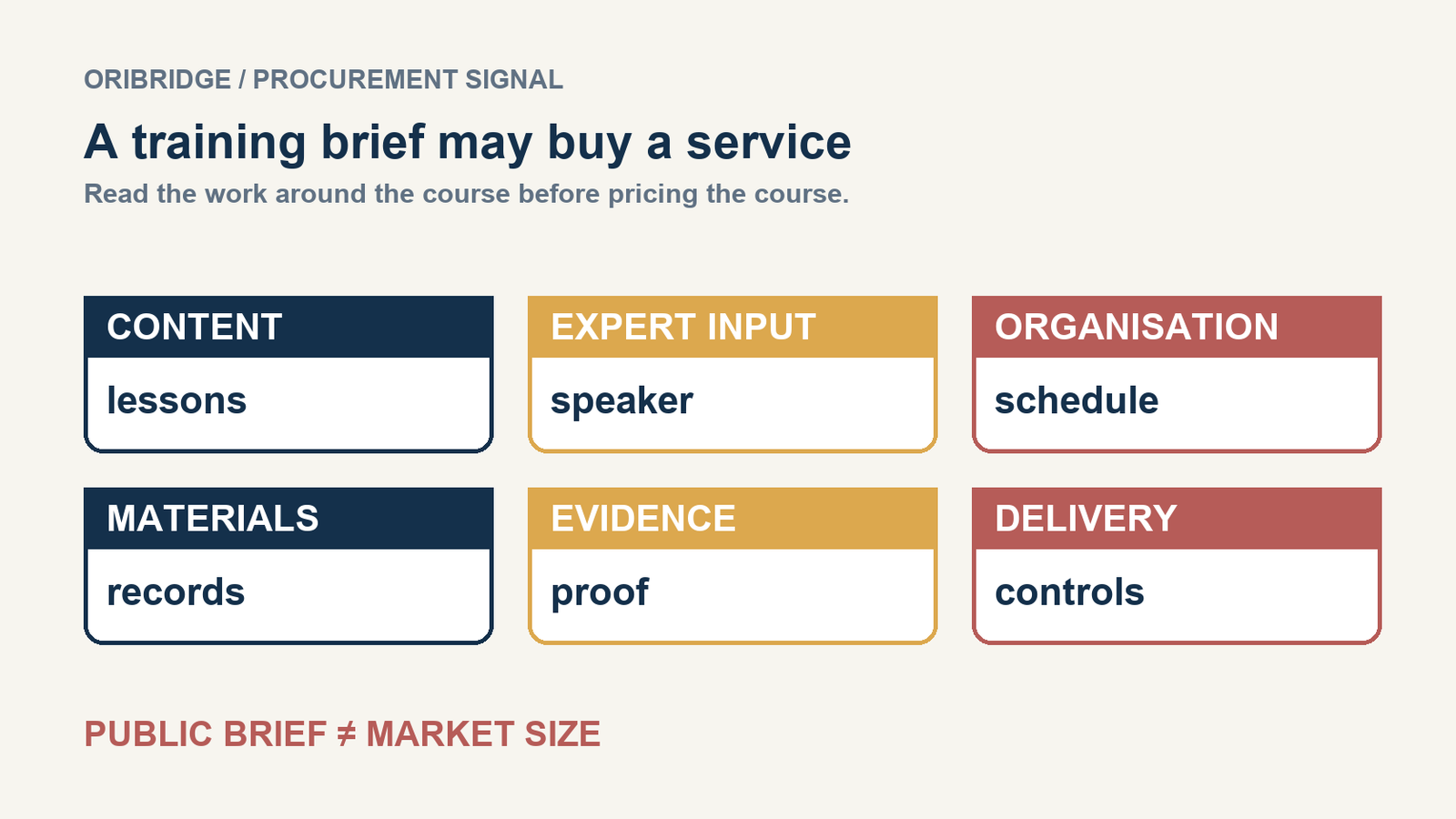
The service-surface map
| Surface | Question for the expert | Typical evidence a brief may request | What a course alone does not supply |
|---|---|---|---|
| Content | What can we teach with permission? | Outline, case, syllabus, teaching plan | Operational ownership |
| Expert input | Who can appear or teach? | Profile, experience, instructor plan | Proof that person is available or qualified |
| Organisation | Who runs the programme? | Schedule, participant and venue plan | A self-paced learning environment |
| Materials | What may be adapted and handed out? | Slides, handbook, attendance or certificate process | Rights to reuse or localise assets |
| Evidence | What shows the service happened? | Records, reports, assessment, acceptance package | A marketing claim about past work |
| Delivery | Who owns support and exceptions? | Safeguards, team plan, commitment | A content catalogue |
The map changes the commercial question. A four-module course may be valuable content input; a three-day managed programme may require a qualified operator to own logistics, records and delivery. That is a route to assess, not a claim that any particular partner arrangement is allowed.
A clear scenario
Suppose a leadership expert has a four-hour module. It may fit a speaker contribution where the buyer owns the programme. It is not automatically a three-day service that includes attendee management, completion records, materials, lodging and a final report. The intellectual asset did not shrink. Its place in the requested service became clearer.
Before treating a notice as a sales lead, make two lists: what the creator is authorised and able to contribute; and what the notice requires from the service operator. The gap is the work that must be separately designed, evidenced and, where relevant, professionally reviewed.
A necessary counterexample
Some notices really do seek a bounded session, named expert or discrete content contribution. In that case, a course owner may not need to become an end-to-end operator. But a topic match still does not establish eligibility, acceptance, payment mechanics, rights or buyer demand. The appropriate next step remains a line-by-line scope and qualification check.
What public procurement can and cannot signal
It can signal that a named public buyer described a training-related service, response materials and evaluation conditions. It cannot establish private-sector buying behaviour, national market size, price benchmarks, award probability, overseas-provider eligibility, tax, licensing, data or intellectual-property outcomes. It is research evidence—not a bid strategy.
If you have found a specific brief, request a bounded validation review with the original notice and the asset you are authorised to provide. The first decision is whether you are looking at a content contribution, expert input or a managed service package.
Related decision guides
- When Topic Popularity Is Not Buyer Demand
- Choosing a China Business Model for an Expert-Led Product
- Workshop vs Full Course
What this article cannot prove
It cannot establish private-sector buying behaviour, national market size, price benchmarks, award probability, overseas-provider eligibility, tax, licensing, data, intellectual-property or payment outcomes. It is public-scope research, not a tender strategy or legal opinion.
Sources and boundary
- Hengqin Economic Development Bureau, 2026 training services procurement notice, published 2026-01-23; checked 2026-09-01. Supports only its stated scope and response requirements.
- Shaanxi Postal Administration, Xi’an training-service procurement notice, published 2026-06-26; checked 2026-09-01. Supports only the stated programme and response materials.
Neither notice is legal, tender, eligibility, tax, licensing, payment or market-demand advice.