
The word finished is seductive. It appears beside a polished report, a list of sources and a confident conclusion. In an AI research workflow, however, it usually means that a task reached its final state. It does not mean that the evidence is sufficient for a China investment, course launch or consulting offer.
The missing control is a decision cover: one page that states what the report can inform, what it cannot decide, and which evidence is still absent. Without that page, teams quietly convert a research artifact into a commercial verdict.
What a finished state actually tells you
Alibaba Cloud’s Deep Writing documentation describes plans, agent activities, intermediate files, data sources and verification or publishing views. Qwen Deep Research describes stages such as search queries, a long-running task and a final report with a finished state. These are useful workflow facts. They help an operator understand whether a task ran and what artifacts it produced.
They do not establish that every important source was found, that every cited source supports the sentence beside it, or that the report answered the decision a buyer or product owner must make. A workflow can finish with a narrow, well-supported answer. It can also finish with a broad answer built from thin evidence.
The decision cover
Put five questions above the report:
- Decision: What exact decision is being considered?
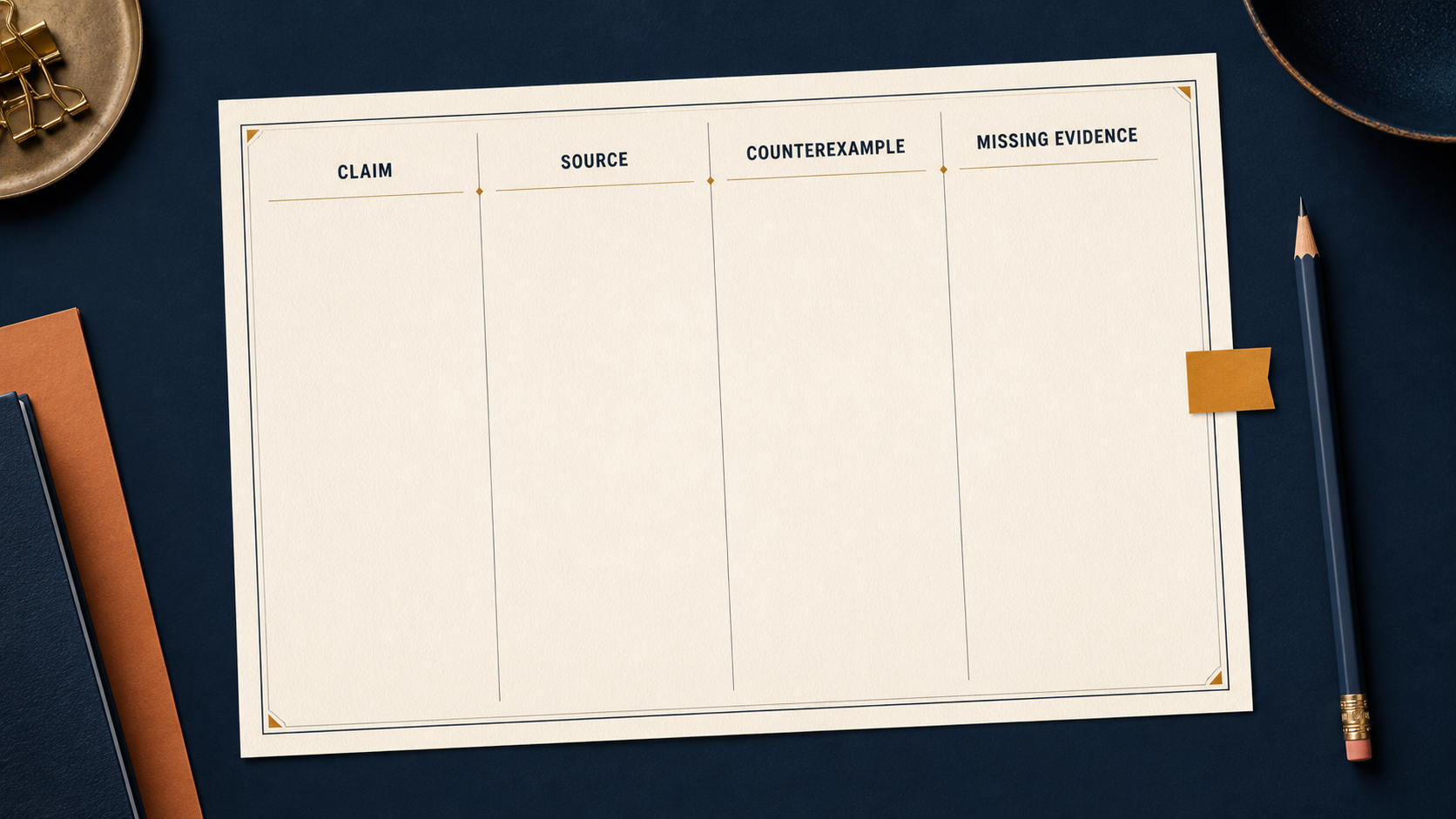
- Claim: Which statements does the report support, and with what source type?
- Counterexample: What evidence would make the recommendation weaker?
- Missing evidence: What buyer, delivery, pricing, access or authorization evidence is absent?
- Prohibited inference: Which conclusions must not be made from this report?
The cover is not a summary. It is a boundary. It prevents a product document from quietly becoming demand evidence, or a policy page from becoming proof that an overseas course can be sold.
Illustrative scenario
Imagine a finished report titled “Chinese teams are adopting agents.” Its inputs are Alibaba product documentation and several platform pages. The report may support a narrow observation: the cited products document agent, workflow or research capabilities. It does not support the decision “translate our agent course and sell it to Chinese teams.” That decision needs buyer evidence, a defined delivery route, a testable offer and a review of rights and operational constraints.
The next action could be to collect interviews or run a bounded validation. The report is valuable because it narrows the question. It is dangerous only when the finished label is treated as a market verdict.
The counterexample
If the report was commissioned only to catalogue public tool capabilities, finished may be enough to close that research task. No investment decision is being made. The boundary changes when someone uses the same report to approve localization, pricing, outreach or publication. The decision cover should name that change rather than silently expanding the report’s authority.
A practical evidence table
| Claim | Source class | What it supports | Still missing |
|---|---|---|---|
| Product exposes a research workflow | official product page | documented feature surface | account access and real use |
| A report task reached finished | workflow status | task state | source completeness and accuracy |
| A topic appears in public material | public source | observable mention | buyer problem and willingness to pay |
| Course should be localized | none of the above alone | no decision yet | authorization, delivery and validation |
This table keeps a polished report from doing four jobs at once. It also makes disagreement productive: a reviewer can challenge a claim, source class or missing field instead of arguing about tone.
What this article does not claim
It does not claim that AI research is unreliable, that Alibaba’s tools are unsuitable, or that a finished report has no value. It claims that workflow completion and decision readiness are different statuses. The official pages support product and workflow descriptions only. They do not prove market demand, model correctness, customer results, legal compliance, account eligibility or commercial viability.
For the product decision boundary, read Product Portability Audit. For a route-level proof, use the End-to-End Access, Payment and Delivery Test Script. For demand evidence, read When Topic Popularity Is Not Buyer Demand.
Before approving the next step
Ask the report owner to write one sentence beginning “This report may inform…” and another beginning “This report cannot decide…”. Then list the next evidence collection action. If those sentences cannot be written, the report may still be a useful draft, but it is not ready to carry a commercial decision.
If you want a scoped review of whether your China research artifact supports a defined next decision, submit a validation request. It is an assessment request, not a promise of demand, access or launch success.
Sources and evidence boundary
- Alibaba Cloud Model Studio Deep Writing — checked 2026-08-24. Supports plans, activities, intermediate files and source/verification views; does not prove report accuracy or market readiness.
- Qwen Deep Research — checked 2026-08-24. Supports task stages and finished status; does not prove source completeness or commercial conclusions.
A decision cover template
Name the decision owner, date, proposed action, supported claims, absent evidence, stop condition and next check. Keep the cover blank where evidence is missing rather than filling it from the report’s tone. A source page may support an observation while the cover records “buyer evidence absent.” A finished status can coexist with an unready decision. Re-read the cover when the decision changes and create a new one instead of rewriting history. This keeps research reusable without allowing an old report to answer a new question by implication.
Read the Chinese source at the right level
The Alibaba Deep Writing page can support a statement such as “the workflow exposes plans, activities, intermediate files and data-source views.” The Qwen Deep Research page can support a statement such as “a long-running task has search stages and a finished state.” Neither page supports “Chinese buyers want this course.” The source ledger should therefore have separate columns for source owner, page type, observable field, date checked and claim supported. Add a final column called “not supported.” That column is where the most important editorial restraint often lives.
For example, a product page may be a useful source for a tool-capability brief. It is not a buyer interview, procurement notice or evidence of account access. A government policy page may establish an institutional direction. It is not proof that an overseas expert can bid or that a paid course will be purchased. The decision cover should name the missing evidence class rather than saying vaguely that “more research is needed.”
A complete scenario
Suppose an internal team asks whether to localize a four-week course on agent workflows. The finished report cites product documentation, a few public articles and a search summary. The cover records: “This report can define a candidate tool map and terminology list. It cannot approve localization, pricing or publication.” The next action is a 30-minute review with a defined buyer segment and a separate access test. If no buyer evidence appears, the team can stop without claiming the course failed. If an actual inquiry appears, it becomes a new evidence record rather than retroactive proof that the report predicted demand.
The same discipline applies to negative findings. A report that did not find a public procurement notice has not proved that no demand exists. It has recorded a search boundary, date and source set. A decision-maker may choose to run a different test, but should not convert absence in the report into a national market conclusion.
Keep the next action narrow
The decision cover should end with one next action, not a list of optimistic possibilities. If the missing evidence is buyer context, conduct a defined interview or review an actual inquiry. If the missing evidence is delivery, test the access and support path. If the missing evidence is authorization, stop at the professional review gate. A finished report is easier to use when it points to the smallest next observation.
Do not repair a weak conclusion by adding more adjectives. Replace “strong opportunity” with the observable fact, source class and unanswered question. This makes the report useful to a product owner, editor and reviewer at the same time. It also prevents a later translation from turning tentative language into a promise.