
“Post less” is popular advice for tired creators because it sounds like a cure.
It can also be meaningless.
You can stop publishing every day and replace the workload with weekly community events, customer support, course updates, cohort calls, partner approvals, or launch campaigns. The calendar gets different. It does not necessarily get lighter.
“Less daily content” is useful only if the work disappears from the business rather than moving into another queue. A self-paced course can reduce live delivery but increase updates and support. A membership can smooth revenue while creating a permanent programming obligation. Licensing can move defined execution to a partner while increasing approval and governance work. The right model is therefore not the one that sounds most passive. It is the one that leaves the expert doing the work only the expert should do. Compare every model across four clocks: creation time, delivery time, maintenance time, and governance time.
Passive income is the wrong comparison
Most expert businesses combine several models: live consulting, workshops or cohorts, self-paced products, memberships, and sometimes licensing or managed partnerships.
The usual comparison asks which one has the highest margin or the biggest theoretical scale.
That skips the operating constraint: where does the expert’s time reappear after the sale?
Creator-economy research from Patreon and Epidemic Sound is useful as context because both reports describe pressure around ongoing publishing, direct fan relationships, platform change, and diversified revenue. Those samples do not tell an individual expert which business model to choose.
They make the workload question worth asking.
The Four Clocks
Every revenue model runs on four clocks.
Clock 1: Creation
How much expert time is required before the offer can exist?
A consulting engagement may need little pre-production. A strong course can require weeks of design. A licensing arrangement may require packaging IP, documentation, permissions, and partner onboarding.
Creation is the clock most people can see.
The others are where “passive” stories usually fall apart.
Clock 2: Delivery
How much expert time is required for each additional buyer?
A self-paced product can reduce live teaching. But delivery also includes onboarding, troubleshooting, feedback, refunds, customer success, community moderation, and enterprise coordination.
A product with low teaching time can still have high delivery time.
Clock 3: Maintenance
What has to stay current?
A writing workshop may age slowly. A course built around AI tools, APIs, platform interfaces, tax rules, or regulated processes may require frequent repair.
Maintenance changes the economics of “reusable.” A long course that needs monthly fixes can be less repeatable than a short workshop that stays valid for two years.
Clock 4: Governance
Who must approve how the work is represented?
This clock becomes visible when someone else operates the product.
A local partner can translate, market, deliver, or support defined work. The expert may still need to approve claims, adapted examples, brand use, curriculum changes, pricing logic, and new commercial uses.
That is not a defect. It is governance.
A partnership reduces founder execution only if the approval system is narrower than the work it replaces.
Compare the models by where the work lives
The following table is not a financial benchmark. It is a workload lens.
| Model | Creation | Per-sale delivery | Maintenance | Governance |
|---|---|---|---|---|
| Consulting | Low–medium | High | Low | Low |
| Live workshop | Medium | Medium–high | Low–medium | Low |
| Self-paced course | High | Low–medium | Medium | Low |
| Membership | Medium | Medium, recurring | Medium–high | Low–medium |
| Licensed / managed distribution | Medium | Low for expert if delegated | Medium | Medium–high |
Two experts can score the same model differently.
A membership is excellent when community itself creates value and the expert wants ongoing interaction. It is a bad fit when “subscription” is being used as a synonym for “the work stops.”
A course is powerful when the outcome can be delivered with limited live diagnosis. It is weak when every learner needs the expert to reinterpret the method for their context.
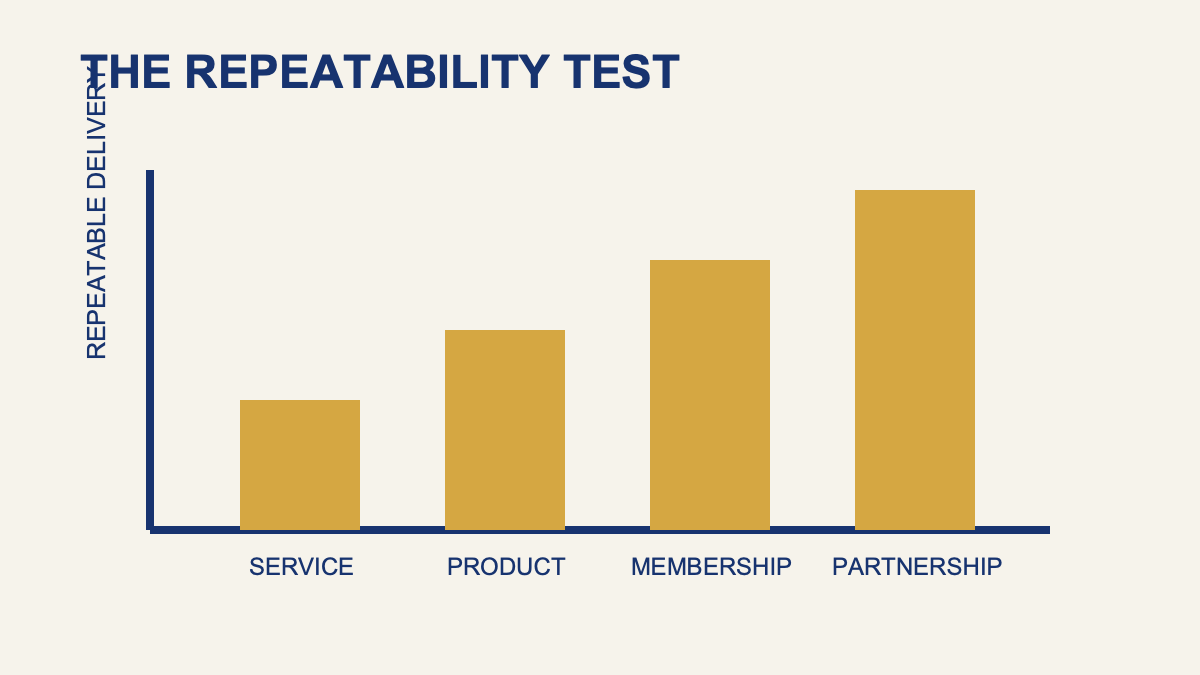
The repeatability test
Before adding a new revenue stream, ask four questions.
Does every transaction require a new appearance?
If the expert must personally show up for every sale, the model scales through price, team, or capacity—not through reuse.
That can still be an excellent business. Call it what it is.
Is the value stored in a usable asset?
Recordings are not enough.
A reusable asset has an outcome, structure, examples, instructions, and enough context for another person to use it. A back catalog can contain the raw material; the five-part inventory helps separate that raw material from an asset that can perform a new job. It still needs product design.
Who carries the operations?
If a course sells while the founder answers every support ticket, the course has not removed founder dependence.
If a license partner handles localization and customer support but the expert rewrites every piece of marketing, the work has only partially moved.
Map the operator, not just the revenue line.
Are the rights defined tightly enough to delegate?
Permission determines whether someone else can actually do the work.
Translation is not publication. Publication is not paid advertising. Paid advertising is not automatically permission to sell, distribute, sublicense, or alter a method.
A vague partnership creates more founder work because every new action becomes a negotiation. OriBridge’s content-rights framework separates review, adaptation, publication, sales, and distribution permissions.
Where a second market can fit
Imagine an expert with a mature workshop who wants to stop personally operating every marketing channel.
One bad option is to rebuild the whole business in another language.
Another is to sign a broad “China rights” agreement and hope the partner handles everything.
A better test is narrower.
Give a local team permission to evaluate or operate a defined asset under defined conditions. Keep the expert responsible for decisions that protect the method and brand. Move the repeatable local execution to the team equipped to perform it.
That may include approved localization, local content production, lead handling, platform operations, or customer support.
It still requires governance. It may also fail. If there is no credible buyer problem, workable delivery path, or operating discipline, stop.
The value is not “extra income with no work.” It is different work allocation.
A one-page workload audit
For every current revenue stream, write down:
- hours to create the offer;
- minutes of expert time per additional buyer;
- monthly maintenance hours;
- support hours;
- approvals only the expert can give;
- tasks another trained operator could own;
- what stops selling if the expert disappears for thirty days.
That last question is revealing.
If every revenue stream stops immediately, the business is still selling the expert’s presence.
If some value continues because the method has been stored in a product, system, or governed partnership, the business has begun to separate expertise from constant appearance.
That is what “less daily content” should mean.
Not passive.
More selective.
Next step: If you are considering a second-market partner because you want to reduce operating burden, first decide which work can actually move and which decisions must stay with you. OriBridge’s content-rights boundary explains how those permissions are separated.
Want to test this model in China? Share one public product link and one decision you need to make. Start a China fit review.
Knowledge hub: Continue with the Business Models, Pricing & Partnerships hub for the wider decision path.
Sources
- Patreon, State of Create — creator/fan research; verified August 10, 2026.
- Epidemic Sound, The Future of the Creator Economy Report 2025 — professional-creator research; verified August 10, 2026.
- OriBridge, Content Rights & Authorization — first-party operating boundary; verified August 10, 2026.