
The answer appears in a neat panel: “Chinese teams need agent training.” It has citations, a few retrieved passages and a confident summary. An overseas expert copies the sentence into a market-entry deck.
That leap is exactly where the research becomes less trustworthy.
Retrieval-augmented generation, or RAG, can make a collection of documents easier to search and compare. It can return source fragments, document references and page information. Those are useful research inputs. They are not, by themselves, evidence that a buyer exists, that a problem is costly, or that an expert product should be sold.
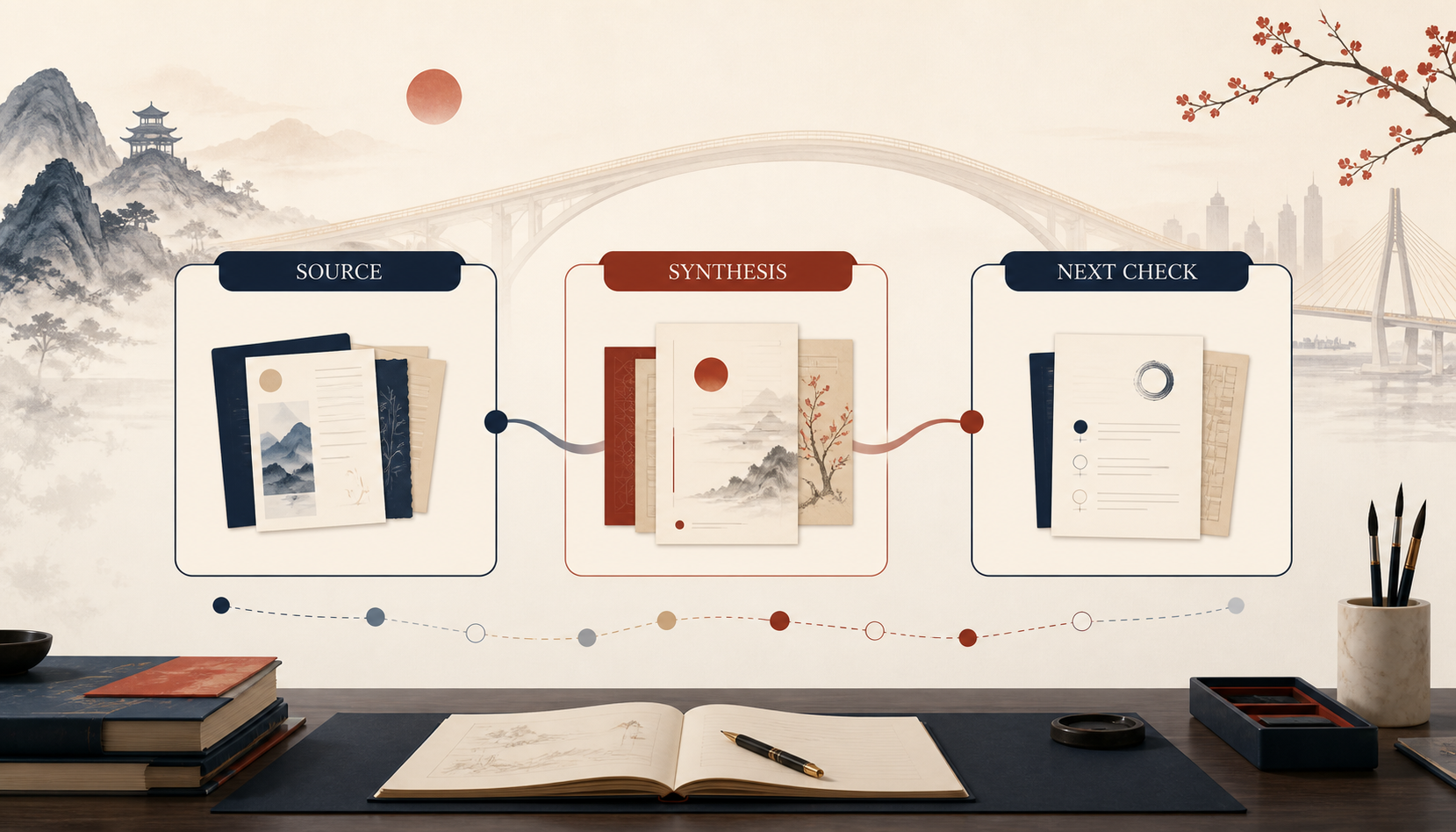
The practical rule is to keep three things in separate columns: what the system retrieved, how the model summarized it, and what still needs to be verified with a buyer or a defined market observation.
Start with the sentence you are tempted to publish
Imagine a small internal knowledge base containing Chinese product pages, course descriptions and a few public procurement documents. A team asks, “What does China need from overseas AI educators?” The RAG system retrieves two product documents that describe workflow nodes and one page describing tool calling. It produces an answer about demand for agent training.
The retrieval may be working perfectly. The conclusion is still unsupported.
The source passages describe products and capabilities. They do not describe a buyer’s budget, authority, urgency or willingness to use a foreign expert. A model can make several accurate sentences sound like one market fact. The problem is not solved by adding a citation after the paragraph. The research record must preserve the distance between source type and business claim.
What a documented RAG workflow can return
Alibaba Cloud Model Studio documentation describes workflows assembled from components such as models, APIs, knowledge bases and MCP nodes. Its RAG-related output can expose source chunks, documents and page-related fields. This supports a narrow operational observation: a retrieval workflow can produce inspectable pieces of a source record rather than only a free-form answer.
Volcengine Ark documentation separately describes private knowledge-base search and tool-calling surfaces. That supports another narrow observation: search and tool invocation are different parts of a documented AI workflow. They should not be treated as one undifferentiated “research capability.”
Neither source proves that an overseas expert can access a particular service, that the same configuration is available to a particular account, or that the model’s answer is correct for a market question. Neither source proves demand, course fit or a China-facing route.
The three-column record
Use a record that makes the model’s contribution visible without granting it authority it does not have.
Column one: retrieved evidence
Copy the minimum source fragment needed to understand the observation. Retain the document title, URL, page or section if available, language, retrieval date and source type. “Product documentation” and “buyer interview” must not share the same label.
Write what the fragment actually says. If it describes a workflow node, record that. If it describes a search function, record that. Do not translate a capability into a user problem in the evidence column.
The source fragment can be wrong, stale or incomplete. That is why the date and location matter. A citation is a way back to the observation, not an automatic quality certificate.
Column two: model synthesis
Summarize the relationship the model noticed, but label it as synthesis. For example: “The retrieved documents place knowledge search and tool calling in separate workflow components.” That is a useful reading of the sources.
Avoid sentences such as “Chinese companies want modular agent training” unless the retrieved material actually contains a buyer statement or another appropriate demand source. The model may propose that as a hypothesis, but it should not silently upgrade it to a finding.
Column three: next validation question
Turn the gap into a question that can change a decision. “Which named buyer currently has this workflow problem?” is better than “research demand.” “Would an operations lead pay for a workshop that teaches evaluation of this workflow, and under what delivery conditions?” is a hypothesis, not a conclusion.
The question should identify the missing evidence. Is the uncertainty about buyer, problem, alternative, access, delivery or authority? A good RAG record does not end at the answer panel. It tells the next researcher where the answer is still thin.
A source is not stronger because it has a page number
RAG systems often make evidence look formal. A page number, chunk ID or source link can give an answer an appearance of auditability. That appearance is valuable only if the cited passage supports the sentence attached to it.
Suppose a source chunk says that a workflow can use a knowledge base, an API and an MCP node. The page number supports those documented components. It does not support “this course is reproducible in China,” “the tool is available to foreign learners,” or “buyers are asking for this.” Those are different propositions with different evidence requirements.
This boundary matters particularly for content planning. A tool page can suggest a lesson about dependency mapping. It cannot, on its own, justify a new article claiming a market trend. The article When Topic Popularity Is Not Buyer Demand addresses the broader attention-versus-demand distinction. The present workflow adds a narrower warning: a cited model answer can still be the wrong kind of evidence.
Make the answer reproducible for an editor
An editor receiving a RAG output should be able to ask four questions without rerunning the whole system:
- Which source passages produced this sentence?
- What did the model add, combine or infer?
- Which terms were translated or normalized?
- What evidence would change the proposed conclusion?
If the answer cannot be traced, reduce its status to an unverified lead. Do not decorate it with a confidence score and call the problem solved. Confidence can describe model behaviour; it cannot replace a buyer record.
The same discipline is useful when preparing a course. Course Dependency and Terminology Inventory records the source terms and dependencies behind learner actions. A market-research RAG record should do something analogous for claims: preserve the source, the transformation and the authority to change the interpretation. Product Portability Audit then asks a different question: can the product and its required route travel honestly?
A useful negative result
Sometimes the RAG answer reveals that the knowledge base is not a market-research corpus. It may contain only vendor documentation, platform help pages and internal course notes. That is not a failed model. It is a source-coverage finding.
The next decision might be to add buyer-language research, an authorized interview record or a defined observation plan. Until then, keep the result in a research queue. Do not fill the gap with more vendor pages merely because they are easy to retrieve.
There is also a legitimate counterexample. If the knowledge base is used only for an internal FAQ—“Which workflow component stores the retrieved source fragment?”—the team does not need to create a market-brief record. The answer can remain an operational explanation, provided nobody reuses it as demand evidence later.
The claim worth carrying forward
RAG is most useful here as a traceable input layer. It helps an editor see what documents were retrieved and what relationship the system noticed. It does not decide whether a Chinese buyer has a problem, whether an expert should enter the market, or whether a course will sell.
Keep the three columns visible. A retrieved fact can become a synthesis; a synthesis can become a hypothesis; only a separately designed observation can begin to test the market question.
OriBridge can help turn a tool-generated research answer into an evidence-bound China market brief with explicit open questions. Request a China validation discussion when the model’s confidence is higher than the evidence behind it.
Sources and evidence boundary
The Alibaba Cloud Model Studio workflow documentation, checked 2026-08-23, supports only its documented workflow, RAG output and component descriptions. The Volcengine Ark tool-calling documentation, checked 2026-08-23, supports only its documented knowledge-search and tool surfaces. These sources do not prove account access, model accuracy, data compliance, buyer demand, course outcomes or market conclusions.