
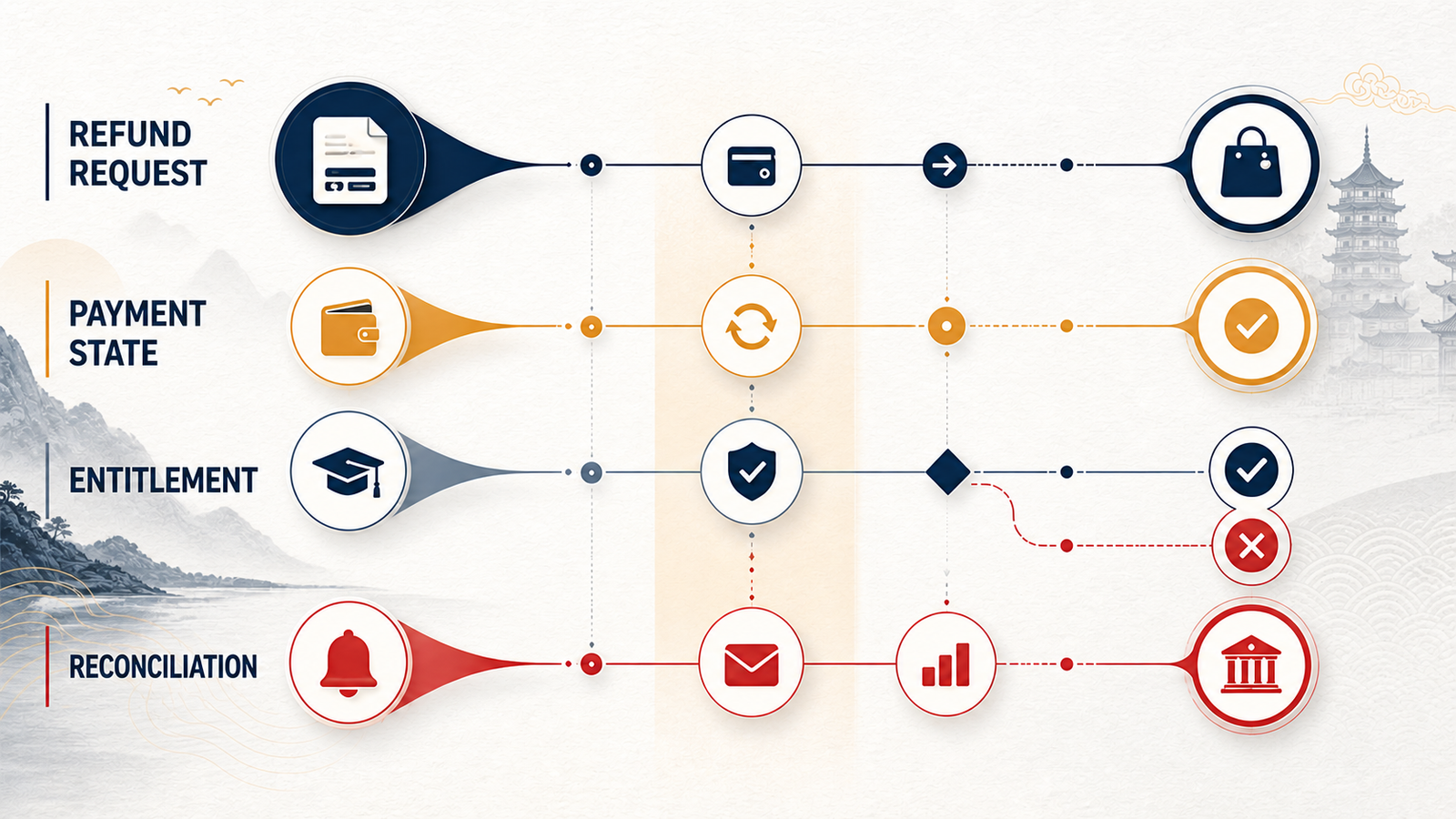
An on-page payment or order entry may display a payment route or attempted screen; it is not evidence that a refund exception has been closed. Before you expand a China-facing course pilot, make the refund state, learner entitlement, buyer notification, and reconciliation visible as separate decisions.
The uncomfortable moment comes after the click
Imagine this as an illustrative scenario, not a customer case.
A small course pilot has begun. A buyer starts an order through the page. Later, a refund request appears. The payment record and the learning platform do not show the same thing. The course still appears in the learner’s account, while the buyer is waiting for a clear message. The operator has enough information to know that something happened, but not enough structure to say who should close it.
That is the moment many teams discover that “payment succeeded” was never the same as “the transaction is operationally finished.”
The mistake is understandable. A payment page gives the team a highly visible event. A refund is less tidy: it may involve a request, a provider-side state, an entitlement decision, a notification, and a later reconciliation record. Those events may be related without being simultaneous.
The useful question is therefore not, “Does the button work?” It is:
If a refund request appears, can we prove what happened next—and can one named person decide whether the pilot should continue?
What the payment button actually tells you
An on-page payment or order entry may show that a payment action was recorded. It may show an order number or a successful-looking screen. That is evidence about one point in the journey, not proof that a refund exception has been closed.
It does not, by itself, close these questions:
- Is the refund request recorded and associated with the right order?
- Is the current payment/refund state confirmed rather than inferred from a page?
- Has the promised course entitlement been cancelled, paused, or intentionally retained?
- Has the buyer received a message that matches the actual state?
- Does the business record reconcile the provider event with the support and entitlement records?
The WeChat Pay refund development guide is used here only as a process-boundary source: the page describes refund handling and status-query/notification steps for the route it documents. That is a reason to record the observed state and its evidence separately. It is not evidence that an overseas entity is eligible to use the route, or that any particular course can accept it.1
Use a small exception state machine
You do not need a giant payments dashboard to begin. You need a record that makes an unresolved exception hard to hide.
For each refund request, record the following four tracks:
| Track | What to record | Owner’s question | A safe stopping condition |
|---|---|---|---|
| Refund request | Request ID, order reference, timestamp, reason as actually received | Is this request attached to the correct order? | Stop if the request cannot be matched or is duplicated. |
| Payment/refund state | Provider record, current state, last query or notification, timestamp | Has the state been confirmed, or are we relying on a screen or assumption? | Stop if the state is unknown or contradictory. |
| Entitlement action | Course access, live-room invitation, replay/download/support entitlement, action and timestamp | Which entitlement action, if any, is permitted by the written offer/refund policy and approved operating scope—and who is authorised to record or carry it out? | Stop expansion if access and refund state disagree without an owner-approved workaround. |
| Notification/reconciliation | Buyer message, support record, accounting/business record, final reviewer | Has the buyer been told the same truth that the internal records show? | Stop if notification, support, and business records cannot be reconciled. |
This table is an operating design, not a legal rule. Your authorized payment route and approved refund policy still govern what action is permitted. The point is to prevent a team from treating a missing record as a completed state.
The sequence matters more than the label
An exception can be expressed as a simple chain:
refund_requested → payment/refund_state confirmed → entitlement_action decided → notification sent → reconciliation closed
The arrows are not a promise that every provider uses the same state names. They are a way to expose the handoffs.
For each arrow, ask three plain questions:
- What evidence moves the case forward?
- Who is allowed to make the decision?
- What happens if the evidence never arrives?
If the answer to the third question is “we will probably check later,” the pilot is carrying an unresolved operating risk. A bounded pilot can use a manual control, but the manual control must have a named owner, a response threshold, and a record of the workaround.
What happens to course access?
Refund handling is not only a money event. It can change what the learner can access, but that change should not be guessed from the order screen.
Bind the entitlement action to the approved offer inventory. If the offer includes a live session, replay window, download, support channel, or certificate workflow, record which action, if any, is permitted by the written offer/refund policy and approved operating scope, and who must review it before it is carried out.
Do not treat a refund request or a payment screen as an automatic instruction to delete access or erase an order record. Record the proposed entitlement action, its written-policy basis, the responsible reviewer, and the resulting evidence.
A practical stop/go rule for a small pilot
Use one internal pilot-governance label at the end of the record. These labels are not a finding that a refund is due, complete, lawful, or accepted by a payment provider. They do not override the actual terms, applicable requirements, or provider process.
- Proceed with the bounded pilot when the required states are confirmed, the entitlement action is permitted under the written policy and approved scope, the buyer communication is sent, and the records reconcile.
- Repair and retest when the failure is known, the owner is named, and the workaround can be tested under the same defined conditions.
- Pause expansion when a required state is unknown, access and refund status conflict, or no one is accountable for the buyer-facing resolution.
This is deliberately stricter than asking whether a single order went through. A single successful payment can coexist with a broken refund operation.
The tempting shortcut—and why it fails
Shortcut: “The payment screen shows success, so we can remove the order and move on.”
Why it fails: it collapses a request, a provider state, an entitlement decision, and a buyer communication into one irreversible assumption. If the learner still has a live invitation or replay access, the record is incomplete. If the buyer has no confirmation, the support burden has merely been moved to tomorrow.
The opposite shortcut is no better: “A refund was requested, so delete every entitlement immediately.” That may create a second error if the request is duplicated, the state is unconfirmed, or the authorized policy requires a different sequence.
What this article does not prove
This article does not prove that any payment wallet is open to an overseas entity. It does not provide payment integration instructions, tax or foreign-exchange advice, consumer-law advice, licensing advice, pricing, fees, refund deadlines, or a guarantee of commercial success.
It also does not claim that a China-facing pilot has passed. A process matrix tells you what to record; only an authorized, fixed-condition route test can tell you what actually happened in your account and offer.
For the complete buyer journey—sales page, identity, payment, access, delivery, support, and recovery—use the end-to-end access, payment, and delivery test script. If the problem is still at checkout rather than refund handling, see why a course payment path can lose a buyer. For a separate platform-path test, use how to test a course platform in China without guessing.
Next step: For a permitted pilot transaction handled under the actual written offer, payment route, privacy controls, and approved operating scope, complete the four-track exception record before expanding the audience. If you need an independent review of that bounded route, request a validation review.
Sources and limits
-
WeChat Pay, Order refund development guide, page updated 2026-06-09 and verified 2026-08-16. The page supports only the documented refund-handling process cited here; it does not establish eligibility, entitlement treatment, accounting results, availability, legality, performance, suitability, or buyer acceptance for a particular offer. ↩