
“We help organizations improve leadership, communication, and cross-cultural collaboration.”
That may be accurate. It may also leave a prospective buyer with nowhere to put their hands.
The problem is not that broad expertise lacks value. The problem is that a new buyer cannot tell what would happen first, what they would receive, or how either side would know whether the first engagement did useful work.
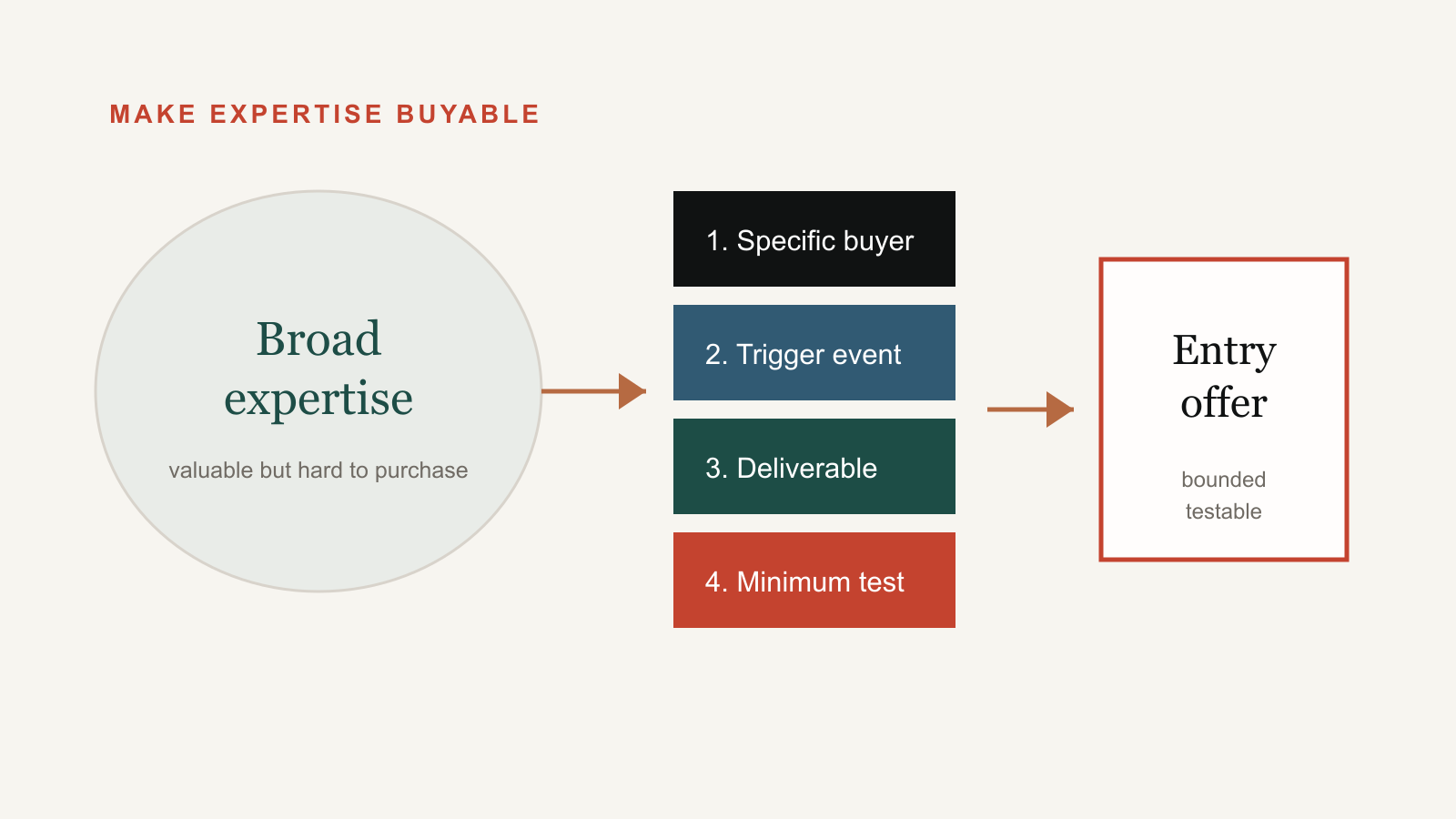
For a China entry conversation, the answer is not automatically a lower price, a translated brochure, or a bigger catalogue. It is often a verifiable entry object: a bounded piece of work with a clear input, a named output, and a completion condition that does not pretend to guarantee a business result.
This is an illustrative framework, not a description of a client project or evidence that a particular service can be sold in China.
A category is not an entry object
“Executive coaching” is a category. “A two-week decision-handoff review that returns a map of escalation points and three options for the next meeting” is an entry object.
The latter may still be the wrong offer. But it is at least possible to inspect. A buyer can ask what inputs are needed, who should attend, what they will receive, and what is outside scope. The expert can decide whether the request matches their actual competence.
That clarity matters before any market claim is made. A broad service list makes it easy for both sides to project their own hopes onto the work. A bounded object forces the first conversation into particulars.
The five properties of a verifiable entry object
1. It begins with a named input
An input is not “whatever the client needs.” It might be three anonymized meeting notes, a workflow description, a selected training brief, or a short pre-session questionnaire. If the work cannot start without proprietary material or rights that have not been cleared, that is a boundary to state—not a problem to conceal.
2. It produces a named output
The output should be something a buyer can recognize without accepting a promise of transformation: a decision map, a risk register, a facilitation plan, a terminology inventory, or a structured debrief.
This differs from claiming that the output will improve revenue, retention, or team morale. An entry object can be useful without pretending it controls the client’s eventual outcome.
Public procurement notices provide a limited illustration. A published training procurement notice can specify activities, deliverables, and service periods.1 It does not tell us what private companies buy, what any supplier is qualified to provide, or how an overseas expert should contract. It does show why a deliverable is more legible than a broad label.
3. It has a completion condition
Completion is not “the organization has changed.” It can be: the agreed workshop occurred, the agreed memo was delivered, or the requested decision record was reviewed. A completion condition keeps an initial engagement from silently becoming open-ended coaching or unlimited support.
For the distinction between a course format, workshop, and advisory engagement, see Self-Paced Course, Cohort, Workshop, and Advisory.
4. It declares what it does not include
This is where credibility is made. A workflow review is not a software implementation. A team briefing is not an ongoing managed service. A diagnosis is not a legal opinion, procurement guarantee, localization authorization, or sales commitment.
The exclusions protect both the buyer and the expert from mistaking a first object for an entire commercial relationship.
5. It produces a next decision, not a forced upsell
The best first object may end with “stop,” “collect more evidence,” “run a different test,” or “consider a larger scope.” If the only possible conclusion is “buy the full programme,” the object is a disguised sales funnel rather than a diagnostic entry.
An illustrative before-and-after
Take an expert whose public site lists leadership coaching, cross-cultural facilitation, strategy workshops, and executive advisory.
The broad version says: “We help global teams collaborate better.”
The entry-object version says: “For a team preparing a cross-border operating change, we can run a structured handoff review. Input: the current decision path and selected meeting material. Output: a map of three recurring handoff risks and a briefing for the next working session. It does not implement a new operating model or provide employment, legal, or compliance advice.”
The second version is not magically easier to sell. It is easier to evaluate. That is the point.
Why this matters in a China context
An overseas expert often arrives with a reputation, a method, and a long service page. A new market may not have the shared references that make those signals legible. A verifiable object reduces the need for the buyer to understand the expert’s entire career before asking a serious question.
It also makes research cleaner. Instead of asking, “Do Chinese buyers want leadership consulting?” you can ask a smaller and observable question: “When teams describe this specific handoff problem, do they understand this proposed output well enough to assess it?”
That is still not proof of demand. It is a better first hypothesis.
The China Training Brief article explains why some briefs purchase an operating service rather than a course. This article is narrower: it helps an expert turn a wide capability into the first inspectable object before assuming any particular purchasing route.
If the entry object depends on named tools, assets, or terminology, Product Portability Audit provides a separate way to identify what still needs confirmation.
Three public-source constraints worth remembering
First, an official WeChat service guide describes a documented service environment with implementation conditions.2 It does not say that your entry object can be sold, enrolled, or delivered there. Do not use platform documentation as an implied approval.
Second, the Cyberspace Administration of China’s provisions on generative AI services are a regulatory source with a defined scope.3 They do not turn every training use case into a legal problem, nor do they offer a compliance checklist for an expert’s course. If an entry object depends on an AI output, say what the output is and obtain appropriate professional advice where needed.
Third, a public procurement example is only an example of its own notice. It is not a price card, a market-size statistic, or a shortcut around qualifications.1
Using sources narrowly is part of making the object verifiable. The supporting evidence should be no broader than the claim it supports.
A counterexample: when a broad offer is better
Some engagements genuinely begin with uncertainty so high that a fixed output would be artificial. A complex executive advisory relationship may need a discovery conversation before anyone can responsibly define a work object. In that case, pretending to offer a neat package can create false certainty.
The correct move may be to say: “We do not yet know enough to define the work. Here is the information needed before we can decide whether a bounded engagement is appropriate.”
This framework is not a mandate to package every form of expertise. It is a test for whether a first offer is concrete enough to assess without exaggeration.
What this cannot prove
A verifiable entry object does not prove demand, buyer authority, pricing, procurement fit, platform eligibility, regulatory compliance, delivery rights, or commercial success. It also does not replace a contract or professional legal advice.
It does one smaller job: it allows a new buyer and an expert to discuss a first piece of work without pretending they have already agreed on the entire relationship.
A one-page test
Before presenting a China entry offer, see whether you can write these five lines without using a broad category word:
- The input we need is ___.
- The output we will provide is ___.
- We will consider this first piece complete when ___.
- It does not include ___.
- After it, the honest next decision is ___, including “stop.”
If line two or four remains vague, the expertise may be real but the entry object is not ready.
If your expertise is credible but a new buyer cannot yet see the first concrete piece of work, request a China validation discussion.
Sources and limits
-
Hengqin New Area Government, public training procurement notice, accessed 2026-08-24. Supports only that a public notice can specify service activities/deliverables; it does not establish private-market demand, supplier eligibility, pricing, or contracting advice. ↩↩
-
WeChat Developers, Service guide, accessed 2026-08-24. Supports only that the documented environment has implementation conditions; it does not establish access or product suitability. ↩
-
Cyberspace Administration of China, Interim Measures for the Management of Generative Artificial Intelligence Services, accessed 2026-08-24. Supports only the existence and scoped text of the published provisions; it is not legal advice or a determination of applicability. ↩