
When a new Chinese AI tool appears, an overseas expert has an understandable reaction: add it to a list, write a short explanation, and publish before the next release makes the page old. That workflow produces activity, but it rarely produces a useful decision.
A tool radar has a different job. It should tell a reader what changed, which work unit might be affected, what the official material actually shows, what remains unknown, and what event should trigger another review. It is a dated research instrument, not a wall of launch announcements.
The first question is not “What is new?”
The first question is: what decision could this documented change alter for an expert product?
Perhaps a course exercise depends on a particular tool-calling pattern. Perhaps a creator brief assumes that a video workflow can return translated subtitles and a terminology list. Perhaps an internal research process needs to know whether a retrieval answer exposes source fragments that an editor can inspect. In each case, the tool is relevant because it touches a work unit, not because its name is currently visible.
Alibaba Cloud’s Bailian workflow documentation describes workflows assembled from objects such as models, APIs, knowledge bases and MCP nodes. It also describes retrieval outputs that can include source fragments, documents and page information. Those are useful fields for a research record. They do not prove that a particular overseas expert can access the service, that a workflow will perform well, or that a Chinese buyer needs a course about it.
Volcengine’s model-evaluation documentation similarly separates the evaluation object, dataset, method, inference mode and cost. That separation is a warning against writing “Model X is better” when the source only documents how an evaluation task can be configured. The page describes an evaluation setup; it does not establish a winner, a curriculum outcome or an enterprise purchase.
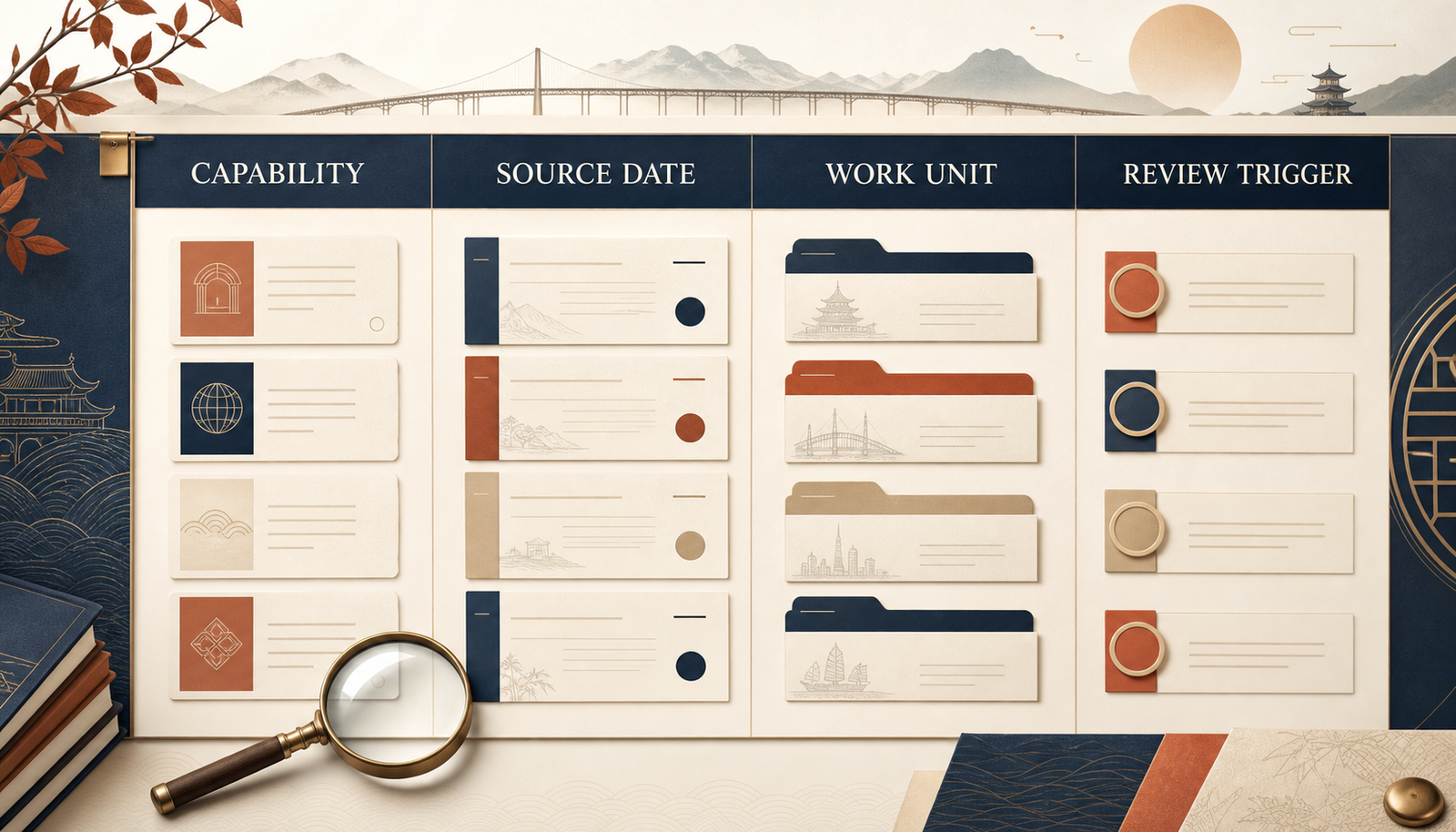
Four columns are enough for a first radar
1. Tool or capability
Record the smallest useful unit. “Supports an MCP node in a documented workflow” is more durable than “new AI platform”. “Returns retrieval source fields” is more precise than “better RAG”. Keep the product name, documentation page and observed date together.
Do not silently convert a product label into an ability that the page did not describe. If the document says a function requires a particular configuration, retain that condition. A radar that removes prerequisites is not a summary; it is an advertisement.
2. Official source and date
Every row needs a first-party URL, the date checked, and a short note about the page type. A product manual, a pricing page, an evaluation guide and a marketing announcement are different source objects. The date is not decoration. It tells the next editor whether they are reading a current capability, a historical configuration or an unreviewed claim.
When a page changes, update the row rather than creating a new SEO article by default. Preserve the previous observation when it explains why a course dependency or research decision changed.
3. Work unit affected
Write the action that could change: retrieve and cite a source fragment, configure a tool input, build an evaluation dataset, inspect an output, translate a subtitle file, or document a fallback. This turns a tool update into a question an expert can understand.
The work unit should be concrete enough that a colleague can ask whether it matters. “Could this change how a learner checks evidence?” is a better question than “Could this disrupt the market?” A work unit can be added to a product dependency inventory, but it should not be promoted to a buyer problem without separate evidence.
4. Limits and review trigger
Write what the source cannot prove: no account access, no result quality, no buyer demand, no ranking, no course eligibility, no price conclusion. Then state what would justify a new review. A documentation change may trigger a terminology check. A changed input/output condition may trigger a controlled reproducibility test. A new evaluation method may trigger a review of a lesson example.
This is the part a launch list omits. Without a trigger, the team either forgets the tool or rewrites the same announcement each time someone notices it.
A radar entry in practice
Imagine an official page documents that a workflow can connect a knowledge base and an MCP node. A launch-list entry might say:
“This new AI workflow makes advanced agents available to everyone. Overseas creators should build a course around it.”
A radar entry should be narrower:
“Checked 2026-08-23. The documentation describes separate workflow nodes for a knowledge base and MCP, with specified configuration and input/output conditions. Possible affected work unit: an exercise that asks a learner to trace retrieval evidence before invoking a tool. Not established: access for an overseas account, reliability, learner demand, or commercial viability. Review trigger: the node contract or required configuration changes, or an authorized test produces a reproducibility record.”
The second entry is less exciting. It is much more useful to an editor who must decide whether a lesson, Product Card or research brief needs attention.
Why evaluation fields belong on the radar
Tool radars often mix capability and performance. A page about model evaluation makes that mix tempting: if a platform lets someone choose a dataset, method and inference mode, the radar writer may want to report an overall score. But a score is meaningful only with the object, data, method and conditions that produced it.
Keep those objects separate. A radar may record that an evaluation workflow distinguishes batch and online inference, or that cost is a configuration field. It should not turn that observation into a model ranking. If an expert later needs to teach evaluation, the evaluation record becomes a source for lesson design. It still does not become proof that the model or course will achieve a business outcome.
What not to put on the radar
Do not add a row solely because a tool is mentioned in social posts. Do not add “best”, “leading”, “most popular” or “China’s answer to” unless the claim has an appropriate source and a defined comparison. Do not use a tool page as a substitute for audience research. Do not make a list of every product name in order to imply coverage.
The radar also should not contain credentials or access assumptions. A documented setup is not permission to operate it. A visible sign-in page is not proof that an overseas expert can register, pay, deploy or support users. Those are separate operational questions with their own evidence gates.
When a separate tool dossier is justified
Most radar rows should remain rows. A separate article or tool dossier is justified only when the subject has a distinct reader decision, stable enough first-party evidence, and a concrete work unit that cannot be explained by an existing canonical. The dossier should retain the same source date and limits as the radar.
For example, a documented retrieval-output format may deserve a focused piece if an expert is deciding how to preserve evidence in a China-facing research workflow. It does not deserve a new URL merely because a release note has a new product name. A maintained radar prevents every update from becoming a near-duplicate page.
A counterexample: archive only
If the tool has no relation to the expert’s product, audience, delivery or research work, archive the source and stop. A radar is not a mandate to investigate every Chinese AI release. The absence of a row can be a correct decision when no current work unit is affected.
Likewise, if the team has an authorized, reproducible test and a clearly defined reader decision, the row can be promoted into a deeper evidence record. The promotion should be visible. It should not be smuggled into the radar as if a documentation page were a test result.
The maintenance rule
Before a radar is published or handed to an expert, ask five questions:
- What exact capability or configuration did the official page describe?
- When was it checked, and what kind of source is it?
- Which work unit could change?
- What does the row explicitly not prove?
- What event will cause the row to be reviewed again?
If the answer to the last two is missing, the team has a launch list, not a decision radar.
The sentence worth carrying forward is: a China AI tool radar earns its place by recording decisions and change triggers, not by being first to name a launch.
If you need to decide whether a fast-moving China AI capability belongs in a product or localization workstream, request a China validation review. Bring the dated source and the affected work unit, not a ranking of tools.
Related reading
- Product Portability Audit
- Course Dependency and Terminology Inventory
- When Topic Popularity Is Not Buyer Demand
- An MCP Lesson Needs a Reproducibility Record in China
Sources and evidence boundary
- Alibaba Cloud Bailian: Workflow applications, checked 2026-08-23. Describes workflow nodes, configuration and retrieval source fields; does not establish access, quality, demand or course outcomes.
- Volcengine: Create model evaluation tasks, checked 2026-08-23. Describes evaluation objects, datasets, methods, inference modes and cost fields; does not establish model superiority, procurement or pricing.
Image brief: Editorial radar board with four columns: tool or capability, official source date, work unit affected, and next review trigger. Avoid rankings, logos, winner badges, user counts and trend arrows. Alt text: “A dated China AI tool radar separates tool capability, work unit, evidence limits and review triggers.”