
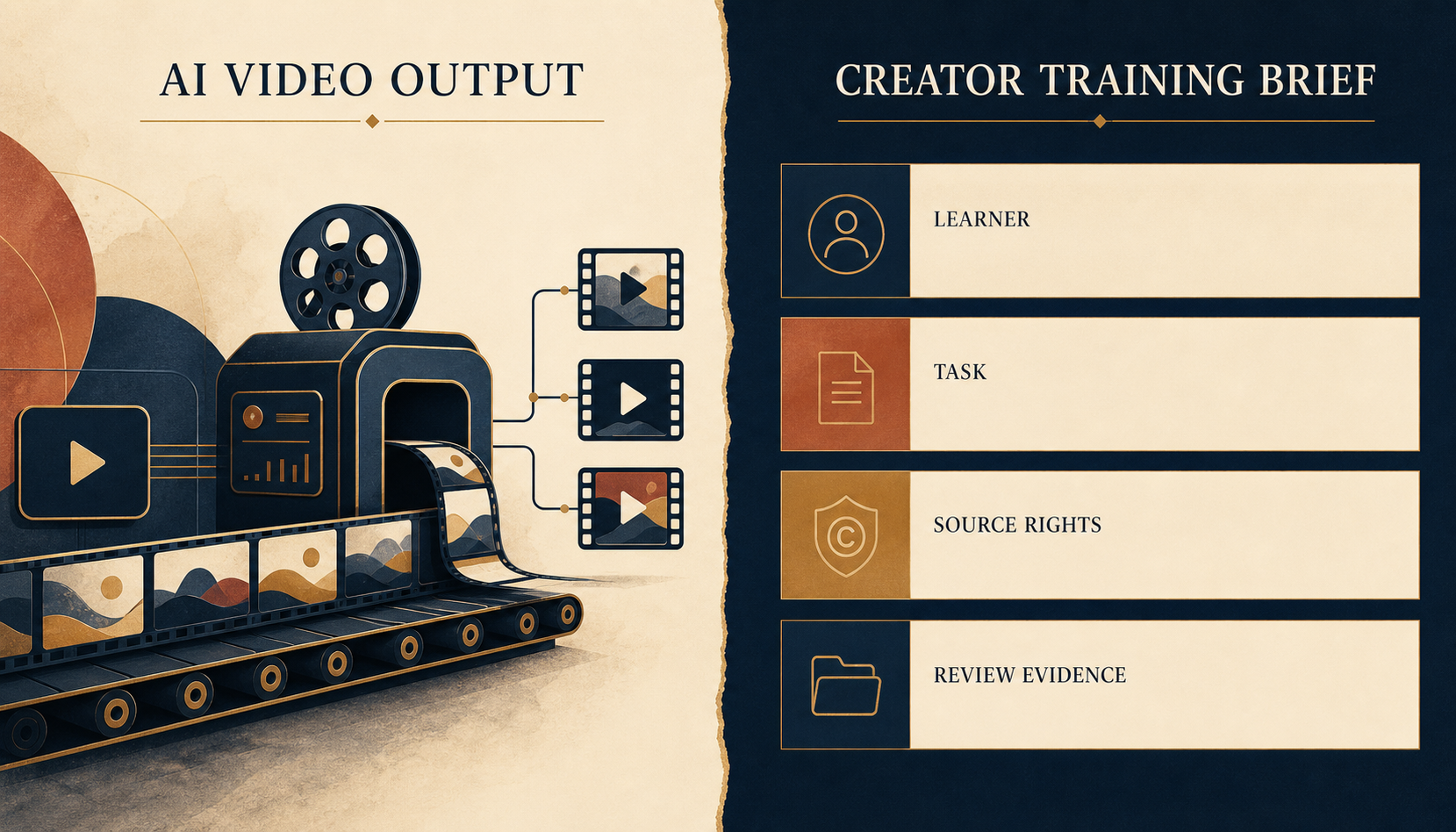
An overseas creator educator reads a striking industry headline: AI-generated audio and video production has expanded sharply in China, and human–machine collaboration is reshaping audiovisual work. The obvious next step seems to be a course called “How Chinese Creators Use AI Video.”
That leap skips the hard part. A production statistic describes output capacity or sector activity. A training brief must identify a creator, a work problem, a learning task, the permitted source material and the evidence that will be reviewed. The first signal can justify a question. It cannot answer the question for you.
What the audiovisual report can show
The China Online Audiovisual Development Research Report 2026, released with CNNIC research and data support, describes the growth of AI-generated audio and video and the move toward human–machine collaboration in audiovisual production. This is useful context for an expert deciding what to investigate: production workflows may be changing, and old assumptions about who performs which editing task may need review.
It does not identify a creator audience for a particular course. It does not say whether creators need prompting, editing, rights management, story development, review or business training. It does not establish that a platform will distribute an AI-made video, that a creator can use a particular tool, or that a course will sell.
The source is a sector observation, not a creator brief.
Capacity and learning are different objects
Production capacity answers: how much content can be generated, processed or supported under a defined system?
Learning design answers: who must perform which action, under what conditions, and what evidence shows that they can do it responsibly?
The two can be related without being interchangeable. More automated production may create new questions about selection, editing and review. It may also reduce the value of a lesson that only demonstrates a button. But the report does not tell an educator which question matters to a specific creator.
Turn the signal into a work question
Start with one creator situation. A creator may be deciding whether to use an AI-generated visual in an explainer, how to review a synthetic voice before release, how to keep a human editorial decision visible, or how to build a repeatable short-video workflow. Each situation has different knowledge, tools and risks.
Then write the work task. “Produce an AI video” is too broad. “Compare two generated openings against a stated audience promise and document which claims require human review” is a work task. “Use an AI tool” is not. “Record the source, transformation and final approval for a short clip” is.
Finally define the evidence. A learner might submit a shot list, an annotated comparison, a provenance record or a review checklist. The output should show the intended action, not merely that a file was generated.
A concrete scene: ten clips and no lesson
Imagine a creator team uses an automated system to produce ten short clips from a long interview. The files exist. The team can report that the workflow is fast. A course designer turns the result into a case study titled “AI Video Production in China”.
What is the learner supposed to learn? How to choose a clip? How to preserve the speaker’s qualification? How to check a translated caption? How to decide whether a visual changes the meaning? How to document permission? The production count answers none of these questions.
A bounded training brief might instead ask learners to select two clips, identify the source claim, mark the edit decision, flag a missing caveat and record the review required before publication. The example is a constructed design scene, not a reported result. It shows how to convert a sector signal into a teachable work unit without claiming that creators want the course.
What teacher guidance adds—and what it does not
The published Teacher Generative AI Application Guidance organises education use into scenario directions such as learning, teaching, assessment, management and research, with examples and guardrails. It is not a creator-economy report, but it offers a useful design principle: a tool should be discussed in relation to a scenario and a responsibility, not as an abstract capability.
An overseas creator educator can borrow that discipline. Ask which stage of the creator workflow is being changed and who is accountable for the output. A teaching scenario may require a different review method from a production scenario. The guidance does not prove that a creator course is needed, that a creator meets any platform standard, or that the educator can transfer the framework across institutions.
The rights boundary arrives before the clip
AI video training also creates a familiar mistake: treating a generated file as an automatically usable asset. A sector report can discuss production. It cannot clear the rights in a source interview, voice, image, music or prompt. A training brief should identify the permitted source material and use constructed or authorised examples.
This is not a legal conclusion about any specific tool. It is a production boundary. If the source cannot be shown, the learner may still practise with a supplied dummy asset. The course should not quietly display a third party’s material to make the exercise look real.
What the report cannot tell an overseas expert
It cannot tell the expert which Chinese platform to use, whether a local creator wants a collaboration, whether a tool is available to an overseas account, whether the output will be recommended or whether a course will generate revenue. It cannot establish that human–machine collaboration is a budget line for a specific buyer.
Those questions require separate evidence: a defined audience, an authorised conversation, a scoped work problem, an operational test or a documented procurement. The sector report remains useful, but only as the reason to ask better questions.
A counterexample: when a production statistic is enough for an internal briefing
If the assignment is to prepare a trend briefing for an executive who only needs to understand why audiovisual workflows are changing, the report may be sufficient as context. No creator curriculum is required. The deliverable can end with three open questions and a recommendation to gather more evidence.
Likewise, if a creator already has an authorised workflow test and a specific review artifact, the sector report can frame the experiment. It still does not turn the experiment into a market result.
The creator-training conversion test
Before turning an AI-video signal into a course brief, write:
- Creator role and decision moment.
- Work unit being changed.
- Source asset and rights/permission boundary.
- Human judgement that remains necessary.
- Learner artifact and review condition.
- Evidence still missing about audience or purchase.
If the first two lines are “all creators” and “make more videos”, keep the signal in research. A production number has not yet become a learning problem.
The sentence worth carrying forward is: more AI video output can justify a training question; it cannot invent the learner.
If you need to test whether an audiovisual industry signal maps to a bounded creator product, request a China validation review. Bring the source statistic, proposed work unit and rights boundary separately.
Related reading
- Product Portability Audit
- On Zhihu, Start With the Question—not the Content Calendar
- A China Creator Collaboration Is Not an Affiliate Link
- When Topic Popularity Is Not Buyer Demand
Sources and evidence boundary
- China Online Audiovisual Development Research Report 2026 release, checked 2026-08-23. Describes sector-level AI audiovisual production and human–machine collaboration observations; does not establish creator demand, rights or sales.
- Teacher Generative AI Application Guidance (first edition), checked 2026-08-23. Describes education-use scenarios and guardrails; does not establish creator qualification, platform access or outcomes.
Image brief: A split scene: an industrial production counter showing generated video volume on one side, and a creator training brief with a defined learner task on the other. No view counts, growth arrows or sales claims. Alt text: “AI video production capacity separated from creator learning needs and review evidence.”