
Public procurement documents can be unusually concrete. One specification asks for a course agent that manages question-and-answer pairs and can generate a presentation outline from input content. Another lists AI course hours, teacher materials and verification experiments for schools.
An overseas expert may read those requirements and think: “The Chinese market wants this course.” That is too fast. A specification tells you what one institution requested or described. It does not tell you how learners should be taught, what they will be able to do, or whether the same requirement exists elsewhere.
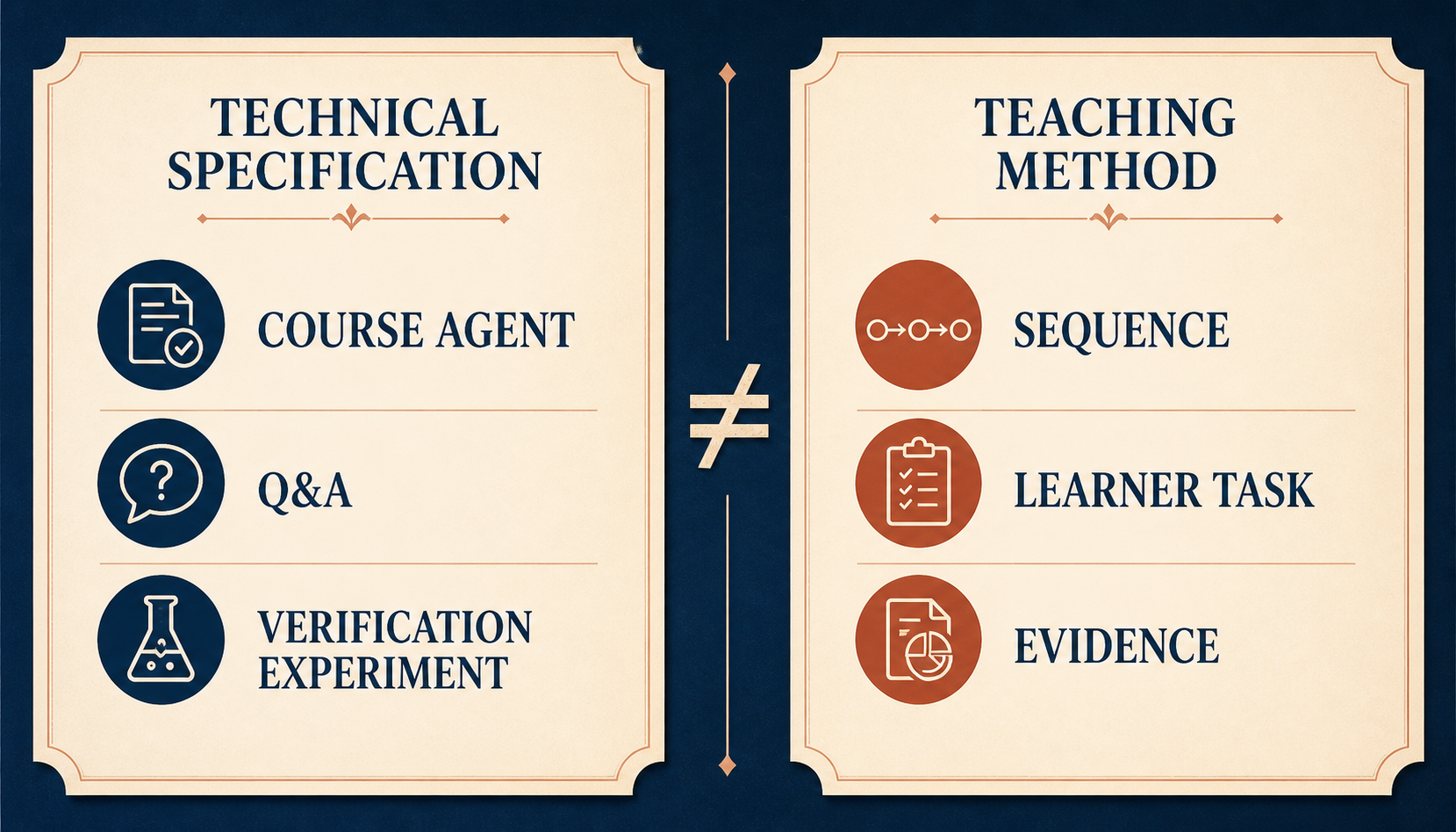
The useful decision is to separate three objects: the technical asset, the teaching method and the learner evidence.
What a specification actually gives you
The Shaanxi vocational-college procurement document includes requirements around a course-agent function, including management of course question-and-answer pairs and AI-generated presentation outlines. The Xin’an compulsory-education equipment specification describes AI-themed course hours, teaching resources and verification experiments.
These are observable requirements in named institutional contexts. They can help an expert notice that a potential buyer may care about assets, administration, classroom materials or practical verification. They can inform questions for a later discovery conversation.
They do not prove that a foreign expert’s existing course fits either institution. They do not prove that the requested functions work as intended. They do not establish a teaching sequence, assessment standard, budget benchmark or general demand.
Three columns instead of one “course” label
Technical asset
What is being requested or described? A Q&A management function, a presentation-outline generator, a set of lesson materials, a number of course hours, or a verification experiment.
This column should preserve the institution’s wording and the scope conditions. It should not silently turn “supports” into “teaches”, or “contains” into “produces mastery”.
Teaching method
How would a learner encounter the idea? Through a demonstration, guided practice, comparison, project, feedback loop, or supervised implementation? What misconception or failure would the lesson address?
A procurement specification may leave this open. That is not a defect in the document; it is a reminder that the expert still has design work to do.
Learner evidence
What can the learner produce or explain, and who reviews it? A completed Q&A set is not automatically a good teaching outcome. A generated presentation outline is not automatically a coherent lesson. A verification experiment needs a question, conditions, observation and interpretation.
The three columns prevent an asset from masquerading as pedagogy.
A scene: “We need an AI course agent”
Imagine an institution showing an overseas expert the line “course agent” in a procurement document. The expert responds with a generic course about prompt engineering. The buyer asks how teachers will manage question pairs, review generated content and use the tool in a class. The expert has no answer because the product was built around a topic, not the specified work.
The opposite response is also risky. The expert promises to reproduce every requested function before checking the environment, data, account and responsibility boundaries. A document has become an implementation commitment.
A better research response is to ask which part is being purchased: a software function, a content asset, a training service, a support layer or a combination. Then ask what a teacher or student must do with it. The source helps formulate the questions; it does not answer them.
Verification experiments are not automatically learning design
The Xin’an specification’s reference to verification experiments is useful because it signals a desire for practical checking. But “experiment” can mean many things. Is the learner reproducing a known result? Testing a design? Comparing two approaches? Debugging a failure? Recording evidence for a teacher?
An expert must choose the instructional purpose. If the goal is concept learning, a small controlled example may be enough. If the goal is project work, the experiment may need data, equipment, a rubric and a fallback. If the goal is procurement acceptance, the verification may belong to a technical test rather than a learner assessment.
The public document does not resolve those choices. It should not be cited as proof that the expert’s experimental method is approved.
What the two documents cannot be combined into
It would be tempting to combine the two specifications and announce a general product: “China needs AI course agents plus 38 hours of verified AI lessons.” That sentence would be unsupported. The documents belong to different institutions and scopes. Their requirements may be comparable as research prompts, not aggregated as a market total or universal curriculum.
The same caution applies to a foreign expert’s portfolio. A public request for course materials does not prove that a particular English course can be translated, that its rights are clear, or that its examples match the institution’s curriculum.
A product decision tree
Use the specification to choose among three next actions:
Research only: The requirement is visible, but the buyer, environment and learner work are unknown. Record it with the source and limits.
Adaptation brief: The buyer and learner are defined, but the existing course does not yet map to the requested asset or evidence. Build a gap list before translation.
Technical or delivery discovery: The request includes an account, system, data, deployment or acceptance test. Open a separate scope with owners, conditions and stop rules.
None of these actions is “publish a course because a specification exists.”
A counterexample: when the specification is enough for a narrow asset
If a buyer explicitly wants a set of teacher handouts matching a defined course-hour count and has supplied the learning objectives, the specification may be sufficient to draft a content-production brief. It still does not prove that the handouts produce learning results or that the expert can provide the associated platform function.
Likewise, if the expert is only asked to review whether an existing course contains the requested topics, the specification can be a comparison input. Do not inflate a comparison into a delivery promise.
The source-to-course check
Before an overseas expert uses a Chinese procurement specification in a product conversation, write five lines:
- Institution and exact document scope.
- Requested asset or function.
- Intended user and work task, if stated.
- Missing teaching and review information.
- Next evidence needed before adaptation or delivery.
If the fourth line is empty, the source has probably been mistaken for a syllabus.
The sentence worth carrying forward is: a specification tells you what was requested; it does not tell you how learning will happen.
If you need to separate technical requirements from course adaptation and delivery scope, request a China validation review. Bring the exact specification and keep its institutional limits visible.
Related reading
- A China Training Procurement Brief Is a Service Scope, Not a Course
- Course Dependency and Terminology Inventory
- Product Portability Audit
Sources and evidence boundary
- Shaanxi National Defense Industry Vocational and Technical College procurement requirements, checked 2026-08-23. Shows institution-specific course-agent requirements; does not establish pedagogy, general demand or overseas eligibility.
- Xin’an compulsory-education information-teaching equipment procurement specification, checked 2026-08-23. Shows specified AI course hours, materials and experiments; does not establish course fit or learning results.
Image brief: Split-screen document: technical requirements such as course-agent Q&A and verification experiments on one side; teaching sequence, learner task and evidence on the other. No procurement seals, price or success claims. Alt text: “Technical AI course requirements separated from teaching method and learner evidence.”