
Skip to content
OriBridge东方桥

Authorization & Rights

A Revenue Split Is Not a Deal Until Both Sides Can Calculate It

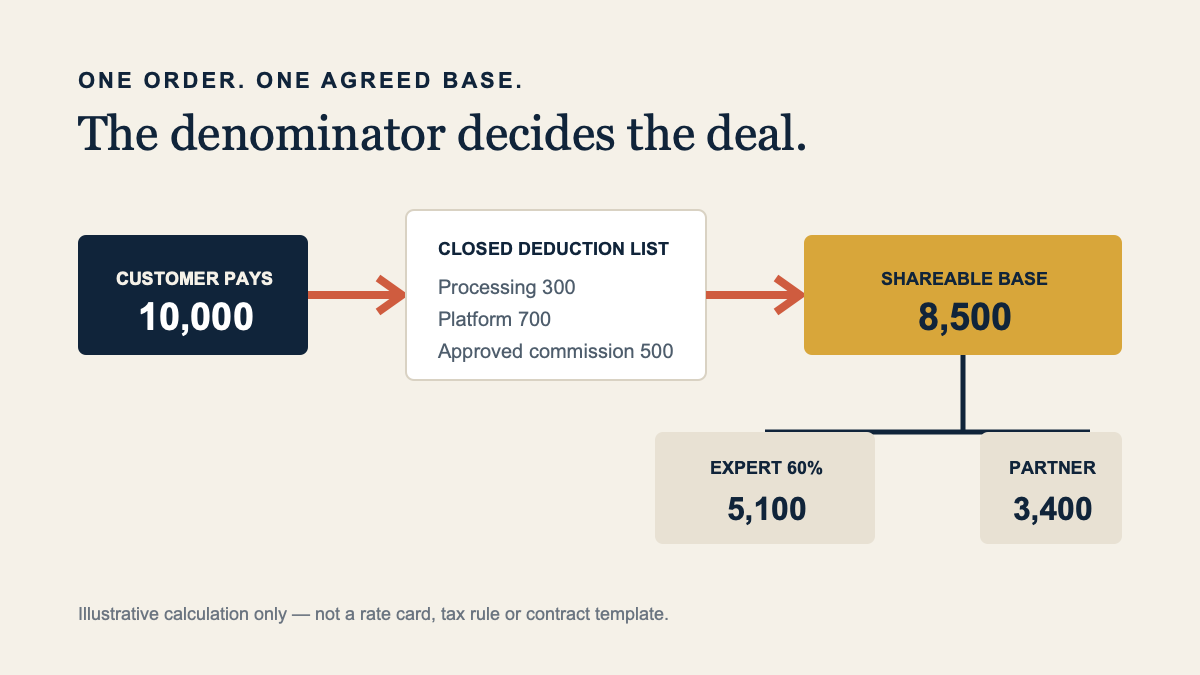
A single customer order being calculated by two parties using the same agreed deductions.

“We can do sixty-forty” sounds like progress. It is often the point where the difficult question has simply been postponed: sixty-forty of what, after which agreed deductions, for which sale, recorded by whom, and what happens if money and delivery later disagree?

The percentage is visible; the denominator decides who gets paid. Before negotiating a share, make two people calculate one illustrative order from the same inputs. If they reach different answers, there is no working commercial model yet—only a percentage.

This article is a commercial clarity exercise, not legal, tax, accounting, foreign-exchange, consumer-protection, payment-provider, or contract advice. It does not state an OriBridge price, a market rate, a standard deal, or a recommended split.

How should a revenue split with a China partner be structured?

Start with one order, not a percentage. Define the money received, the closed list of permitted deductions, which sale belongs to the arrangement, how refunds and chargebacks are handled, when each party is paid, and which records both parties can inspect. If two people cannot calculate the same payout from the same order, the proposed split is not yet a workable commercial term.

Term to define Question the agreement must answer
Receipts Which collected amounts enter the calculation, in which currency, and at what point?
Deductions Which named, order-level costs may be removed before the split, and who approves them?
Attribution Which buyers, links, accounts, cohorts, or introductions belong to the arrangement?
Adjustments How are refunds, chargebacks, discounts, taxes, and reversals recorded and timed?
Evidence Which order records, statements, and reconciliation rights can both sides use?
Payment When is the calculation final, who pays whom, and what happens when the records disagree?

This framework does not supply a normal China percentage, decide tax treatment, grant content rights, or replace legal and accounting advice. It makes the commercial question testable before specialists document the actual cross-border arrangement.

Start with one illustrative order

Assume, purely for illustration, that a buyer pays 10,000 units of the agreed settlement currency. The parties have already agreed that this order has: a 300 processing fee, a 700 named platform charge, and a 500 pre-approved referral commission. No refund has occurred.

If all three deductions are genuinely agreed and tied to this order, the illustrative shareable base is 8,500. A 60/40 allocation would produce 5,100 and 3,400.

Now add 4,000 of advertising chosen by only one party. If that spend becomes a pre-split deduction, the headline percentage did not change—but the economic result did. The question is not whether advertising is good or bad. It is whether this cost was agreed, attributable, capped, recorded, and intended to be shared for this kind of sale.

That is why “net revenue” is too elastic to carry a partnership conversation by itself.

Make the base a closed calculation

For one order, record the gross amount, currency, refund state, named permitted deductions, and the calculated base. A useful calculation is boring enough for both sides to repeat.

Line item Question to settle before the split
Gross receipt Which record establishes the amount, currency, and sale date?
Refund or reversal When does a request become a resolved adjustment, and who records it?
Transaction cost Is it directly tied to this order and visible to both sides?
Platform or delivery charge Is it named, agreed, and linked to this sale rather than a general operating expense?
Commission Which introduction or route qualifies, and how is attribution evidenced?
Marketing spend Was it pre-approved, capped, and explicitly included in the calculation?
Shareable base Can both sides reach the same number from the same order record?

A general phrase such as “market development” is not a deduction definition. It may be a sensible investment, but it should not silently alter the base after money is collected.

Separate the commercial model from rights and authority

Revenue share does not grant a person authority to translate, adapt, reproduce, distribute, market, set prices, promise refunds, retain learner records, or sublicense a creator’s materials. Those actions require their own written scope and approval.

The reverse is also true: a person may have a limited operational role without acquiring a share of every future order. Someone who introduces one named buyer, coordinates one approved workshop, or supplies a narrowly defined service may be better served by a fixed fee or a limited commission than a vague perpetual percentage.

Before discussing a share, separate three questions:

  1. What work is being done?
  2. What authority, if any, is being granted?
  3. Which recorded sales, if any, participate in the calculation?

The published course dependency and terminology inventory is an adjacent operational tool for identifying assets, owners and change authority. It does not make a revenue split legal or fair; it helps prevent a calculation conversation from being mistaken for a content licence.

Payment status and delivery status are different records

Commercial disputes often begin when a team writes “the buyer paid” and means several different things: a payment attempt occurred, a payment was accepted, an order was created, access was granted, a refund was requested, or money was returned.

WeChat Pay’s refund documentation distinguishes a refund request from the later status of that request.1 It is not evidence that any particular merchant, offer, or overseas creator can use WeChat Pay. It is a narrow operational reminder: a request is not the same as a completed adjustment.

For a share calculation, define which state changes the base. Does a refund request reduce the payable base immediately, or only when it reaches an agreed resolved state? Who updates the order record? How is learner access handled while the exception is open? These are agreement and process questions, not conclusions supplied by a payment document.

For the related operational path, see why a payment button is not a refund operation. This article stays focused on the calculation after the relevant states have been defined.

Attribution deserves its own sentence

“The partner brought the buyer” can become as ambiguous as “net revenue.” Define the qualifying route before the test begins. It might be a named account, a recorded introduction, an approved campaign link, or a dedicated checkout route. It should not become a retrospective claim after a buyer appears.

Maven’s B2B-sales documentation is a product-specific reminder that different sales arrangements can have distinct workflows.2 It is not a China rate card and cannot prove any route is available. The general lesson is simple: the record that supports a private cohort may not be the record that supports an individual purchase, and neither should be assumed to cover every subsequent sale.

Run the two-calculator test

Before signatures or launch, give both sides the same fictional order and ask them to calculate the outcome without talking to each other. Compare:

  • the qualifying sale;
  • gross amount and currency;
  • each permitted deduction;
  • attribution evidence;
  • refund and reversal treatment;
  • settlement date and reporting record; and
  • the resulting payout.

If the answers differ, do not “solve” it by adding more prose around the percentage. Name the disputed line item. Then decide whether it belongs in the deal at all.

This test is useful before a small second-market experiment too. A bounded second-market test may reveal whether a commercial route is worth designing before either side grants broader commitments. It does not make a share structure necessary.

When a fixed fee may be clearer

A fixed fee, limited referral payment, or tightly capped service arrangement can be more intelligible when one side does not control delivery, incur agreed shared costs, or receive a right to the customer relationship. A revenue split may fit a more involved operating arrangement, but complexity has to earn its place by exposing responsibility—not concealing it.

There is no universal answer. The right structure depends on actual authority, contribution, risk, records, and jurisdiction-specific advice.

What this article cannot decide

It cannot choose a fair percentage, decide tax treatment, set a China market price, determine a payment route, or create a contract. It cannot grant content rights, diagnose legal compliance, or promise payout outcomes.

It provides one pre-negotiation test: can both sides calculate the same illustrative order from the same agreed inputs?

If the answer is no, that is not a failure of trust or a reason to rush toward a more elaborate formula. It is a signal to reduce ambiguity before either party makes broader promises, spends money on a route, or treats a percentage as settled commercial reality.

Also record the cadence. A calculation can be correct for one order and still create conflict if one side expects weekly information while the other reports only after a quarter. The exercise should therefore name the record owner, a cut-off date, a correction path, and how both sides receive the same underlying order view. Those are operating details, not a substitute for legal or accounting advice.

If a line item cannot be explained in a sentence and tied to a record, it should remain outside the illustrative calculation until the parties decide otherwise.

Next step: ask each party to run the two-calculator test before debating a headline split. If you need to decide whether an expert-led product should begin with a bounded pilot, referral arrangement, or another path, read how to choose a China business model or request a validation review.

Sources and limits


  1. WeChat Pay, Refund API documentation, rechecked 2026-08-24. Used only for the distinction between a refund request and its later documented status. 

  2. Maven Help Center, How to facilitate B2B sales on Maven, rechecked 2026-08-24. Used only as an example of product-specific B2B workflow documentation. 

Scroll to Top