
Imagine being told that exploring a new market requires you to translate twenty hours of teaching, hire a local team, open new accounts, learn unfamiliar platforms, and sign a long-term deal before you know whether anyone needs the work.
Saying no would be sensible.
That is often how an overseas expert first hears the China question: not as an experiment, but as an expansion project with all the cost moved to day one.
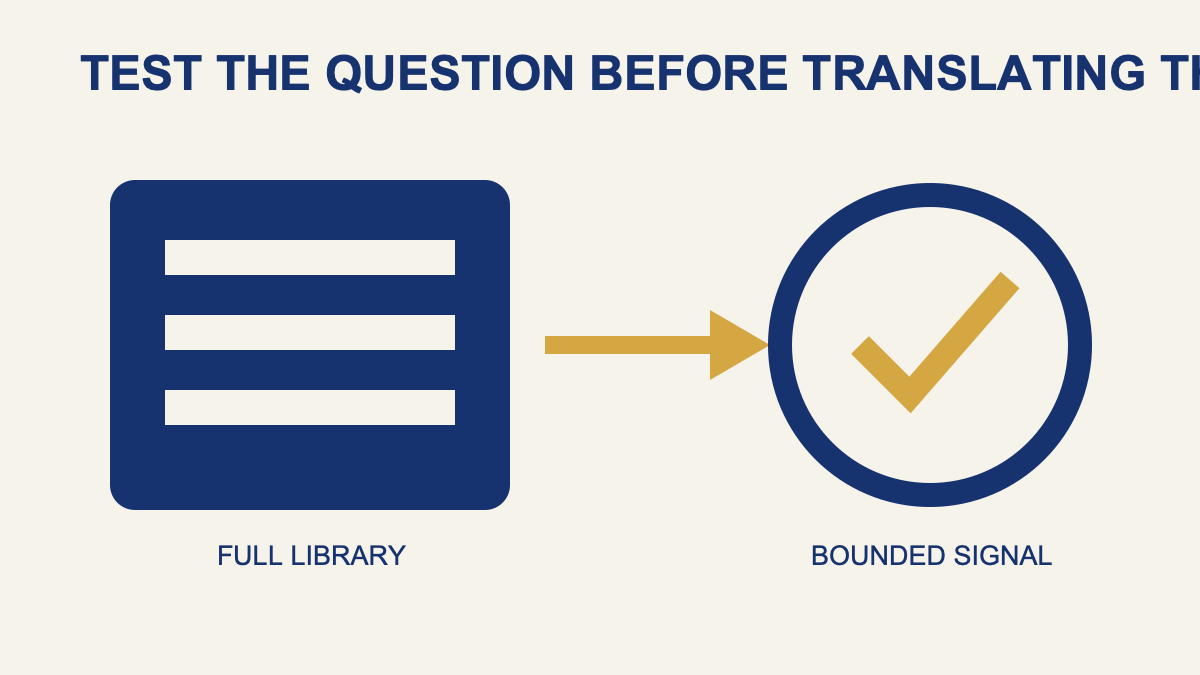
There is another way to frame it. Before committing to a market, ask whether one existing knowledge product is worth a limited, reviewable test with a defined end point.
That is not a shortcut to sales. It is a way to replace a large unknown with a smaller, better-formed question.
This article concerns an initial assessment or test design. It does not authorize translation, publication, selling, or distribution of a creator’s material.
The first decision is what not to build
If the first step requires the machinery of a full launch, it is no longer a test.
A sensible early-stage inquiry should not require an expert to hand over an entire course, give up long-term or exclusive rights, or treat China as a settled business priority. Nor should a local partner imply that a creator can send files and forget about the process. Control is not an inconvenience to be designed away; it is part of the product relationship.
The useful early question is narrower: can a real product, aimed at a specific buyer situation, produce enough evidence to justify a next decision?
For example, a remote-management course might contain a module on how headquarters and distributed teams make decisions across time zones. Rather than localizing the whole curriculum, an assessment can ask whether a defined group of China-based international operators recognizes that problem, what they use today, and whether the proposed framing survives local scrutiny. That can be explored with approved concepts or materials. It does not establish demand, price, or a right to sell.
The smallest useful test has six parts
The test needs more than a translated excerpt. It needs a boundary.
- One product. Choose a real, existing offer—not an entire catalogue.
- One buyer. Name the person or organization making a decision, rather than “the China market.”
- One problem. State the costly or persistent situation the product might address.
- One representative module or concept. Use only the material and form that the creator has approved for the purpose.
- One feedback path. Decide how learning will happen: desk research, a private assessment, approved concept testing, or another controlled route.
- One stop condition. Agree in advance what would make the next step unjustified.
This structure protects both sides from a familiar trap: interpreting activity as progress. A translated deck, a new account, or a few encouraging comments may be useful inputs. None is, by itself, evidence that a market path exists.
A limited test is not a smaller launch. It is a decision instrument with permission to stop.
Permission is not a single switch
Rights are often discussed in the vague language of “using the content.” In practice, different actions carry different implications:
- reviewing materials privately;
- translating a small approved portion;
- adapting an example or a concept;
- creating a test asset;
- showing something publicly;
- collecting expressions of interest;
- selling, delivering, or distributing a product.
Agreement to one of these actions does not automatically grant the next. The creator should know what will be seen, by whom, for how long, in which language, and how approval works. WIPO’s copyright resources are a useful general reminder that permissions are specific to the rights granted; a commercial arrangement should define its own scope rather than rely on a broad informal understanding.1
For OriBridge, that distinction is operational as well as legal. Any public content, product test, sale, or distribution requires explicit approval. A preliminary China Product Card or internal assessment is not a license.
What the local side should carry
The creator should not have to become an expert in every unfamiliar part of the market just to decide whether a conversation is worth continuing.
The local work is to make the unknowns visible: identify plausible buyer situations, examine whether the product depends on tools or institutions that do not travel well, distinguish a course host from a sales channel, and return the evidence in a form the creator can challenge.
That still asks something of the creator. They need to provide accurate product context, clarify their intended outcome, specify what can be reviewed, and respond to proposed positioning or adaptations. “Low commitment” is not the same as zero commitment. It means the commitment is proportional to the question being asked.
A pause can be the right result
China may not be the right next market for a particular product. A strong English-language offer can rely on a regulatory setting, credential, software stack, or buying habit that cannot be carried across without losing the result it promises.
That is why a useful assessment can end with Proceed, Validate, Refine, or Pause. The last option is not a failed sales pitch. It is a decision that avoids a much more expensive mistake.
The point of a second-market test is not to make expansion feel inevitable. It is to make the next decision more honest.
Before you ask for a full translation
Ask four questions:
- What exact buyer situation would this product address?
- What is the smallest approved material or concept that can clarify the question?
- Which actions are permitted, and which remain off limits?
- What evidence would justify continuation—and what would make us stop?
If those questions cannot yet be answered, the next step is not production. It is clarification.
OriBridge can review an existing expert product for China-market fit and outline a limited, approval-led path for further validation. The outcome may be to proceed, refine the premise, validate a specific unknown, or pause.
Related reading
- A Strong Course, the Wrong First Move
- Your Most Undervalued Asset May Be the Content You Already Published
- Do You Own Your Audience—or Are You Renting Reach?
- Submit a product for a bounded review
Sources and further reading
- OriBridge, Company Introduction and Cooperation Boundaries (internal policy basis; public claims in this article are limited to OriBridge’s stated process).
- OriBridge, China Product Card Assessment Framework (internal decision framework).
- World Intellectual Property Organization: Copyright (general background on copyright and permissions; accessed 2026-08-01).
-
This is general information, not legal advice. The applicable agreement and jurisdiction determine the actual permission scope. ↩