
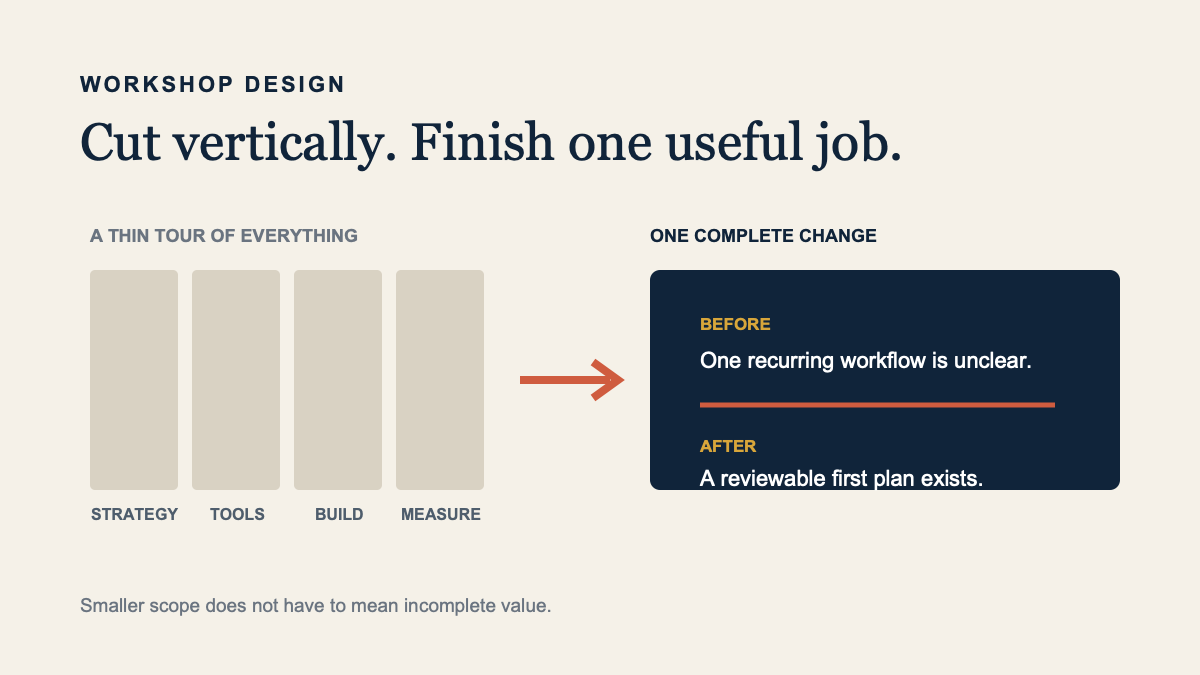
The rehearsal was supposed to last ninety minutes. The instructor had reduced an eight-session course to its “essential” slides: strategy, diagnosis, tool choice, implementation, governance, measurement. At minute fifty, the group was still debating definitions. The final exercise became homework. The promised result—one reviewed workflow plan—never had a chance to exist.
That is not a timing problem. It is a product-design problem.
A workshop should be smaller in scope, not incomplete in value. It should enable one observable change a participant can make inside the session and explain afterwards. A short course often tries to introduce an entire curriculum quickly. A workshop selects one job and completes it with the people in the room.
This is a framework for designing a bounded, authorised test. It does not prove that a workshop will find demand in China, that a given platform can host it, or that any account has live, replay, payment, or delivery eligibility.
Decide what must be true at the end of the room
Start from a visible before-and-after state.
For a full programme on AI-assisted operations, the curriculum may include strategy, workflow mapping, tool selection, implementation, governance, and measurement. A workshop should not allocate ten minutes to each. It might instead ask every participant to bring one recurring workflow and leave with:
- a named decision within that workflow;
- one risk or exception that cannot be delegated blindly to an AI tool;
- a draft owner-and-reviewer map; and
- a next experiment that can be checked.
That is not a miniature version of the programme. It is a vertical slice through it: one narrow but complete piece of work. “Participants understand the topic” is not an outcome. “Participants can explain who reviews the output before it reaches a customer” is.
The distinction matters commercially. A buyer can assess a bounded promise. They cannot sensibly evaluate “a fast overview of everything the course might eventually cover.”
The five parts of an honest workshop promise
Before calling an event a workshop, write these five elements in one place.
| Element | The question | Weak version | Testable version |
|---|---|---|---|
| Participant | Who brings the problem? | Anyone interested in AI | Operations leads with one recurring workflow |
| Input | What must they bring? | Curiosity | A real process, decision, or example |
| Action | What happens in the room? | Learn best practices | Map one decision and its reviewer |
| Evidence | What exists afterwards? | Better understanding | A one-page workflow decision record |
| Boundary | What is not promised? | Unstated | Tool implementation, certification, or ongoing support |
The table is not a universal training specification. It is a way to catch a familiar failure: a facilitator promises an outcome that depends on work outside the room, then treats enthusiasm as evidence that the workshop worked.
A Chinese delivery surface adds owners; it does not choose the promise
When a China-facing session uses a live room, broadcast, replay, course administration, or follow-up channel, those may be separate operating surfaces. Tencent Meeting’s public documentation, for example, describes meeting controls and roles. ClassIn’s public product and pricing materials list certain teaching and replay-related product surfaces. Those pages support only that narrow observation: room control and learning delivery involve features and responsibilities that must be checked for the chosen route.
They do not prove availability to a particular overseas instructor, price a workshop, establish an appropriate China course format, or substitute for an outcome design.
Put differently: the platform can provide a room. It cannot decide what the room should honestly promise.
The course-compression trap
The trap is understandable. An expert fears that a narrow event will seem less valuable than the original course, so they try to demonstrate every module. Participants see many ideas but cannot finish the work that would let them judge the method.
Use three questions to resist it:
- Which one decision can a participant make by the end of this session?
- What would make that decision visible to another person?
- What work must happen later, and therefore cannot be promised now?
The third question is the integrity check. If the claimed result depends on a week of implementation, organisation-wide approval, or ongoing coaching, call the workshop an introduction or diagnostic. Do not sell it as completion.
Design the follow-up before the invitation
The room is only one part of the event. An honest workshop also says what happens to the work produced there. Will participants receive a copy of their own decision record? Does someone review it? Is there a permitted next exercise, or does the work stop when the session ends? The answer should be modest enough to be carried by the actual team.
This is where a full course and a workshop often diverge. A course may promise a sequence of practice, feedback, and reinforcement. A workshop may only promise a useful first artefact and a clear next decision. Neither is inherently better. The problem starts when a short event borrows the language of the longer programme but cannot supply its support structure.
For a China test, record the question the follow-up is meant to answer. Is the team testing whether participants finish the action, whether a buyer wants a larger programme, or whether a delivery route is workable? One session should not be asked to answer all three.
There is also a practical communications benefit. A participant who can describe the one completed action is more likely to give useful feedback than someone asked whether they “liked the session.” Specific feedback can be compared across a small pilot; generic satisfaction cannot tell an expert whether the method, the buyer problem, or the operating environment deserves another round of work.
A counterexample: when a workshop is the wrong format
A workshop is not the right substitute for every programme. Certification pathways, supervised competence, regulated procedures, and progressive technical skills often depend on accumulated practice and assessment. A two-hour session may introduce the problem or reveal a training need, but it cannot honestly replace the programme.
The same is true if the buyer’s real need is a customised consulting engagement. In that case, a workshop may help define the work, but it should not be priced or framed as a standard course simply because it has slides.
Treat the rehearsal as evidence, not a performance
Before inviting a buyer, run a rehearsal with the actual promise and room constraints. Watch for four things:
- Does the opening scenario make sense without the rest of the curriculum?
- Can the group complete the one named action in the time available?
- Does someone own questions, materials, recording/replay decisions, and follow-up?
- Can a neutral observer recognise the work result without being told it happened?
If the answer to the second question is no, reduce the scope. If the answer to the third is no, the operating design is incomplete. Adding more slides will not fix either problem.
A constructed observer note should record work, not applause: “The group named the workflow owner and reviewer; it stalled when nobody could define the exception path; tool implementation was outside the session.” That note does not claim training effectiveness. It shows what was completed, where the exercise stopped, and what a single workshop must not claim to have solved. If the observer can only write “participants were engaged,” the promised action was probably not observable enough.
The note should be written before the debrief, while the unfinished step is still visible. Otherwise enthusiasm can quietly replace the evidence the rehearsal was meant to capture.
For a broader format decision, compare self-paced courses, cohorts, workshops and advisory. For the operating question around a live room and replay, read the three surfaces of a China-facing live cohort. If the next uncertainty is budget rather than format, see why an AI workshop seat price is not a tool budget.
The next useful move is not “make the course shorter.” It is: choose one workshop promise that can be observed, completed, and honestly bounded. If you need help defining that first test, ask OriBridge to review the proposed scope.
Sources and boundaries
- Tencent Meeting: in-meeting controls, checked 2026-08-24 — supports only the documented meeting-control and role features.
- ClassIn pricing and product surface, checked 2026-08-24 — supports only its displayed product categories and offers, not route eligibility or market outcomes.
- Maven: Projects and B2B sales, checked 2026-08-24 — examples of project and B2B format design, not China-market evidence.