
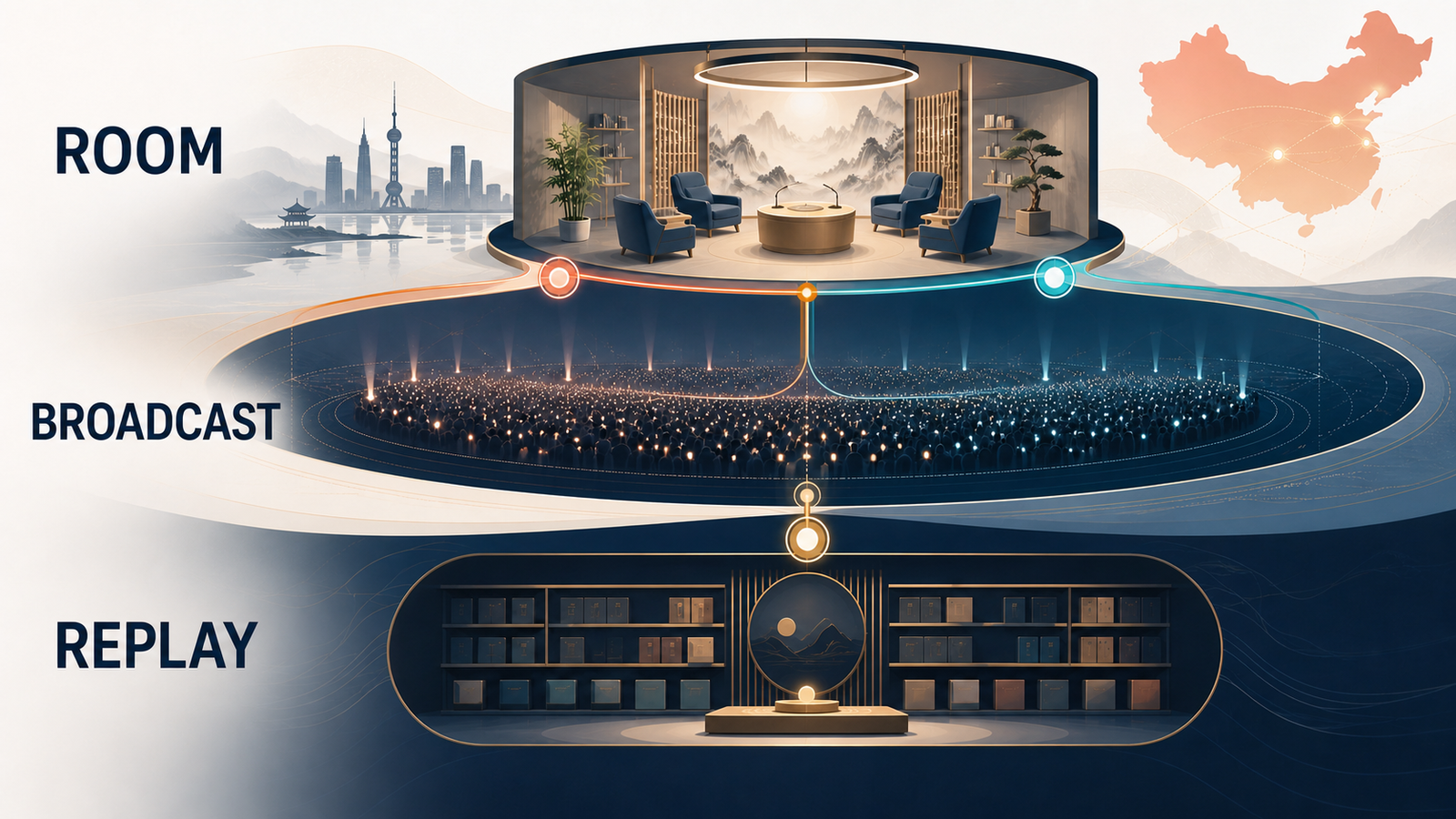
A live cohort is not one link. Before choosing a platform, separate the interactive room, the live broadcast, and the replay—and give each promised learning action its own test, owner, and fallback.
The link opened. The class still failed.
Consider this an illustrative scenario, not a customer story.
An overseas expert schedules a two-hour cohort for learners in China. The sales page promises interaction. The host has a meeting link. A broadcast page is available for people who cannot join the room. A replay is meant to remain available for a limited period.
On the day, the host can open the room. One learner can watch the broadcast but cannot ask the question the course promised to answer live. Another learner misses the session and finds a replay link with a different expiry condition. Everyone can truthfully say, “the livestream link worked.” Nobody can truthfully say that the course delivered one consistent learning experience.
The problem was not necessarily the platform. The problem was that the team treated three different promises as one technical object.
In this article, room, broadcast, and replay are editorial design labels. They are not a universal vendor taxonomy and do not assert that any provider offers a particular feature. Their purpose is to force a useful design conversation before a platform is selected.
Start with the learning action, not the platform name
Write down what the learner is being promised:
- Room: “I can join the interactive session, follow the host, and perform the promised live action.”
- Broadcast: “If I use the viewing route, I can see and hear the live lesson under the stated conditions.”
- Replay: “If I miss the live moment, I can complete the defined follow-up action within the stated access window.”
Those sentences are deliberately different. A viewer route is not automatically an interactive route. A recording is not automatically a replay experience. A link being reachable is not proof that the learner can perform the promised action.
One China-specific source can anchor the boundary without answering the route question. Tencent Meeting’s official livestream documentation says that meeting screen/video can be relayed to a livestream webpage, that only the host can configure the livestream, and that chat and documents do not travel with the broadcast. It also describes discussion and replay as settings, with a stated 30-day replay condition. These are product-documentation facts for that page, not proof that a particular China-facing course route works. Any platform condition still belongs in the route-test record, where the exact version, role, device, network, and date can be preserved.
The three-surface design table
Use this as an illustrative decision table. Replace the wording with the exact promise of the course.
| Promised learning action | Design label | Role and conditions to define | User action to test | Failure handling and owner |
|---|---|---|---|---|
| Ask, respond, practise, or receive live feedback | Room | Host, participant identity, joining permission, device/app version, moderation, language support | Join as the intended learner; perform the promised interaction; leave and rejoin if relevant | Name the support owner and the alternate interaction route; do not silently convert interaction into passive viewing. |
| Watch the live lesson when the room is full, restricted, or not the learner’s route | Broadcast | Broadcast host, viewing URL, supported environment, latency/quality expectation, captions or interpretation promise | Open as the intended viewer; check the promised audio, video, captions, and viewing action | Provide a dated fallback or support response; do not claim that broadcast access includes room chat or documents. |
| Complete the lesson after the live session | Replay | Recording owner, publication time, access identity, expiry rule, download/caption conditions | Open the replay as the intended learner; locate and complete the defined follow-up action before expiry | Record how the learner is helped if the recording is late, unavailable, or expired; assign one owner for the window. |
The table is not a recommendation to buy three products. It is a way to avoid buying one product while leaving two promises undefined.
Hand the design to the route tester
The three-surface table is the handoff card. Give it to the person running the route test with one instruction: test the promised learner action, not merely the link. The complete evidence fields, environment controls, and PASS/PARTIAL/FAIL decision belong in the end-to-end access, payment, and delivery test script. This article does not create a second test protocol.
The handoff card should name, for each surface, the promise, intended learner role, fallback, and support owner. A host-side pass is not a learner-side pass. A viewer-side pass is not an interaction pass. A replay URL that exists is not proof that the intended learner can enter it before the expiry condition.
Where language belongs in the design
Language and interpretation are not a separate decorative layer added at the end. They are variables inside the three surfaces.
For the room, decide whether the promise is translated discussion, written prompts, a moderator, or another defined interaction. For the broadcast, decide whether captions, interpretation, or a bilingual host is actually part of the viewer promise. For replay, decide whether the recording, captions, slides, glossary, or follow-up notes carry the meaning after the live event.
Do not write “Chinese subtitles” as if that phrase itself guarantees comprehension. State the action the learner must complete and pass the relevant asset to the route tester. No unverified supplier page can tell you whether your terminology, lesson design, or support path works for your audience.
A failure map is more useful than a platform score
When a test fails, identify the broken promise rather than assigning a vague “platform problem” label:
| Observed failure | What it might mean | What not to conclude |
|---|---|---|
| The room opens but the learner cannot perform the promised interaction | Permission, identity, device, moderation, or interaction design needs investigation | Do not conclude that all live delivery is impossible. |
| The broadcast plays but the promised captions or interpretation are absent | The viewing route and language asset were not configured or tested together | Do not conclude that watching equals participating. |
| The replay exists but the learner cannot access it before the stated window | Publication, identity, expiry, or support ownership is unresolved | Do not conclude that a recording automatically completes delivery. |
| The host passes every check but the test learner fails | The route was tested from the wrong role or environment | Do not generalise the host’s result to learners. |
This is the practical value of the three labels: they create three places to put evidence, not three reasons to market a vendor.
The tempting shortcut—and why it fails
Shortcut: “We have a livestream link, so the cohort is ready.”
Why it fails: the link may prove only that one page or stream can open. It does not establish the interaction promise, the viewing conditions, the replay window, the language assets, or the fallback owner.
The other shortcut is to choose a platform first and then rewrite the course promise around whichever features happen to be visible. That can be reasonable for an internal experiment, but it is risky when learners have already been promised a specific action. Define the action first; test the platform against it.
What this article does not prove
This article does not prove that any platform is available, suitable, affordable, performant, or legally appropriate for a particular overseas expert or Chinese learner. It does not prove that any learner can join, watch, interact, download, or replay. It does not provide payment, network-coverage, sales, learning-effect, or compliance conclusions.
The Tencent documentation is used only for the narrow broadcast, host, chat/document, discussion, and replay conditions stated above. It does not establish overseas eligibility, learner coverage, or platform suitability. The only end-to-end route-test conclusion may be recorded through BLOG-20260812-103 under fixed, authorized conditions.
For the actual buyer path—access, payment, delivery, support, and recovery—use the end-to-end access, payment, and delivery test script. To test a specific platform path without guessing, see how to test a course platform in China. For the content, tools, and delivery dependencies that may need localization, read what must change beyond translation.
Next step: write the three promises for one real cohort, then test room, broadcast, and replay separately with the intended learner role. If you need an independent review before a wider launch, request a validation review.
Sources and limits
Tencent Meeting’s official livestream documentation is the sole China-specific source for this candidate, verified 2026-08-16. It supports only the stated product-documentation conditions; all learner-route claims remain subject to the authorized route test.