
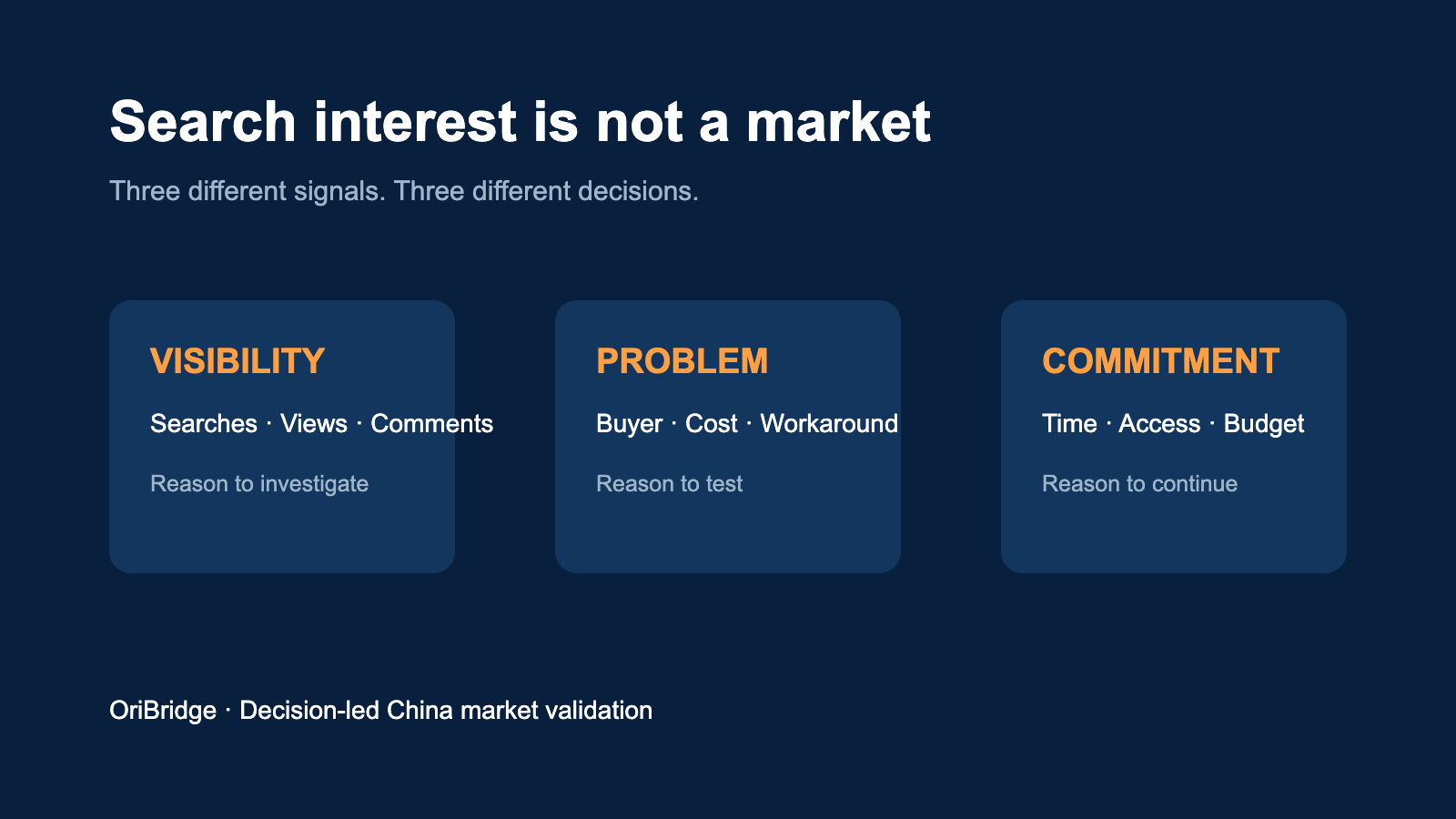
An educator sees Chinese-language comments beneath a video. Search impressions for the topic are climbing. A market report says the surrounding industry is growing. By the end of the week, those separate observations have acquired a shared, unwarranted conclusion: we should translate the course.
Not yet.
Those signals may be good reasons to look closer. They are not, on their own, reasons to build, localize, or launch. The missing question is brutally ordinary: who has a problem costly enough to act on, and what would acting look like?
For a course or expert product, China is worth exploring only when the evidence begins to connect a defined buyer, a current problem, a feasible buying path, and a meaningful commitment. Until then, attention is a lead—not a market.
Put every signal in an evidence ledger
The simplest way to avoid being persuaded by a pile of unlike numbers is to stop adding them together. Record each one against the decision it can actually support.
- Searches, views, follows, reposts, comments. They can tell you that a topic or creator is being noticed. They cannot tell you who the buyer is, whether the problem matters, or whether anyone can buy.
- Repeated descriptions of a recent workaround. They can suggest that a named group has a real operating problem. They cannot tell you whether your offer is the acceptable solution.
- A buyer gives time, access, budget details or pilot constraints. That can show willingness to move a real decision forward. It still cannot tell you whether demand will repeat at scale.
The first row is visibility evidence. It is useful, and it is often cheap to obtain. YouTube’s creator guidance, for example, describes audience, returning-viewer and related-content signals; its Trends feature is available only in select markets and is meant to surface content gaps and searches.1 That is enough to shape a question. It is not enough to identify a budget owner.
Platform scale belongs in the same column. Kuaishou’s 2025 results describe a very large, commercially active platform. They establish context about that company and its ecosystem, not a route by which a particular overseas expert will be found, trusted, and paid.2 The distinction matters because a dashboard can make a hypothesis look finished.
A China AI commercialisation special case
AI makes this mistake easier to make because several visible signals can arrive together. DeepSeek, Kimi, Doubao and Qwen have public official product pages; those are useful observations of supplier visibility and product supply, not measurements of course demand.3 Kimi publishes API inference-pricing documentation, Alibaba Cloud Model Studio publishes usage-based model pricing, and Volcengine maintains a commercial cloud-pricing entry. DeepSeek’s developer documentation describes an API route, although its pricing endpoint was not readable in the editorial check.4
Those facts support only a supplier-side conclusion: AI-tool providers have made products, developer access, cloud billing, or enterprise-oriented routes available. They cannot prove that a Chinese learner will buy an overseas course, that an employer has an external-training budget, or that any course price is credible. Tool billing is not a course purchase order.
Consider an illustrative counterexample. An overseas instructor sees heavy discussion of local AI tools and a company’s cloud-model pricing page, then assumes a translated AI course can use the overseas catalogue price. But the prospective operations team may already rely on free demos and internal guidance; it may need a workflow review rather than a course, or have no external-training budget at all. Until a named buyer identifies a costly job, an acceptable format and a meaningful commitment, the correct conclusion is HOLD, not “price localised.”
This special case changes the research question, not the ledger: check which workflow, buyer and delivery format the local tool environment affects. Use the Decision Ledger below for the general test rather than treating tool heat or supplier commercialisation as a separate demand category.
The signal that changes the conversation
The useful transition is from “people are interested in this topic” to “this role is already losing something by handling this problem badly.”
Consider an illustrative example. A cybersecurity educator notices Chinese comments asking for incident-response material. That is a promising content clue. It becomes problem evidence only when, say, managers responsible for escalation describe a recurring failure, show the current workaround, and explain the cost of delay. The educator may then discover that the real question is not whether managers want a translated course. It may be whether a team needs a short, facilitated exercise tied to its own incident workflow.
This is why broad market context must stay in its lane. China’s National Bureau of Statistics reported that the value added of core digital-economy industries was 9.9% of GDP in 2023, and its Fifth National Economic Census provides broader detail on emerging and digital-industry activity.5 Those are legitimate reasons to investigate digital-work questions. They do not answer which manager owns a training decision or whether an external course is an acceptable remedy.
Ask for an action that costs something
Opinions are easy to collect. Commitments are harder to fake.
Before treating interest as an opportunity, ask a qualified prospective buyer for a next action that is proportionate to the offer. That could be a redacted workflow for a diagnostic, an introduction to the person who owns the outcome, time with a second stakeholder, a written pilot constraint, or a small paid discovery engagement. The point is not to manufacture a sale. It is to learn whether the problem can survive contact with the way work and purchasing actually happen.
The evidence becomes stronger when the action is both costly and relevant. A free webinar registration tells little about an enterprise programme. A manager assigning colleagues to bring real work samples tells more. Neither proves a national market. The latter may justify solving the next uncertainty instead of commissioning another translation.
A decision ledger in practice
Use three columns: keep, test, and do not infer.
- Chinese comments ask for subtitles. Keep: there is language-related curiosity. Test next: whether commenters match a defined role and problem. Do not infer that subtitles will create a course market.
- Search activity rises around a method. Keep: there may be a terminology or content gap. Test next: which jobs and recent situations prompt the search. Do not infer that searchers can buy or prefer your offer.
- Three managers describe the same painful workaround. Keep: the problem hypothesis has substance. Test next: who authorizes a trial and what format they can use. Do not infer that a full course is the right first product.
- One employer funds a bounded diagnostic. Keep: a real buying path may exist. Test next: whether the path repeats with comparable buyers. Do not infer forecastable demand or a scalable price.
The ledger also gives permission to stop. Stop when visibility is broad but no relevant role can be found; when people like the subject but cannot name a consequential current workaround; when every request is for free material; or when the only feasible next step requires custom delivery the business cannot support.
That is not a failure of research. It is a cheaper failure than translating a catalogue for an audience that never had a usable buying path.
When not to run more interviews
There is an opposite error: turning validation into a ritual. If a qualified buyer has already named participants, shared constraints, introduced the decision-maker, and offered a paid, bounded pilot, another month of broad demand interviews may answer the wrong question. The remaining uncertainty might be delivery, permissions, or operational fit.
Evidence should change the next move. It is not a scorecard to complete.
For a useful contrast, a narrow specialist audience can be commercially healthier than a broad one when the buyer is identifiable and the problem is expensive; see why a niche expert needs the right buyer. And platform reach is only one layer of a durable relationship, as the Portability Test explains.
What this article cannot tell you
This ledger cannot calculate total addressable market, forecast sales, or prove that a content platform will convert attention into revenue. It does not establish access, payment, product rights, regulatory fit, or delivery feasibility. It helps only with a prior decision: whether the next sensible spend is a bounded buyer test rather than a localization project.
Next step: If you have scattered China signals and one product question, send OriBridge a public product link and the decision you need to make. We can help separate a reason to investigate from evidence of a buyer.
A public procurement notice is a buyer signal, not a market-size claim
A named public notice can make a China signal more concrete: one organisation has published a bounded scope, date and response process. Recent notices reviewed for this update include needs assessment, instructors, organisation, records, evaluation or acceptance materials in particular projects. That is stronger than a topic trend, but it is still not evidence that private buyers generally want the same thing, that an overseas provider is eligible, or that a course will sell.
- Record: the named buyer, exact service scope, date, response materials and any stated boundary.
- Separate: a public-sector signal from private-company demand, a course asset from a complete delivery service, and visible requirements from eligibility conclusions.
- Do not infer: national demand, budget, payment willingness, overseas participation, or commercial success from the notice alone.
Sources
-
YouTube, “Understand Your Audience on YouTube”, checked 2026-08-12. Supports the described Audience and select-market Trends capabilities, not demand or conversion. ↩
-
Kuaishou Technology, “Kuaishou Technology Announces Fourth Quarter and Full Year 2025 Financial Results”, checked 2026-08-12. Supports company-reported scale and commercial-ecosystem context only. ↩
-
Official product pages for DeepSeek, Kimi, Doubao, and Qwen, checked 2026-08-12. They support observable supplier presence and product visibility only, not user counts, paid users, course buyers, training procurement or willingness to pay. ↩
-
Kimi API model pricing, Alibaba Cloud Model Studio model pricing, Volcengine pricing, and DeepSeek developer API documentation, checked 2026-08-12. They support supplier-side API, cloud or commercial-route evidence only. The Volcengine page did not expose a stable product-level price statement, and the DeepSeek developer endpoint returned HTTP 403 during the publication check; neither is treated as proof of tool sales, course demand, enterprise-training budgets or a course-price benchmark. ↩
-
National Bureau of Statistics of China, core digital-economy value added and Fifth National Economic Census, No. 6, checked 2026-08-12. Supports macro context, not product-specific demand. ↩
-
Xi’an Jiaotong University, non-degree continuing-education training service transaction notice, checked 2026-08-16. Used only as a specific public buyer-scope example, not general demand or eligibility evidence.
-
Chongqing Shapingba District training procurement notice, checked 2026-08-16. Used only for the response-plan, instructor, materials, schedule and confidentiality fields listed in that project.
-
Jiangmen rural construction craftsperson training procurement notice, checked 2026-08-16. Used only for its stated course/instructor/organisation/evidence and acceptance language.
-
Wuchuan transition training service procurement notice, checked 2026-08-16. Used only for the stated qualification materials, instructor proof, outline, assessment mechanism and quotation fields.