
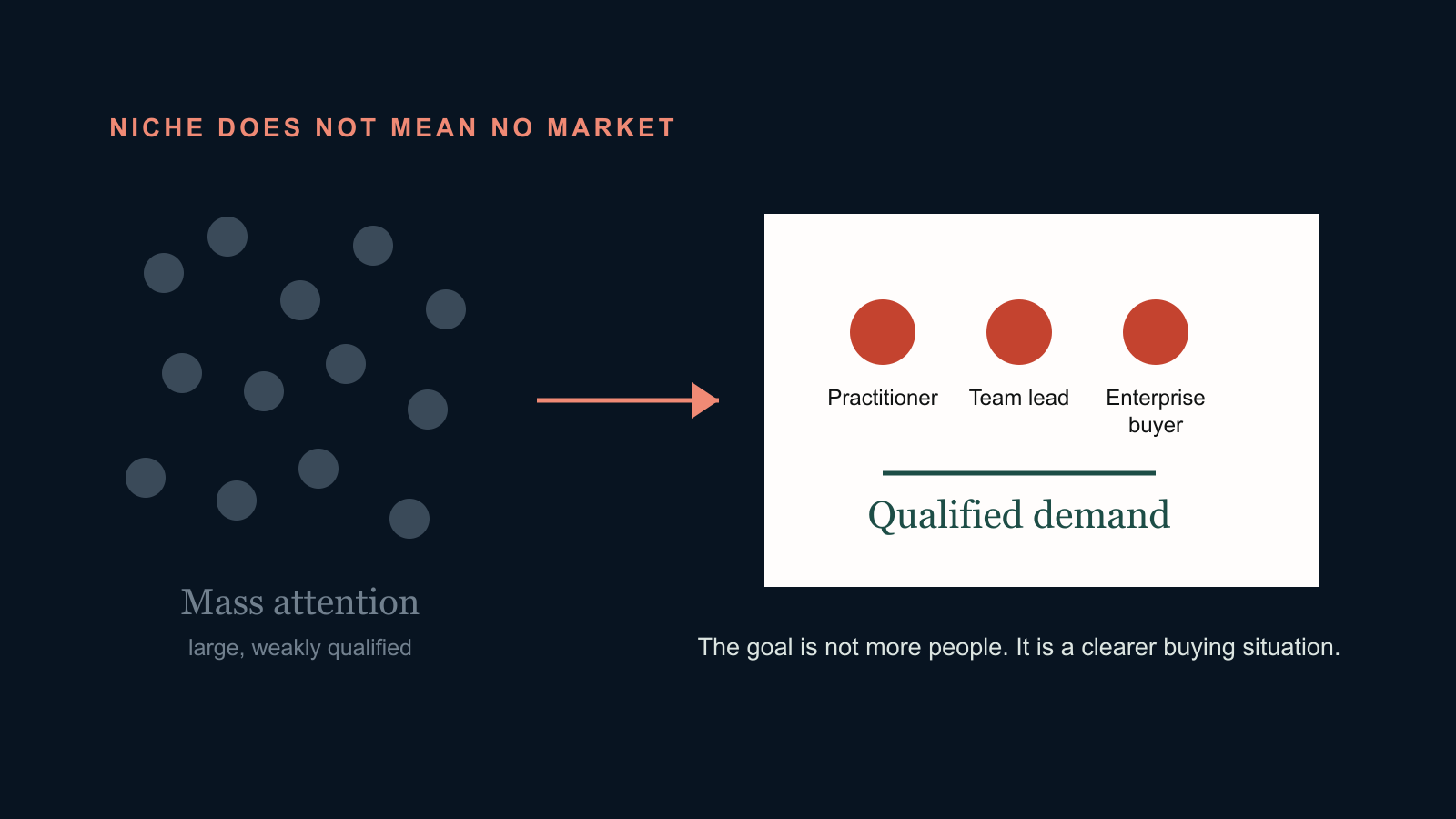
A niche expert can publish into China, receive more views than expected, and still learn almost nothing about whether the right people were present.
The opposite can happen too. A narrowly framed piece may reach very few people, yet the test may be too narrow to reveal whether the problem exists beyond one professional circle.
So the useful decision is not simply “broad reach or niche reach.” It is:
Should the next test increase market coverage, or increase the density of plausible buyers inside the audience already reached?
Coverage tells you how widely a question travelled. Buyer density asks what proportion of the reached audience plausibly occupies the role, faces the trigger, and could accept the next step the expert is prepared to offer. Neither number proves demand. But choosing between them prevents a specialist from treating “more exposure” as the automatic cure for an unclear market test.
This is an illustrative framework. It does not describe a client engagement, a verified China audience, or a commercial result.
Coverage and density answer different questions
Suppose an expert teaches a specialist method for reducing errors in regulated manufacturing handoffs.
A broad post titled “Five Ways to Prevent Expensive Team Mistakes” may travel across general management audiences. That increases coverage. It can reveal whether the broad problem language is understandable, but it may contain few people who manage the relevant handoff.
A narrower post might address quality leaders preparing a supplier transition and describe one specific review failure. It may reach fewer people, but more of those readers could plausibly evaluate a diagnostic, briefing, or workshop. That increases buyer density.
The two tests are not competitors forever. They are different moves at different moments.
- Increase coverage when you do not yet know where the problem appears, which language travels, or which adjacent role may care.
- Increase buyer density when broad exposure is no longer making the buying situation more specific.
The mistake is repeating the same move after it has stopped answering a question.
Use a coverage-versus-density choice table
Before planning the next piece, event, or outreach test, identify the missing variable.
| Current evidence | What is still unclear? | Better next move | What not to conclude |
|---|---|---|---|
| Low coverage, buyer role still speculative | whether the problem language travels beyond a tiny circle | broaden the problem framing or test one adjacent role | that low reach proves no demand |
| Broad coverage, mostly general-interest audience | whether plausible buyers recognize the work situation | narrow the role, trigger, and proposed next step | that popularity proves buyer fit |
| Narrow coverage, several plausible buyers | whether the pattern extends beyond one network | repeat the same bounded question in a second context | that a few relevant contacts prove market size |
| Broad coverage, repeated role-specific questions | whether a defined next step is acceptable | test one concrete next step with clear boundaries | that questions equal purchase intent |
| High exposure, no increase in specificity | whether the topic is too generic to qualify anyone | stop buying or chasing more exposure; redesign the question | that the platform itself failed |
This is a decision aid, not a scoring model. There is no universal percentage at which an audience becomes “dense enough.” A specialist enterprise topic and a consumer learning product have different tolerances, buying paths, and evidence needs.
When more coverage is still the right move
Coverage is useful early when the expert’s initial buyer hypothesis is too confident.
Imagine a researcher who assumes that only learning-and-development managers would care about a method for reviewing AI-generated work. A wider content test may reveal serious questions from compliance teams, consulting leads, or technical managers. If the expert had narrowed immediately to one job title, the test could have hidden a better use case.
Coverage is also useful when the vocabulary itself is untested. A translated category name may make sense to the expert and fail to match how Chinese practitioners describe the problem. A broader exploratory round can compare problem language before a buyer segment is frozen.
Zhihu’s official Knowledge Plan manual documents a platform-specific knowledge and publishing environment.1 That source can support only a narrow point: the surface has its own operating context. It does not prove that publishing there provides representative coverage, that a topic has demand, or that readers are buyers.
Similarly, Douyin E-commerce’s learning centre separates content, live-operation, and other operating activities.2 This reminds us that “reach” may be produced by different activities with different jobs. It does not prove that any activity will deliver qualified buyers, eligibility, or sales.
Broader coverage is therefore a research choice, not a growth claim.
When to stop pursuing more exposure
More exposure has stopped being useful when it changes the top-line count but not the decision.
Three warning signs matter.
1. The same vague audience description survives every round
If the audience is still “professionals interested in leadership” after several posts, additional reach may only enlarge an undefined group. The next test should name a narrower role and a work situation.
2. The problem remains detached from an action trigger
People may agree that communication, AI governance, or team alignment matters. A plausible buyer appears only when the issue is linked to an event that makes action reasonable: a supplier transition, a new system rollout, a failed audit, a cohort launch, or a repeated escalation.
The trigger does not prove budget. It makes the timing hypothesis visible.
3. The next step is unacceptable or invisible
An audience can include the right roles and still be commercially unusable if the only proposed next step is “buy my full programme.” A first step may need to be a diagnostic call, a sample workflow review, a team briefing, or another bounded object.
If readers cannot tell what agreeing to the next step entails, more impressions will not repair the offer.
At that point, stop asking the platform for a larger audience. Ask the offer to become more specific.
Increase density with three constraints
Higher buyer density does not mean hiding content from everyone except executives. It means making three aspects sufficiently specific that irrelevant attention is less likely to dominate the test.
Name a narrower role
Replace “business leaders” with a role close enough to recognize the workflow: a quality lead managing a supplier change, a training manager scoping an internal AI programme, or a product educator adapting a cohort for a new language environment.
The role is a hypothesis. Avoid implying that every person with that title has the problem or authority to buy.
Name an action trigger
Describe the event that changes the problem from interesting to current. “Your team wants better communication” is weak. “A new cross-border operating process keeps failing at the same approval handoff” is testable.
The trigger should be observable without inventing urgency.
Offer an acceptable next step
Ask whether the person could reasonably evaluate a bounded next move. That might be reviewing a one-page diagnostic output, joining a short working session, or sharing the minimum information needed to assess fit.
An acceptable next step is not a hidden commitment to purchase a large localization project. It should be easy to decline and clear about what happens next.
For defining the role, problem, alternative, and delivery route separately, use the Buyer–Problem–Alternative–Delivery Worksheet. This article makes a prior decision: whether the next test needs more people or a more concentrated set of plausible buyers.
An illustrative scene: the same expert, two next moves
An overseas instructor teaches a detailed method for incident review in software teams. The first China-facing article explains why postmortems should not become blame exercises. It receives broad interest from developers, students, founders, and general technology readers.
The instructor now has two choices.
Choice one is another broadly accessible article promoted to a larger audience. That would be sensible if the instructor still needs to discover which professional roles connect the principle to a costly workflow.
Choice two is a narrower piece for engineering managers preparing to standardize incident reviews across teams, ending with an invitation to inspect a sample review template. That would be sensible if broad interest has already shown the language is understandable and the missing question is whether plausible buyers accept the proposed next step.
Neither choice is inherently more professional. The evidence gap chooses the move.
The China Course Offer Legibility article provides a separate check for whether a buyer can tell what is being offered. Once the offer is legible, coverage-versus-density determines where the next audience test should concentrate.
A counterexample: density can become a comfortable illusion
An expert may speak with five highly relevant people from one existing partner network and conclude that broad research is unnecessary. That audience appears dense because it was preselected. It may share the same employer type, professional assumptions, or relationship with the introducer.
In this case, increasing density again would add little. The next responsible move is controlled coverage: repeat the same question in a second context without changing the offer, then compare whether the same role, trigger, and acceptable next step appear.
Density is not representativeness. A perfectly concentrated room can still be the wrong room.
Keep platform facts narrow
Xiaohongshu’s official business help page describes a platform-specific business environment.3 It does not establish that an overseas specialist can operate a particular account, open a store, sell training, or reach a professional buyer. Those require separate checks.
This distinction matters because platform capability is frequently smuggled into audience conclusions. “The platform supports an activity” and “our plausible buyers are there in useful concentration” are entirely different claims.
For a broader look at separating public topic attention from evidence of a buying situation, read When Topic Popularity Is Not Buyer Demand. The current framework does not grade individual comments or infer demand from them. It decides which audience variable the next test should change.
What this framework cannot prove
Coverage and buyer density cannot establish market size, purchase intent, price acceptance, platform eligibility, procurement authority, localization rights, or commercial success. They also cannot tell you whether one channel represents China as a whole.
The framework does one smaller job: it stops a niche expert from reaching for a bigger audience when the real problem is that the current audience contains too few people who can evaluate the work—and it stops the expert from over-narrowing when the first buyer hypothesis still needs broader discovery.
Make the next test change one variable
Complete this sentence before commissioning more content or promotion:
“The next test will increase —coverage or plausible-buyer density—because the unanswered question is .”
If both blanks keep changing, the test is trying to solve too much at once.
If you have China-facing attention but cannot decide whether to broaden the market test or narrow it toward plausible buyers, request a China validation discussion.
Sources and limits
-
Zhihu, Knowledge Plan manual, accessed 2026-08-24. Supports only that Zhihu documents a distinct knowledge/publishing environment; it does not establish coverage quality, demand, or buyer identity. ↩
-
Douyin E-commerce Learning Center, operations home, accessed 2026-08-24. Supports only the distinction among documented operating activities; it does not prove reach, eligibility, conversion, or product-market fit. ↩
-
Xiaohongshu School, official business help page, accessed 2026-08-24. Supports only that Xiaohongshu has platform-specific business guidance; it does not establish account access, buyer concentration, distribution eligibility, or results. ↩