
The last ten minutes of an AI-agent workshop often look excellent. A learner enters a prompt, the system returns a plausible answer, and a screenshot becomes the final assignment.
The same learner later tries the exercise with a different input or environment. Now nobody can say what happened. Which source was retrieved? Which instruction controlled the response? Was the path intended, or did the answer merely look good once?
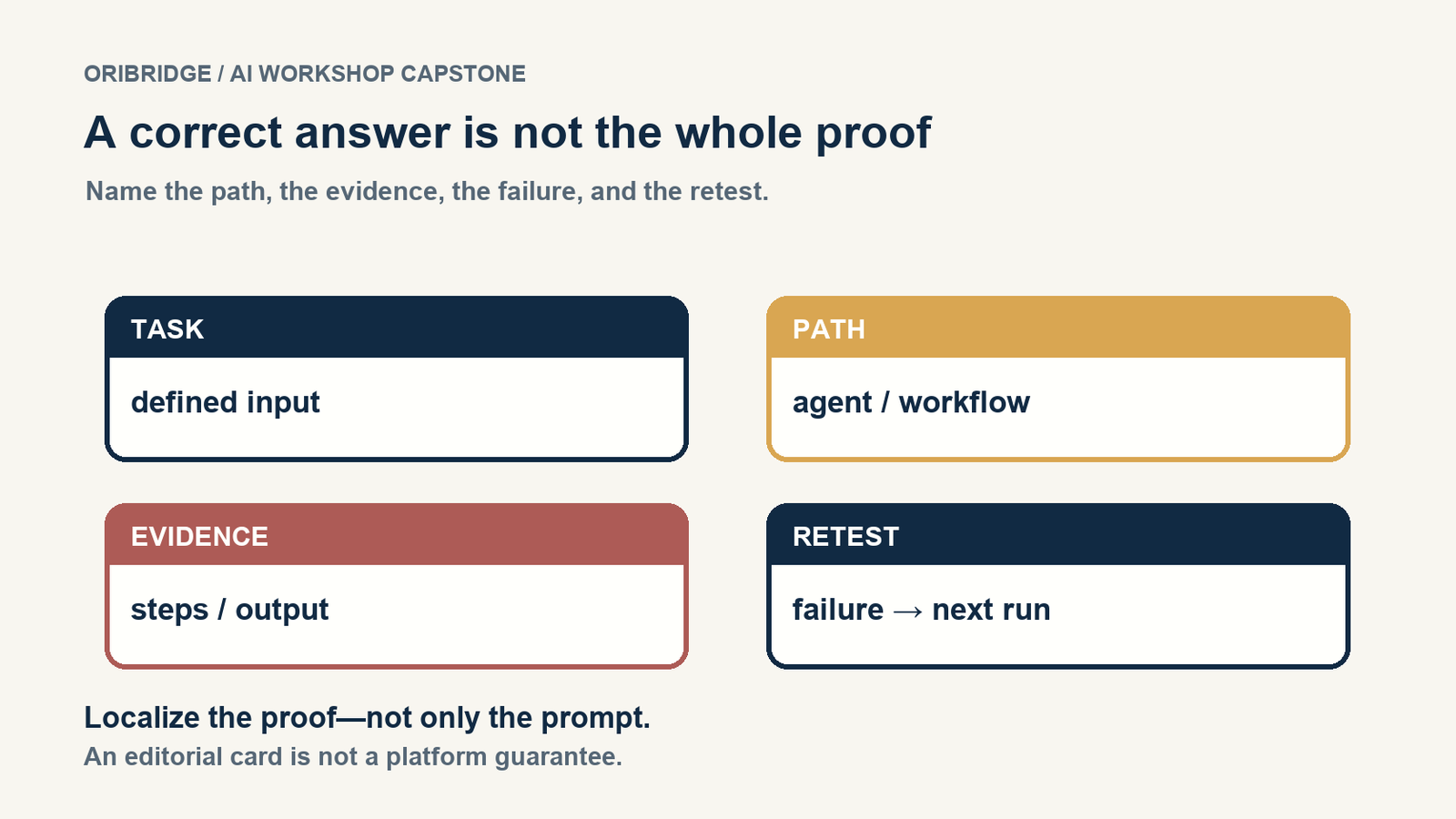
A China-facing AI-agent workshop is not ready because its prompts have been translated. It is ready for a bounded test when learners can name the task, inspect the workflow evidence available to them, recognise a failure condition, and know when to retest.
This is a course-design argument. It is not a claim that any Chinese platform is accessible, suitable, eligible, reliable, or commercially appropriate for a particular instructor or learner.
The final answer is not always the learning object
Many introductory AI workshops are designed around a satisfying moment: the model produces an answer that demonstrates an idea. That can be entirely appropriate for a first lesson.
It becomes weak as a capstone when the learner is meant to transfer the method to another task. A convincing answer may have used the wrong source, skipped an intended step, or behaved differently after a change in model, tool, data, or instruction. The learner needs a way to tell.
LangChain’s evaluation guidance provides a useful comparison: a team may assess a final response, a single step, or the trajectory of an application.1 These are different objects. The framework does not prescribe a China course design, but it makes one editorial point clear: “the answer looks right” is not a complete evaluation plan.
Moving a workshop exposes hidden design choices
In a familiar English course, a screenshot can hide a great deal. It might hide whether the exercise relied on a particular tool, a preloaded knowledge source, an access permission, a chain of prompts, or an instructor’s intervention.
When that course is adapted for another operating environment, those hidden choices become visible. Replacing every screenshot first is often wasted effort. The first job is to identify what the workshop honestly promises a learner will be able to do and what they will be able to inspect.
Alibaba Cloud Model Studio documentation distinguishes agent, workflow, and high-code application construction modes.2 The documentation does not say which mode an overseas course should choose. Its narrow value is that different construction paths exist, and different paths make different things visible. A lesson that teaches a controlled sequence should not quietly become a lesson about autonomous decisions without changing its learning evidence.
Rewrite the capstone as an evaluation path
Start with one task, not one fashionable label. “Build an agent for customer research” cannot be evaluated until the learner knows what inputs are allowed, what output is expected, and which failure matters.
Use a bounded task instead:
Given five approved product descriptions and one buyer question, produce a comparison memo that cites the supplied descriptions and flags missing evidence.
Now an instructor can inspect the task. The learner can tell whether the answer used an approved source, whether it invented a feature, and what happened when a required input was missing.
Then define four parts of the capstone.
1. Construction path
Record whether the exercise uses an agent, a predefined workflow, or a code-led application. If the original course teaches one path and the China-facing version uses another, say so openly. The difference changes the learner’s observable actions and the instructor’s assessment method.
2. Observable evidence
Ask for more than a final answer. Depending on what the selected environment actually exposes, the evidence may include a versioned input set, expected behaviour for a known case, key workflow steps, cited sources, a refusal or clarification response, and date/version of a retest.
Do not ask learners to submit evidence that the environment does not expose. If a critical step cannot be inspected, remove that step from the learning promise or redesign the exercise.
3. Failure condition
Write one result that should trigger investigation rather than applause. For the comparison-memo task, that could be a citation outside the supplied material, an invented feature, a confident response with a missing required field, or a materially changed result after a version change without explanation.
The point is not to create a universal safety threshold. It is to give the learner an honest reason to look again.
4. Retest trigger
Name the change that requires the exercise to be run again: an altered model, prompt, knowledge source, workflow step, permission, or output requirement. A course update notice is not itself a retest record; see the reproducibility record for an MCP lesson for the adjacent environment-and-evidence problem.
The Capstone Evaluation Card
This is an OriBridge editorial device, not an Alibaba Cloud template, a platform requirement, or a certification criterion.
| Card field | Question |
|---|---|
| Target task | What one job is the learner trying to complete? |
| Construction path | Agent, workflow, or code-led application? |
| Input boundary | Which inputs, versions, and permissions are in scope? |
| Expected behaviour | What should happen on a normal and boundary case? |
| Observable evidence | Which outputs, steps, sources, or refusals can be inspected? |
| Failure signal | What result requires investigation? |
| Retest trigger | What change makes the old result stale? |
Alibaba Cloud’s documented automatic-evaluation flow includes creating an evaluation task, setting an evaluation set and rules, and executing the evaluation, subject to the page’s prerequisites.2 It does not prove a learner can access the service or that a workshop will work. It is a useful narrow signal that evaluation needs a defined object, inputs, rules, and an execution point.
A concrete redesign
Imagine an English workshop that asks learners to create an agent summarising customer interviews. The original assessment says: submit a clear summary.
In a China-facing pilot, the instructor retains the learning goal but changes the capstone. Learners receive a fixed anonymised input set. They label the construction path, identify the source behind each key claim, and run one boundary case with a required field removed. If the system silently fills the gap rather than asking for clarification, that is the result the group discusses.
This does not prove production reliability. It proves something smaller and teachable: the learner can distinguish a plausible answer from a workflow whose behaviour has been examined.
More evaluation machinery does not automatically create more expertise. The useful question is where a practitioner must still make a consequential judgment that a generic output cannot carry. See What Expertise Is Worth in the AI Age for that wider decision.
When not to add this machinery
Do not attach a heavy evaluation card to a one-hour exploration session whose honest promise is simply to let people try an AI tool. Do not force an agent/workflow comparison when the outcome is creative ideation rather than a decision-critical process. And do not turn an evaluation worksheet into a claim of safety, legal compliance, data-protection compliance, commercial demand, or learning impact.
Use the course dependency and terminology inventory before this step when the problem is still which tools, terms, screenshots, and dependencies the course contains. Use the localization readiness checklist when the broader course is not yet ready for an adaptation decision.
What this article cannot prove
It cannot prove Alibaba Cloud Model Studio—or any other tool—is accessible to a particular creator or learner. It cannot prove eligibility, price, performance, legal compliance, data protection, demand, revenue, or learning outcomes. Adding an evaluation card cannot make an AI application reliable.
It gives a course team a sharper question: what exactly did the learner test, what evidence could they inspect, and what would make them run it again?
That is a better adaptation target than surface similarity. A China-facing course can retain its intellectual aim while honestly changing screenshots, tools, or paths—provided the learner’s evidence and the limits of the exercise remain visible.
It also gives facilitators a fairer way to assess learners. Instead of rewarding whichever person found the most polished prompt, the instructor can ask whether the learner named the task boundary, preserved an inspectable input, recognised a failure, and described the next retest. Those are transferable habits even when the surrounding tool changes.
Next step: identify the existing capstone’s task, evidence, failure signal, and retest trigger. If you need a bounded China-fit review of an AI course, request a validation review.
Sources and limits
-
LangChain, Application-specific evaluation approaches, rechecked 2026-08-24. Used as an overseas comparison for distinct evaluation targets. ↩
-
Alibaba Cloud Model Studio, Application types and Automatic evaluation, rechecked 2026-08-24. Used only for their documented construction-mode distinction and evaluation sequence; not as evidence of access, eligibility, performance, suitability, or outcomes. ↩↩