
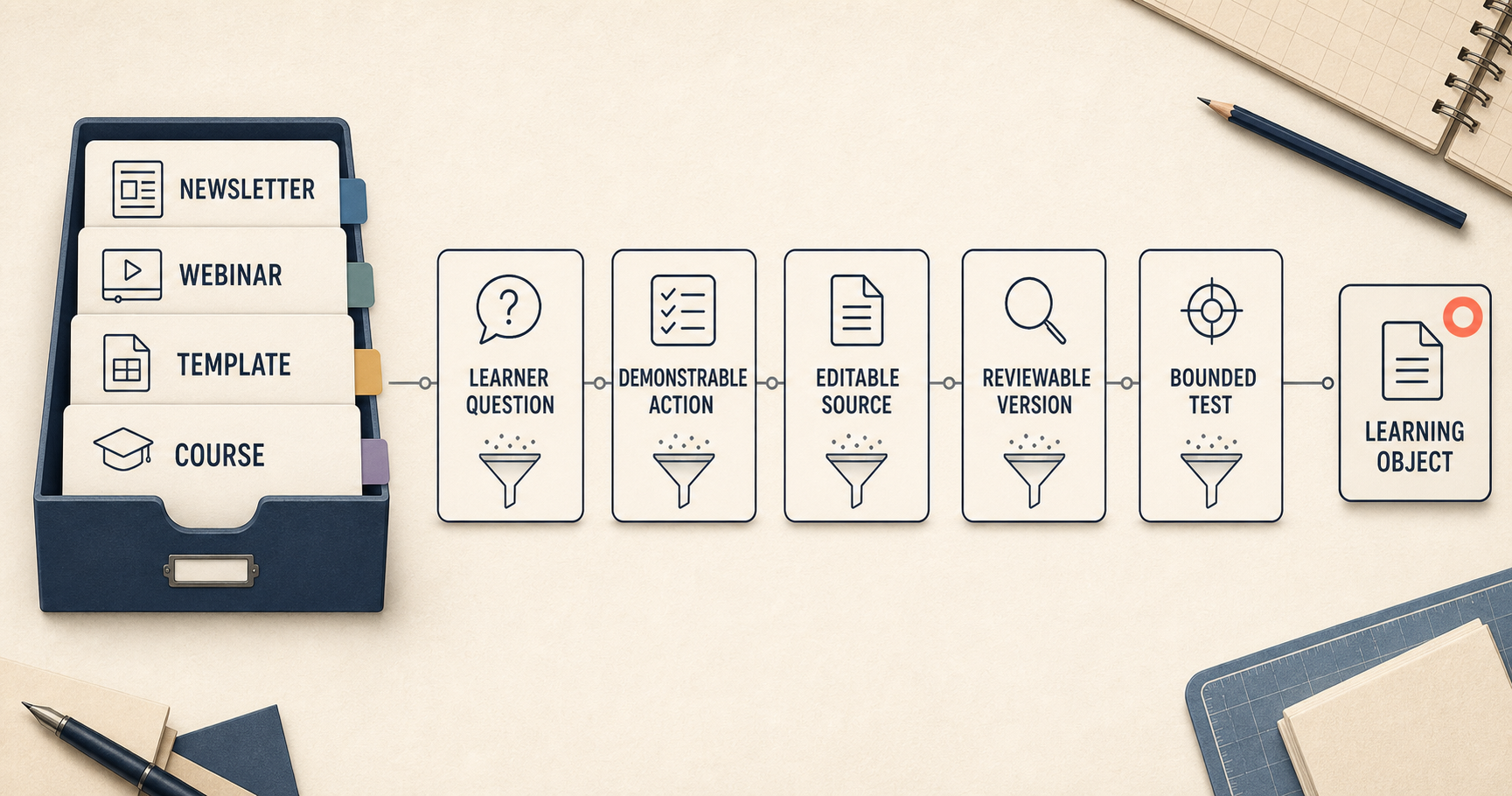
An expert with a substantial archive faces a flattering but dangerous question: “Which of your 80 newsletters, 10 webinars, templates and full course should we translate for China?”
The obvious answer is often the wrong one. The most-viewed webinar may rely on a screen recording that cannot be updated. The most popular newsletter may be a useful opinion piece but contain no action a learner can practise. The flagship course may be valuable, yet too large to make a first test interpretable.
Start smaller. Select one learning object: a bounded piece of content that helps a defined person attempt one recognisable action, with a source you can edit and a version you can review. It might be a 12-minute lesson, a worksheet plus a short explanation, a small cohort exercise, or one section of a webinar. It is not simply “the content we already have.”
The aim is to choose the first asset worth examining honestly, not declare it China-ready.
The five filters
Put candidate assets through five filters in this order. A candidate does not need to be perfect. It must be clear enough that a team can see what to fix and what not to promise.
Filter 1: is there a learner question, not merely a topic?
Topics are broad: AI strategy, leadership, productivity, design systems. A learning object starts with a person trying to decide or do something.
Compare these two candidate descriptions:
- “A webinar about AI research.”
- “A 20-minute segment that teaches an operations lead how to identify where a generated market summary needs a source check.”
The second description gives an editor a learner, an action and a boundary. The first names a subject but not a job.
This matters because course information itself is made of distinct fields. Bilibili Classroom’s course-content guidance separates learning goals, suitable audience, highlights, outline consistency, video/subtitles and validity period. That page does not tell anyone what an overseas expert should teach or whether a course will sell. It does, however, illustrate a practical discipline: audience and learning goal are not decorative metadata added after the content choice. They are separate decisions.
If you cannot complete this sentence—“After this asset, the learner can attempt ______”—do not choose it first.
Filter 2: can the asset show an action, a judgment or a failure mode?
A learning object needs more than a good explanation. It should give the learner a chance to observe or attempt something: compare two source records, identify an assumption in a workflow, revise a claim, prepare a brief, or decide when to stop.
This is where a newsletter can still win. A concise newsletter that walks through a real decision may be more teachable than a polished keynote that only inspires. Equally, a webinar clip can lose if the useful logic is trapped in an hour of context and no transcript, worksheet or example can be separated.
Ask three questions:
- What does the learner see or make?
- What would a plausible mistake look like?
- How would a reviewer tell the difference between a completed click-path and a considered judgment?
If every answer is “watch the expert talk,” the asset may be a marketing or thought-leadership asset, not the first learning object.
Filter 3: do you have an editable source, not just a polished output?
A video can play perfectly and still be a poor first choice. Perhaps it contains burned-in captions, an outdated tool interface, an example that cannot be reused, or a claim that must be updated. If the team cannot find the transcript, slides, worksheets, recordings or source files, adaptation becomes guesswork.
Tencent Cloud’s Media Processing documentation distinguishes operations such as subtitles, terminology or hot words, summaries, tags and clipping. That distinction does not prescribe an editorial workflow, but it is a useful warning: a finished media file is not one simple, editable thing. The material needed to change spoken language, text on screen, a clip boundary and a learning task may be different.
Choose candidates where the answer to “what can we safely edit?” is known. A rough, well-documented workshop segment can be a better first object than a beautiful video with no source trail.
Filter 4: can this version be reviewed without reconstructing history?
The selected object needs a reference version: title, date, owner, source materials and a note of what may change. Otherwise, a team cannot tell whether the adapted piece is still teaching the intended method or has gradually become another product.
This does not require a complex content-management system. A one-page record is enough:
| Record | What to capture |
|---|---|
| Original asset | Link or file reference, owner and version date |
| Learner job | The one action or judgment the object is designed to support |
| Editable inputs | Transcript, slides, worksheet, screen sources or template |
| Change boundary | What may change; what needs separate approval |
| Review evidence | Who checks the version, and what they compare it against |
Xiaoe-Tech’s merchant guidance separately presents content, users, feedback, orders and channels. That does not prove that any workflow is right for a given creator. It does reinforce the useful habit of separating a content version from user feedback, distribution and commercial records. An asset’s version record should not be inferred from a sales page, an order list or a comment thread.
Filter 5: can the first test stop cleanly?
The best first object has a bounded test. You can state the intended reader, the action, the available materials and the condition that would make the team stop or revise. A full archive translation usually fails this test because every problem becomes someone else’s future problem.
For a first object, a sensible stop condition might be: “If the selected lesson cannot be edited without changing an unapproved example, we do not expand it.” Or: “If the learner task cannot be understood without live support, we rewrite the task before choosing a second asset.”
The stop condition is not a prediction of demand. It is a boundary on work. That is what makes the test useful.
A selection exercise for a real archive
Take three assets from the archive and score them only with words—green, yellow or red—against the five filters. Avoid a false precision score like 8.3 out of 10. The discussion is more valuable than the number.
| Candidate | Learner question | Demonstrable action | Editable source | Reviewable version | Bounded test |
|---|---|---|---|---|---|
| Popular newsletter | Yellow: useful theme, unclear job | Red: mostly opinion | Green: editable text | Green | Yellow |
| Recorded webinar | Green: a concrete workflow question | Yellow: action buried in long session | Yellow: transcript available, screens uncertain | Yellow | Green: isolate one segment |
| Full flagship course | Green | Green | Yellow: many assets and dependencies | Yellow | Red: too much scope for first test |
In this constructed comparison, the webinar segment may be the right first object—not because webinars are superior, but because the team can isolate one task, obtain the source materials and set a stop condition. The newsletter may later become a public explanation. The full course may remain the strategic asset, but not the first thing to localize.
This is a constructed example, not a claim about a client, platform, audience or revenue result.
Do not let popularity select the curriculum
Creators understandably look at views, subscriptions, shares or sales history. Those signals can help identify material worth inspecting. They should not decide the first learning object alone.
High reach may reflect a broad idea that cannot be practised. A short template with low historic traffic may be ideal because it exposes a precise judgment and can be edited safely. The guide therefore privileges reversibility: can you test this without quietly committing to whole-library translation, a new delivery promise or a permanent platform decision?
The back catalog may be your hidden asset is relevant here, but archive value is only a starting point. A product portability audit helps separate the asset from its delivery assumptions. The purpose is not to turn every past publication into a course.
The counterexample: start from a buyer-defined scope
There is one important case where the five-filter exercise should not lead. If a known buyer has already provided a clear, permissioned scope with a defined outcome, start from that scope. The relevant question is then which existing material supports the agreed learning job—not which asset is easiest to repurpose.
For example, a buyer may ask for a workshop on a specific operational decision. An old webinar with excellent archive metrics may be irrelevant; a small internal template may be the stronger input. The selection guide still helps compare assets, but it must follow the buyer’s defined problem.
Likewise, an asset that is easy to edit is not automatically authorised for translation, publication or distribution. Rights, names, screenshots and proprietary examples remain separate checks.
Choose one object, then keep the promise small
Once a candidate passes the filters, write a one-paragraph selection note:
We are selecting [asset] for [defined learner] to attempt [one action or judgment]. The editable inputs are [sources]. The first review will check [bounded evidence]. We will stop or revise if [condition]. This selection does not establish [demand, access, rights or sales].
That paragraph is more useful than a long content inventory because it gives everyone the same object to inspect. It also makes it easier to choose the appropriate format: a self-paced lesson, a small cohort exercise, a workshop or advisory material. Those forms make different promises; see self-paced course, cohort, workshop and advisory before treating them as interchangeable containers.
The durable conclusion is simple: do not start with the largest asset or the loudest metric; start with the smallest asset that can teach one real action and survive an honest review.
If you want to select and test one bounded learning object before committing a larger expert archive to China adaptation, request a China validation review.
Sources and evidence boundary
- Tencent Cloud Media Processing product functions, checked 2026-08-24. It distinguishes media-processing capabilities such as subtitles, terminology/hot words, summaries, tags and clipping; it does not prove that an asset can be adapted or published.
- Xiaoe-Tech merchant instructions, checked 2026-08-24. It separates content, users, feedback, orders and channels as management surfaces; it does not prescribe an overseas creator’s workflow or establish account access.
- Bilibili Classroom course-content guidance, checked 2026-08-24. It lists separate course-information fields; it does not establish demand, approval or learning outcomes.
- Zhihu commercial-content preparation handbook, checked 2026-08-24. This older handbook is used only as a field-structure reference for audience and discussion context, not as a current platform or market claim.