
An overseas education expert is asked to adapt an AI course for China. The first draft has one audience label: “teachers and education leaders.” It has one sequence of lessons, one set of exercises and one outcome statement about using AI responsibly.
That draft may be well intentioned and still be too broad. Chinese government teacher-development documents describe several roles and capability-building contexts. The Ministry of Education’s digital empowerment action discusses teacher digital literacy, national training channels and AI-focused training for teachers and school leaders. The “AI+Education” action plan also refers to training, standards, evaluation and differentiated capability building.
These documents are policy signals, not a purchase order for one foreign course. Their practical value is that they warn an expert to map the role before adapting the curriculum.
The word “teacher” hides several decisions
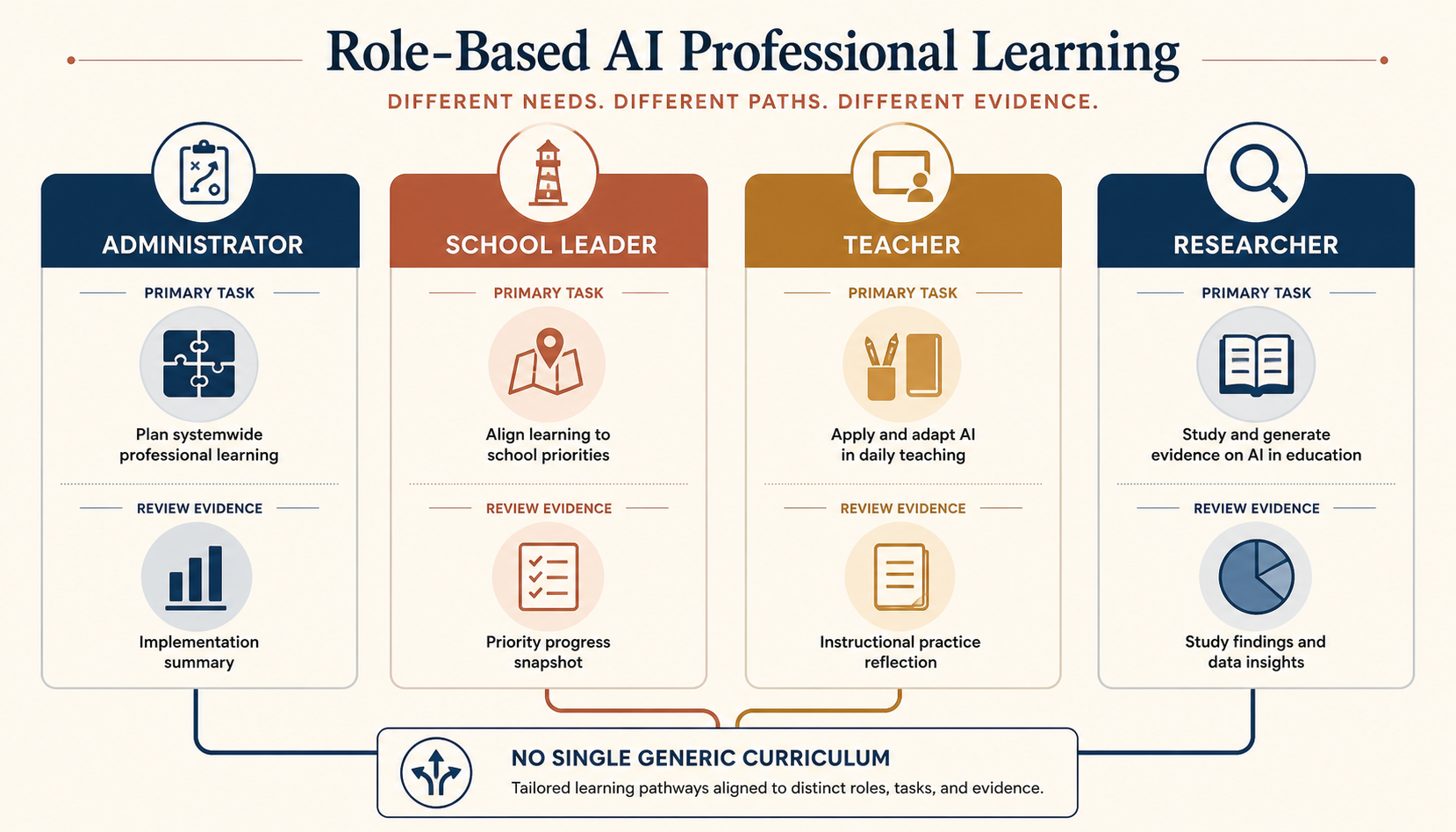
An education administrator may need to decide how an institution sets priorities, supports staff and evaluates a programme. A school leader may need to organise a local implementation plan. A classroom teacher may need to design or review an activity. A researcher or trainer may need to compare practices and develop guidance.
Those roles can discuss the same technology and still require different work. A generic lecture about prompt writing may be too operational for a policy audience and too abstract for a classroom teacher. A lesson about school-wide governance may be useful to a leader but irrelevant to a teacher who needs to create and review a specific learning activity.
The policy pages do not tell an overseas expert which role is present in a particular buyer conversation. They do justify asking the question before translating a curriculum.
Read policy as a role map, not a syllabus
The Ministry of Education’s teacher-development action places digital literacy and AI-related training inside a broader teacher-development system. The AI+Education action plan describes education, training, application innovation, standards and support as connected areas, and mentions differentiated capability development.
An expert can use those documents to create a scoping table:
| Role | Decision or work task | Possible evidence of learning |
|---|---|---|
| Education administrator | Choose a capability priority and define institutional constraints | A short priority memo with stated assumptions |
| School leader | Design a bounded implementation or support plan | A role/responsibility map and review checkpoint |
| Teacher | Build or review one AI-supported learning activity | An annotated activity and limitation note |
| Trainer/researcher | Compare practices and formulate guidance | A source-backed comparison with uncertainty marked |
The table is an internal design aid, not a government taxonomy or a claim that all buyers use these labels. Its purpose is to stop the curriculum from treating every participant as the same learner.
A concrete scene: one workshop, four wrong outcomes
Imagine a two-hour workshop titled “Use Generative AI in Education”. The organiser invites a principal, a curriculum researcher and classroom teachers. The instructor demonstrates a chatbot, asks everyone to write a prompt and ends with a general discussion about ethics.
At the end, the principal wants a school plan, the researcher wants a comparison framework, and the teachers want a classroom activity they can inspect. Nobody is necessarily dissatisfied with the demonstration. The problem is that the workshop never chose a work product.
A role map would expose the collision before delivery. The organiser could split the session, choose one primary role, or state that the event is an orientation rather than a skills workshop. The example is a constructed planning scene, not a reported customer result.
What the policy evidence supports
It supports saying that Chinese education policy documents are treating AI capability, teacher development and education application as distinct planning concerns. It supports researching what a role-specific training offer would need to explain and what evidence a reviewer might request.
It does not support saying that every teacher needs the expert’s course. It does not establish an open procurement, a platform route, a standard curriculum, permission to use a particular policy phrase, or a learner outcome. It does not tell an overseas expert whether their examples, tools or assessment method fit a specific institution.
This source boundary should appear in the brief before the curriculum is translated. Otherwise a broad policy sentence becomes an unspoken sales claim.
Role-specific does not mean four separate businesses
An expert does not always need four complete products. A common conceptual core can remain shared, while the work task, examples and review artifact change by role. One course might have a short common foundation and four optional paths. Another might choose one role for a small test.
The decision depends on what is being promised. If the promise is “understand the language and limits of generative AI,” a common orientation may be reasonable. If the promise is “design a school implementation plan,” the audience and artifact must be narrower. If the promise is “build a classroom activity,” a leader-focused policy lecture cannot be the only evidence.
A counterexample: when a generic orientation is correct
There are situations where a mixed audience needs a shared orientation. A conference session may only aim to establish vocabulary, risks and questions for later work. It should be labelled as orientation, not as a role-specific capability programme.
Likewise, a private internal briefing may not need a complete assessment. The point is not to force every event into a multi-track curriculum. It is to make the intended work and limits visible.
The offer-review checklist
Before an overseas expert proposes AI teacher training for China, ask:
- Who is the primary role, and who is only an adjacent audience?
- What decision or work should that role complete?
- Which examples are local context, and which are generic?
- What is the review artifact?
- What does the policy source suggest, and what does it not establish?
- Is this orientation, skills training, institutional planning or research support?
If the answers are missing, do not solve the uncertainty with more translated slides. First clarify the role and work.
The sentence worth carrying forward is: policy can show that capability is being organised; it cannot choose your learner for you.
If you are deciding whether an existing education product needs role-specific China adaptation, request a China validation review. Bring the original learner promise and the role map as separate inputs.
Related reading
Sources and evidence boundary
- Ministry of Education: Digital empowerment for teacher development action, checked 2026-08-23. Describes teacher digital-literacy and AI training directions; does not establish a specific buyer, course or result.
- Ministry of Education: AI+Education action plan, checked 2026-08-23. Describes training, standards and capability-building directions; does not establish procurement or overseas eligibility.
Image brief: A role map connecting education administrators, school leaders, teachers and researchers to distinct AI training tasks and review evidence. Use neutral classroom/workflow shapes, no institutional logos, rankings or outcome claims. Alt text: “Different education roles mapped to different AI training tasks and review evidence.”