
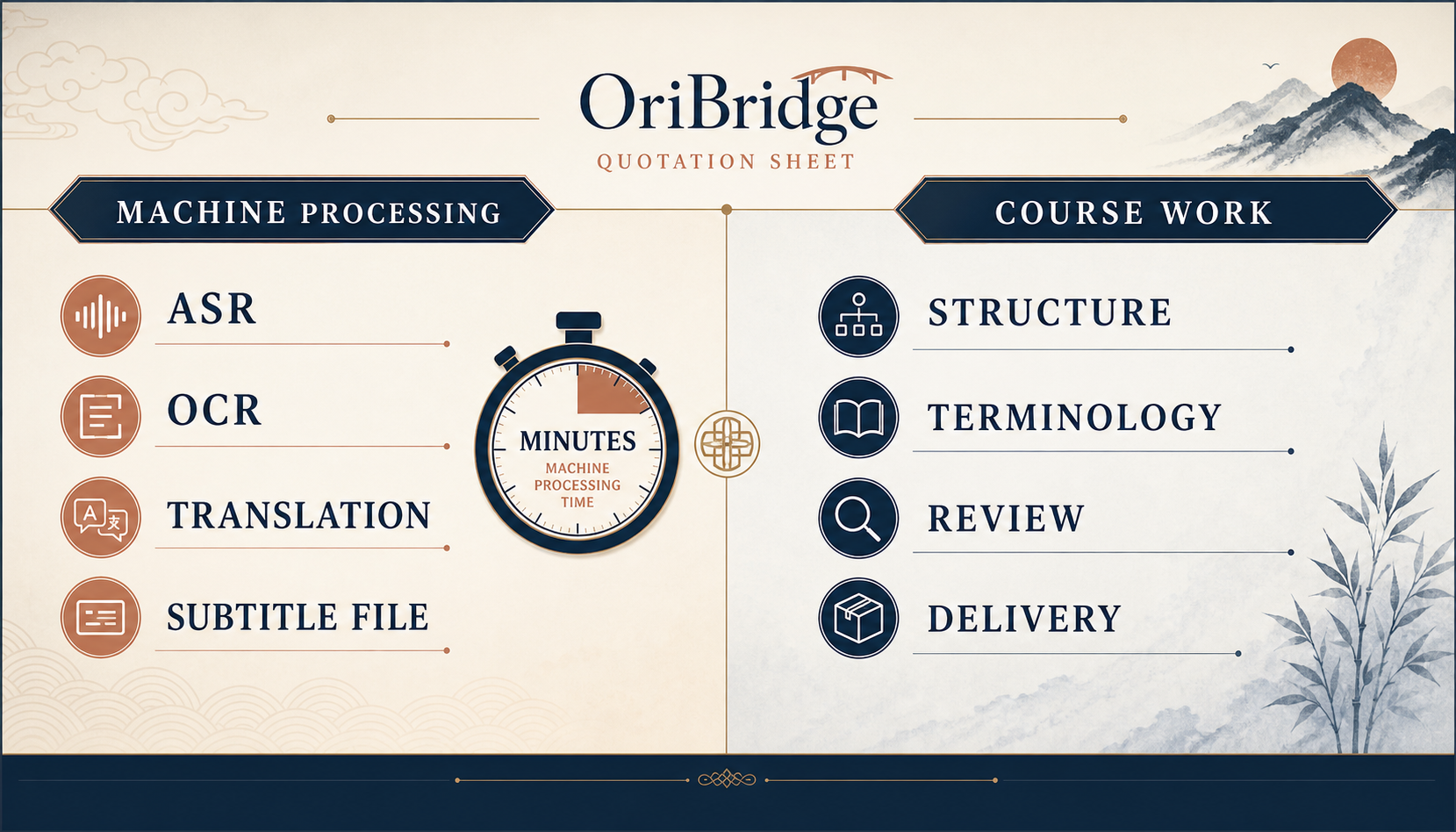
The calculation looks reassuring. A course is 90 minutes long. A media service publishes a per-minute charge for speech recognition or subtitle translation. Multiply the two numbers, add a small margin, and call the result a China localization quote.
That calculation prices a processing unit. It does not describe the work required to make an expert course understandable, reviewable and deliverable in Chinese. A machine can process minutes while a course still lacks a clear overview, stable terminology, coherent exercise instructions or an agreed review boundary.
Start by naming the asset
“Video localization” can mean several different things:
- an internal transcript for a private review;
- a Chinese subtitle file attached to an existing recording;
- translated and edited captions for public video;
- a course whose overview, directory and exercises are also localized;
- a release package with multiple formats, review rounds and delivery records.
The duration is relevant to all five, but it does not make them the same job. Before reading a processing table, write what the client will receive and what they will not receive.
Tencent Cloud’s intelligent subtitle documentation separates ASR, OCR, subtitle translation, terminology libraries, subtitle files and burned-in subtitles as different options with different prerequisites. Its media-AI integration documentation also describes captioning, dubbing, video translation, summaries and clipping as distinct paths. This supports a narrow operational conclusion: a media pipeline contains different processing choices. It does not turn any one choice into a complete course-localization service.
What the minute can measure
A processing minute can be a useful unit for the work the service actually performs. It may help estimate the number of minutes sent through speech recognition, subtitle translation or another configured media function. A public pay-as-you-go page can separate processing items by function and duration.
That unit is useful only when the request matches it. If the client needs a subtitle file from a clean, single-speaker recording and no editorial review, duration may be a meaningful input to a narrow technical estimate. The quote should still state the source format, language pair, terminology assumptions, output file and review limits.
The minute cannot measure whether the course title makes sense, whether a Chinese learner understands a prerequisite, whether an exercise has to be rewritten, or whether a rights holder approved the translated asset. Those are not hidden decimals in the processing price. They are different work units.
The four layers a course quote must separate
Processing
This layer covers configured machine operations: speech recognition, OCR, translation, subtitle generation or rendering. Record the source duration and format, the selected operation and its expected output. Do not call the machine output “final” if human review is not included.
Editorial and terminology
An expert course may use product names, technical verbs, role labels and repeated concepts that need a terminology decision. The editor may need to compare the subtitle with the transcript, preserve caveats, flag ambiguous phrases and keep the same term across lessons. A terminology library can support processing, but it does not decide the course’s learning promise.
Course structure
If the asset is meant to be found and compared as a course, the overview, intended learner, outcome, directory, lesson relationship and exercise instructions may need attention. A subtitle file cannot supply those objects. This layer can be small for a private replay and substantial for a public course; the quote must say which case it covers.
Review, delivery and rights boundary
Who reviews the Chinese output? How many rounds? Is the output a file, a platform upload package, a set of edited lessons or an internal handoff? May the translated material be displayed or distributed? These questions are not answered by a cloud billing page. They should be explicit in the scope and, where relevant, a separate authorization process.
A quote that hides the work
Imagine a team sends a 90-minute AI workshop recording and asks for “Chinese localization”. The quote says:
“90 minutes × subtitle processing rate = complete China-ready course.”
That sentence silently claims that the source audio is usable, the terminology is stable, the subtitles are accurate enough, the course structure is clear, the exercises need no change, the output can be delivered as intended, and the rights boundary is settled. The processing table supports none of those claims.
A bounded quote might instead say:
“Phase 1: process the supplied audio into a Chinese subtitle file using the selected media options. The estimate excludes course-page rewriting, exercise localization, terminology adjudication beyond the agreed list, platform upload, additional review rounds and rights clearance. Those items require a separate assessment.”
This is not evasive pricing. It is a truthful unit boundary.
Why “add a little editing” is not a scope
Editing is often added as a vague percentage because the team knows machine output needs review. That obscures the decision. Review may mean correcting names and punctuation. It may mean checking every caveat against the speaker. It may mean rewriting examples, splitting long captions, rebuilding a directory and testing whether a learner can follow the route.
Describe the review artifact instead. Is the editor returning a marked transcript, an approved subtitle file, a terminology list, a revised course overview or a delivery checklist? A quote can then tie effort to an observable output without pretending that every course has the same editing burden.
The counterexample: when the minute rate is enough
Suppose an internal team wants a searchable Chinese subtitle file for a private recording. The audio is clean, the output format is known, no course page will be published, and a single reviewer will check names. In that case, processing duration may be the main technical input. A narrow quote can be appropriate.
The important point is not that the minute rate is wrong. It is that the asset is narrow. Once the request includes public discovery, course restructuring, exercises, multiple review rounds or distribution, the minute becomes only one line in a broader scope.
What a public price page cannot establish
A public processing page may establish that certain functions are billed separately or that a service uses a duration-based unit. It cannot establish OriBridge’s price, a client’s budget, profitability, accuracy, platform access or whether an overseas expert can purchase and operate the service.
Do not turn a public rate into a market benchmark. Do not quote it as if it includes human work. Do not imply that a processing option clears copyright or distribution rights. Keep the source in the evidence file and write the commercial decision from the actual project scope.
The scope worksheet
Before preparing a quote, fill in these fields:
- Source asset and total duration.
- Machine operations requested.
- Source and target language.
- Terminology and named-entity requirements.
- Human review artifact and number of rounds.
- Course-page, directory or exercise changes, if any.
- Delivery format and destination.
- Authorization and distribution assumptions.
- Explicit exclusions and next decision.
If the only completed field is duration, the team has a processing estimate, not a localization quote.
The sentence worth carrying forward is: a caption minute rate prices a machine operation; it does not price the course work around it.
If you need to separate media processing from a China-facing course-localization scope, request a China validation review. Bring the source duration, intended asset and desired review artifact rather than a single per-minute assumption.
Related reading
- Course Dependency and Terminology Inventory
- Subtitles, AI Dubbing and Rerecording Are Different China Release Records
- A Workshop Quote Needs an Operating Layer in China
- A China-Facing Live Cohort, Room, Broadcast and Replay Are Different Assets
Sources and evidence boundary
- Tencent Cloud intelligent subtitle template, checked 2026-08-23. Describes ASR, OCR, translation, terminology, subtitle-file and burned-in options; does not establish accuracy, course suitability or rights.
- Tencent Cloud Media AI access, checked 2026-08-23. Describes captioning, dubbing, video translation, summaries and clipping as distinct processing paths; does not establish access, quality or complete course-localization scope.
- Tencent Cloud Media AI pay-as-you-go pricing, checked 2026-08-23. Describes separate processing-duration billing items; does not establish complete localization pricing, buyer budget or profitability.
Image brief: A quote sheet split into machine processing units and course editorial work: ASR, OCR, translation and subtitle file on one side; structure, terminology, review and delivery on the other. No currency, vendor price or savings claim. Alt text: “A video processing minute separated from the editorial and course work in a localization quote.”