
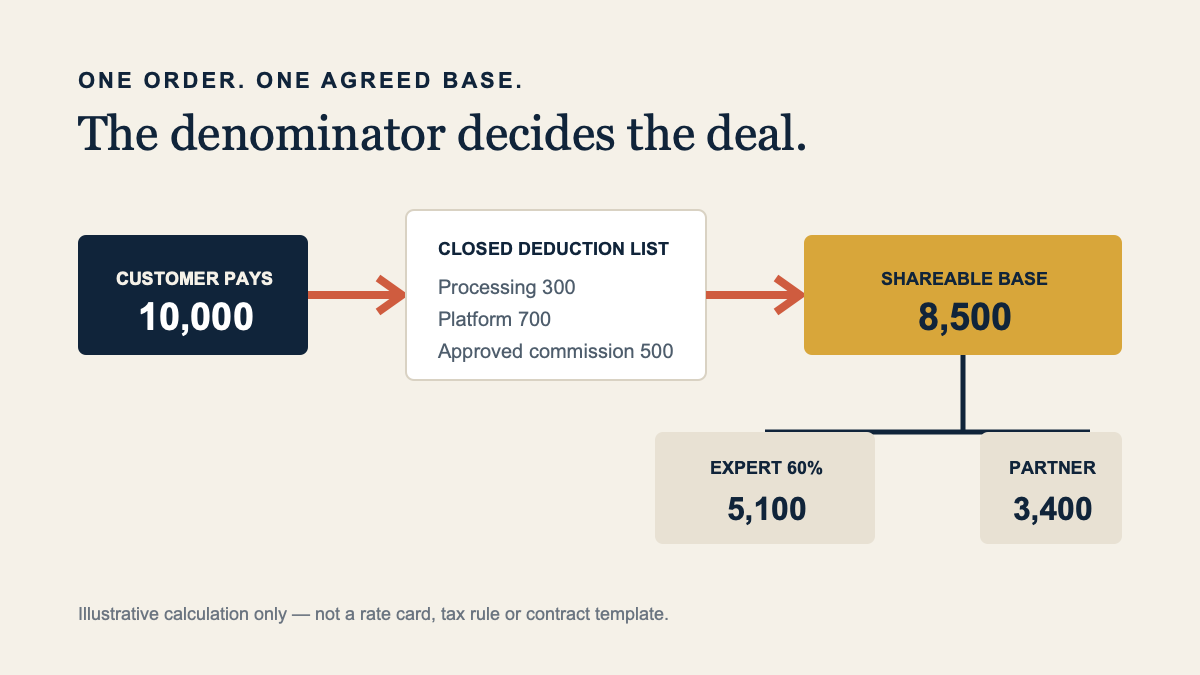
“We can do sixty-forty” is not yet a commercial agreement. The visible percentage is the easy part; the denominator decides who gets paid.
Use this deliberately illustrative order: a buyer pays 10,000; the recorded processing charge is 300; the named platform charge is 700; an approved sale-specific commission is 500; no refund has occurred. If all four items are in the written calculation, the shareable base is 8,500. At 60%, the expert receives 5,100.
Now add 4,000 in advertising selected by only one party. If that cost can be silently deducted before the split, the stated percentage has not changed but the deal has. This example is not a price, tax figure, market norm or OriBridge quote.
The order-record test
Before discussing fairness, ask two people to calculate the same single order using the same written inputs. If they cannot reach the same answer, the split is not ready.
| Order stage | Record to agree | Decision to write down | Common hidden dispute |
|---|---|---|---|
| Money received | Payment and currency record | When does an amount enter the calculation? | Gross amount vs collected amount |
| Permitted deductions | Closed, order-level list | Which costs may reduce the base and who approves them? | Broad “marketing” costs appear later |
| Attribution | Buyer, link, account or named introduction | Which sales belong to this arrangement? | Organic or pre-existing customer is claimed twice |
| Adjustment | Refund, chargeback, discount record | When and how is the prior payout corrected? | A later reversal has no owner |
| Reconciliation | Shared statement or audit record | What evidence can both parties inspect? | Each side maintains incompatible numbers |
| Payment | Settlement schedule and recipient | When is the calculation final? | Percentage agreed, payment timing omitted |
Keep money and rights separate
A party may introduce a buyer or support an operational step without receiving permission to translate, adapt, reproduce, distribute or market a creator’s materials. A revenue split does not create those permissions. Write the commercial calculation and the scope of rights as separate questions.
Maven’s B2B guidance distinguishes individual enrolments and private cohorts in its own workflow. It is useful as a reminder that transaction type changes the record set. It is not a China rate card, contract template or proof that a named commercial route is available.
When a split is the wrong mechanism
For a documented introduction with no shared delivery, cost ownership or customer-record responsibility, a fixed referral fee may be easier to audit. For a deeper operating relationship, a more detailed waterfall may be justified. Complexity should expose responsibility, not make the base harder to inspect.
Counterexample: identical maths is not sufficient
Two parties can calculate the same order and still lack an agreement about rights, tax, data, refund authority, customer support or cross-border payment. The order-record test is necessary commercial hygiene; it is not a substitute for specialist advice or a signed agreement.
Related decision guides
The commercial route should be chosen before its split is calculated: Choosing a China Business Model for an Expert-Led Product separates the first testable route from a final operating model. Second Market Test Without Full Translation helps keep a bounded test from becoming an unapproved content expansion.
What this article cannot prove
It does not set a normal China percentage, decide a fair price, determine tax, VAT, accounting, contract enforceability, licensing or intellectual-property rights. It only creates a testable commercial question: can both sides calculate the same payout from the same order?
If the answer is no, stop negotiating the percentage and define the base. If you need a bounded commercial-path review before broader rights are granted, request a scoped validation review.
Sources and boundary
- Maven: How to Facilitate B2B Sales, checked 2026-09-01. Used only for its product-specific transaction workflow context.
This page provides a commercial clarity framework, not legal, accounting or tax advice.