
Translate the explanation only after you can explain how the learner will complete the work. A course is not localized when its words are Chinese; it is localized when the promised learner action still survives its tools, accounts, assets, feedback and support.
One short lesson can contain a hidden rebuild
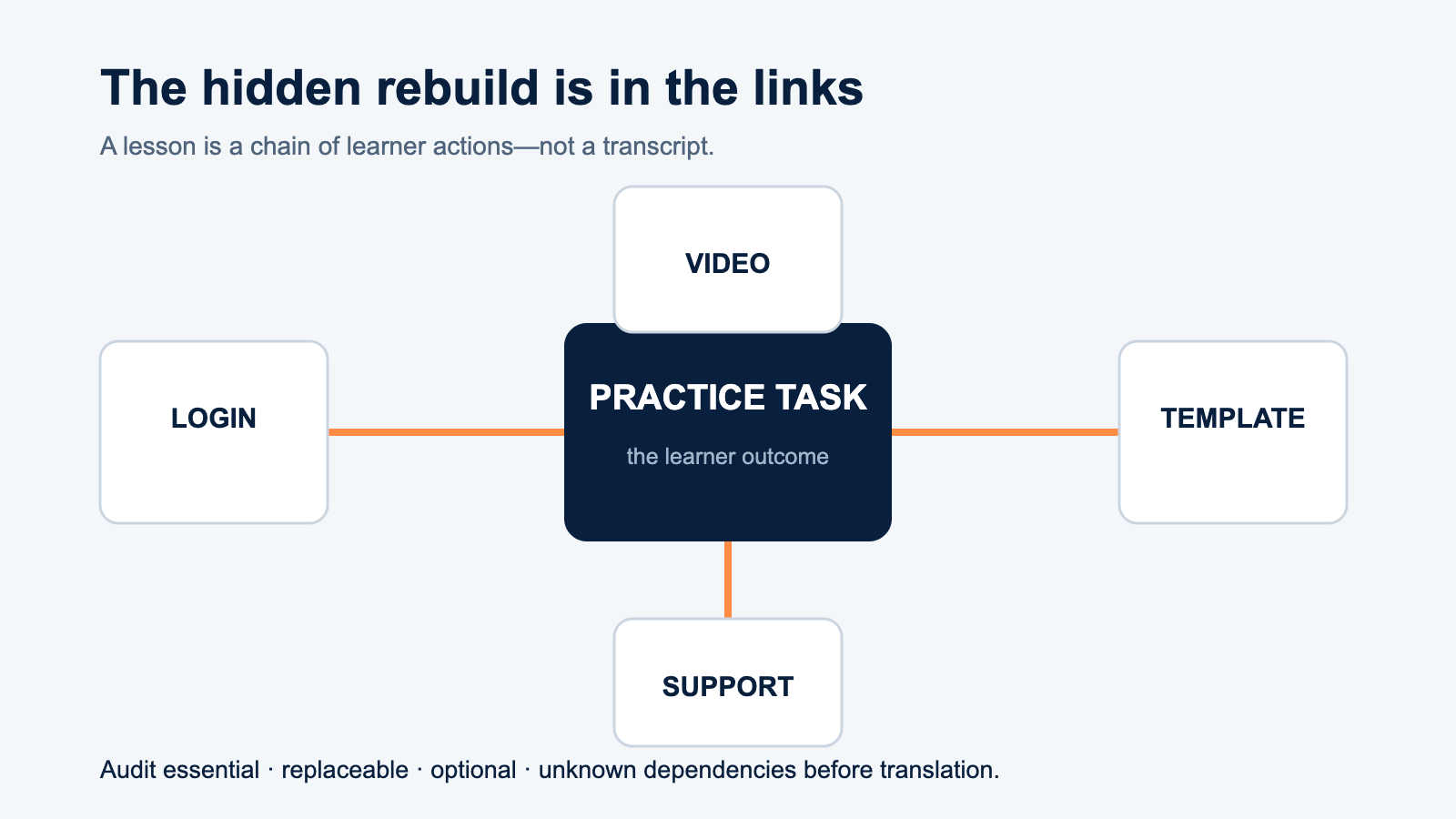
Consider an illustrative AI-workflow lesson. It asks a learner to watch a demo, create an account, receive a verification message, copy a cloud template, use a named tool and submit a result for feedback. The video transcript may take an afternoon to translate. The workflow may take weeks to make responsible.
Call that gap localization debt: the replacement, explanation, testing and support work attached to dependencies that do not travel with the script. It is a working label, not an accounting metric.
Audit actions, not chapters
Choose one dependency-heavy lesson and record every learner action. The audit below is deliberately small enough to use before a full production budget is approved.
| Learning outcome | Required learner action | Named dependency | Decision owner | China decision | Evidence still needed |
|---|---|---|---|---|---|
| Complete the practice task | Watch the method | Video host and embed | Content owner | keep, replace or stop | Route test on intended device/network |
| Complete the practice task | Create account | Service signup and verification | Product owner | keep, parallel path, replace or redesign | Current account conditions and test record |
| Produce a usable output | Get the template | File permission and delivery path | Operations owner | retain controlled fallback or rebuild asset delivery | Download and permission test |
| Improve the output | Receive feedback | Calendar, channel and response window | Support owner | asynchronous alternative or explicit support boundary | Named response owner and timing |
The table does not recommend a Chinese substitute. It makes the original promise inspectable before one untested component is swapped for another.
What official pages can tell you—and what they cannot
Vimeo’s help centre documents regional availability restrictions. Teachable documents that automatic translation is student-facing web text and does not extend to its mobile apps. Kajabi documents course-download controls as a separate setting.
Those are useful facts about the named products. They do not prove that a particular learner in China can use an account, that an alternative service is equivalent, or that a new route is allowed, secure or commercially sound. Platform documentation is an input to a dependency record, not a release decision.
Four honest outcomes
Every essential dependency should end in one decision, not an indefinite research list:
- Keep it when the exact configuration can be tested and supported.
- Replace it when the replacement preserves the learner outcome, not just the screen sequence.
- Teach a parallel path when both routes are feasible and someone owns the maintenance burden.
- Remove or redesign it when the dependency is effectively the lesson and no outcome-equivalent route exists.
The fourth option is often the honest one. A course can be excellent and still contain an exercise whose promised result cannot responsibly be carried into a new setting.
A counterexample: translation may actually be most of the work
An instructor-led module that relies on a downloadable reading, an approved bilingual facilitator and a simple written response may have few critical dependencies. Translation, examples and facilitator guidance may genuinely be the bulk of the job. The audit should reveal that—not force every course into a technical-rebuild story.
The test that changes the next decision
Run one bounded completion test before expanding. Define the intended device and conditions, ask a small approved group to finish the selected learning action, and log the first point at which human assistance becomes necessary. Record whether the workaround preserves the original outcome.
If an essential dependency fails repeatedly, the workaround changes the outcome, or support becomes too complex to own, pause the rollout. That is a product-design finding, not proof that Chinese learners reject the expertise.
What this article cannot prove
This audit cannot certify a tool’s availability, legal status, data treatment, account eligibility, security, learning effectiveness or market demand. It also cannot authorise a creator’s content changes. It helps a team see the dependencies that require separate evidence and permission.
For a bounded audit of a representative module, request a China validation review. For the route that follows the audit, see Test a Course Platform in China and Course Dependency and Terminology Inventory.
Sources and boundary
- Vimeo availability and regional restrictions, checked 2026-09-01: supports the named availability boundary only.
- Teachable: How do I translate my school?, checked 2026-09-01: supports the web/mobile translation distinction only.
- Kajabi: Course downloads, checked 2026-09-01: supports the existence of separate download controls only.