
A flat sales line is emotionally persuasive.
It points at the course.
The obvious response is to open the curriculum, rerecord weak modules, add a bonus, rebuild the landing page, and plan a relaunch.
That response feels productive because the product is the part you control.
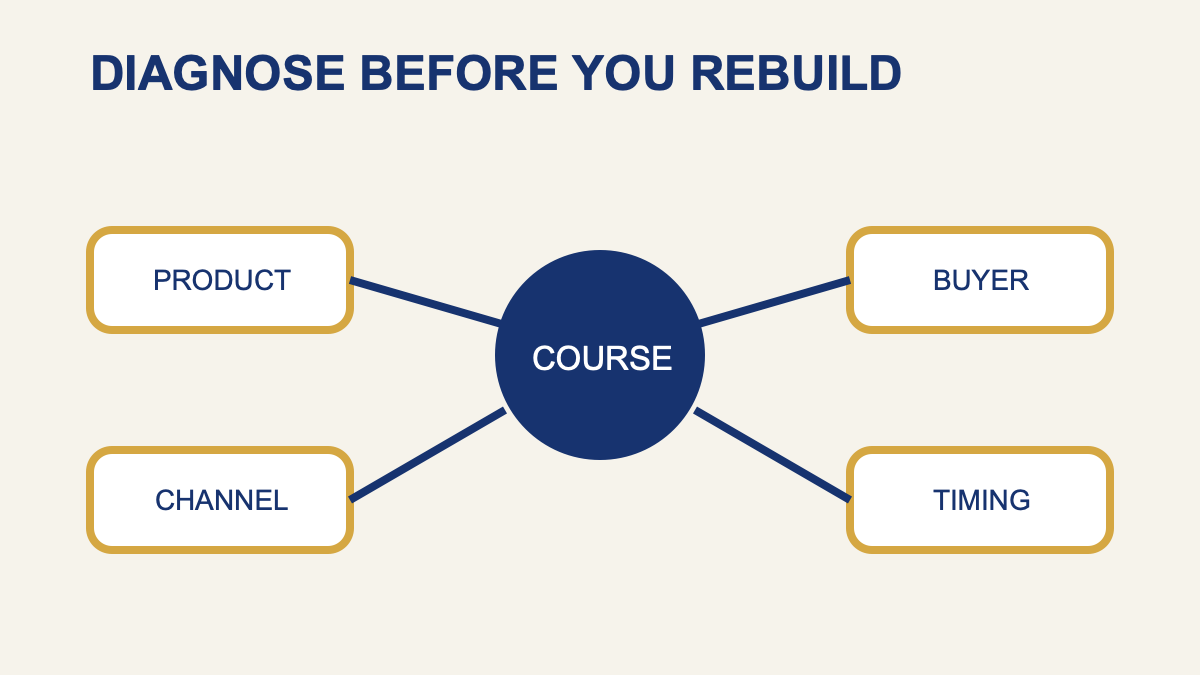
Flat course sales do not tell you that the course is broken. They tell you that the path from problem to buyer to purchase has stopped producing enough transactions. Before rerecording lessons, classify the failure: product, buyer, channel, delivery, or market. Then choose one test that can disprove the leading explanation. If buyers no longer value the outcome, fix the product. If qualified people still want the outcome but discovery collapsed, fix the channel. If buyers want it but cannot use the workflow, fix delivery. A rebuild is justified only when the evidence points back to the product itself.
This is not a recovery formula. It is a way to avoid spending the most money on the first explanation that feels convenient.
One symptom, five different failures
Consider an illustrative expert course that sold for a period and then slowed. No client result is being described here; the example exists only to separate causes.
The owner sees fewer sales.
That observation can be produced by very different systems.
Product failure
The promised outcome has weakened.
The method may be dated. Free alternatives may now solve enough of the problem. The course may have accumulated modules without making the buyer’s decision easier. Learners may not get the result they expected.
Evidence to look for: repeated objections after people understand the offer; weaker learner outcomes; a workflow that has materially changed; buyers who no longer believe the method solves a costly enough problem.
If this is the pattern, product work is justified.
Buyer failure
The product may still be good for someone—just not for the person you keep targeting.
Strategyzer’s Value Proposition Canvas is useful because it separates customer jobs, pains, and gains from the product built to address them. Mixing several customer segments into one profile can hide which buyer is actually evaluating the offer.
A course can drift this way: the headline speaks to freelancers, the proof to managers, the modules to founders, and the price assumes enterprise value.
The product becomes relevant to everyone and urgent to no one.
Evidence to look for: qualified people say “interesting, but not for me”; the strongest learners do not resemble the marketing persona; consumer and enterprise questions conflict.
The next move is buyer clarification, not “more content.”
Channel failure
The course can remain relevant while the discovery path degrades. The Portability Test helps distinguish a reach problem from a relationship or market problem.
Patreon’s creator research is not a course-sales benchmark, but it is a useful reminder that platform reach can change. If a course historically depended on one algorithm, affiliate partner, marketplace, newsletter placement, or launch mechanism, the distribution engine can weaken while the product stays unchanged.
Evidence to look for: traffic falls before qualified conversion; source mix changes; referral/direct traffic remains healthy; past buyers still recommend the product.
Do not rewrite curriculum to fix a discovery problem.
Delivery failure
The buyer wants the promise. The course cannot deliver it cleanly in the buyer’s environment.
This matters for products built around software, AI workflows, communities, live interaction, or tool integrations.
Delivery failure can look like checkout friction, login problems, inaccessible tools, unreproducible exercises, timezone problems, weak onboarding, or support that overwhelms the value.
A course can be intellectually sound and operationally unusable.
Market failure—or market opportunity
Sometimes the product still works, the buyer is clear, delivery is solid, and the original audience has become harder to expand.
That creates a legitimate market question. It does not automatically create a new-market opportunity.
A second market deserves a test only when the underlying problem appears portable and the product has evidence worth carrying.
The five-door diagnosis
| Door | What would support this explanation? | Smallest useful test | Expensive mistake to avoid |
|---|---|---|---|
| Product | Outcome or method no longer works | Interview recent buyers; review outcomes | Rerecording everything before knowing what failed |
| Buyer | Strongest users differ from the target segment | Separate customer profiles and offers | One page for incompatible buyers |
| Channel | Qualified conversion is stable while reach falls | Test another acquisition path | Adding modules to fix traffic |
| Delivery | Intent exists but use or purchase breaks | Observe the full buyer/learner journey | Calling friction “no demand” |
| Market | Product works but the current audience is constrained | Run a bounded second-market test | Assuming a new country rescues weak product-market fit |
A good diagnostic tries to kill the wrong explanation quickly.
Use evidence you already have before collecting more
Most course businesses have more diagnostic evidence than they realize.
Start with traffic by source, landing-page conversion, checkout starts/completions, refunds, support reasons, completion/attendance, sales notes, repeated objections, and where qualified leads disappear.
Then label each item:
Observed evidence
or
Interpretation
This prevents statements such as “the market is saturated” from sitting next to actual metrics as if they were the same kind of information.
Strategyzer’s experiment guidance is relevant here: connect a belief about the customer to a deliberate test instead of treating the proposed solution as already validated.
What changes if China is the hypothesis?
A China test should not be the fifth version of the same launch. Buyer, access, delivery, and permission questions must remain separate. This article does not cite a current China demand statistic or a route-specific platform rule; China enters here only as a proposed second-market hypothesis after the original bottleneck has been isolated.
It should answer a question the current market cannot.
Start with the last observable action
Picture one defined journey: a visitor can read the offer, begins a purchase, and then stops before payment, login, or access to the first session. That is not sufficient evidence that the course is weak. It is evidence that the course team has not yet located the break. A payment capability page, a classroom attendance record, and a support message each describe only part of that journey. Mark the last action you can actually observe; then decide whether the next test belongs to checkout, access, recovery, or the offer itself.
This is deliberately a bounded claim. Alipay’s web and mobile documentation and ClassIn’s LTI material describe named product surfaces, not a guarantee that a particular course, account, buyer, or route will work. They are useful prompts for a route-specific check, not proof of demand or eligibility.
For example:
- Does the buyer problem exist in a recognizable form?
- Does the method survive different tools and examples?
- Does the first offer make sense as B2C, enterprise training, a workshop, or a diagnostic?
- Can the buyer discover, pay for, and receive the product through a workable path?
- What evidence would justify deeper localization?
OriBridge’s current validation path begins with a product and a decision, not an instruction to translate the full course.
The test can also tell you not to enter.
That is useful evidence.
When rebuilding is the right answer
A rebuild is justified when evidence points back to the product: buyers understand the problem but no longer believe the method solves it; outcomes fail for curriculum reasons; a core workflow has materially changed; or the strongest buyer needs a different product architecture. If a review has already established that the lesson itself contains a material error, correct the lesson. Do not hide a known content defect behind another round of path diagnosis.
Even then, rebuild the failing mechanism—not everything you are emotionally tired of looking at.
The decision at the end
Write one sentence:
We believe sales slowed mainly because _, and the cheapest test that could prove us wrong is _.
If you cannot complete it, you are not ready to rebuild.
You are still guessing.
Related decision paths
If the evidence points to a buyer problem rather than the curriculum, use A Good Product, a Buyer, and a Channel Are Three Separate Tests. If the unresolved question is whether a bounded China test can be interpreted, use the China Test Plan and Stop Conditions Template. If delivery—not demand—appears to be failing, use the End-to-End Access, Payment, and Delivery Test Script.
Next step: If “market” or “delivery environment” remains a plausible bottleneck after testing the home-market product, start with the exact China decision you need to make.
Sources
- Strategyzer, The Value Proposition Canvas — customer jobs, pains, gains, and value-proposition fit; verified August 10, 2026.
- Strategyzer, experiment design connected to the Value Proposition Canvas — experiment framing; verified August 10, 2026.
- Patreon, State of Create — creator/fan research on platform pressure; verified August 10, 2026.
- Hengqin Guangdong–Macao In-Depth Cooperation Zone Economic Development Bureau, 2026 training-service procurement notice — one named public project that specifies a training-service scope; it does not establish private-market demand, a suitable buyer, provider eligibility, or a route to sell a course; checked August 24, 2026.
- Alipay, Web and Mobile Application documentation and ClassIn, LTI documentation — named product-surface documentation, rechecked August 24, 2026. They do not establish availability, eligibility, buyer behaviour, or the health of any course route.