
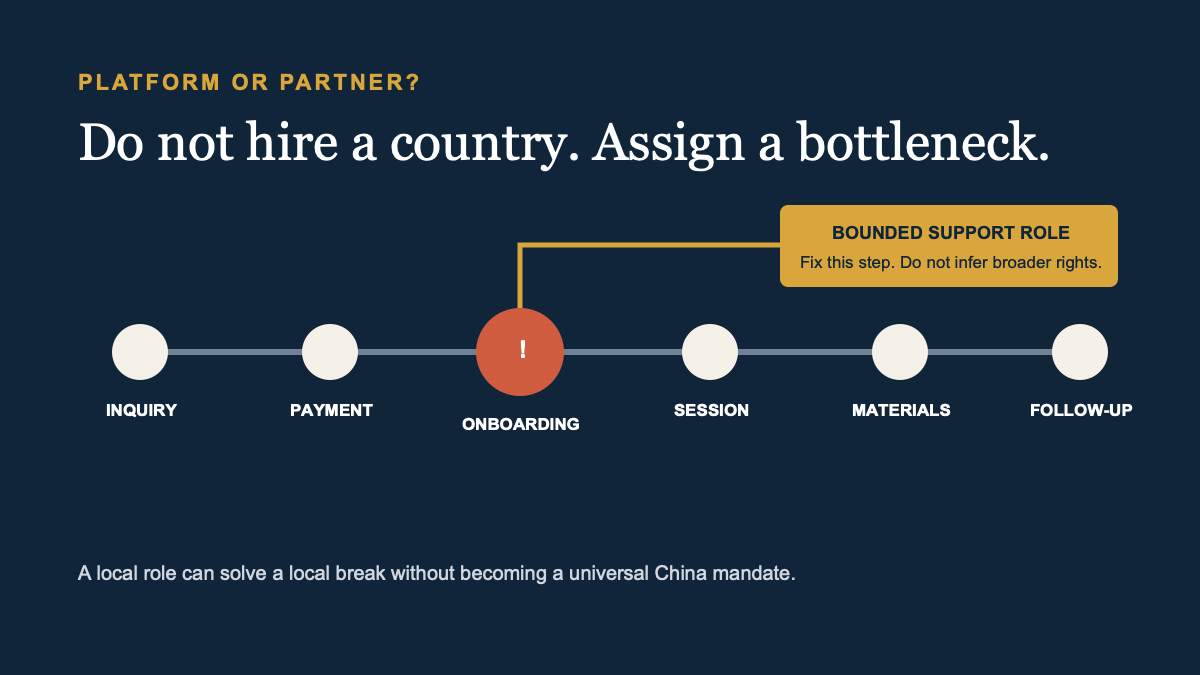
The workshop is sold. The instructor is ready. Then the first group receives an English registration message, cannot tell where pre-work lives, and sends three different questions to three different people. It is tempting to answer the embarrassment with a large solution: “we need a local partner.”
Usually that conclusion arrives too early.
Do not choose an overseas platform or a local partner by label. Find the first buyer promise that is blocked, assign a narrow accountable role, and test whether that role removes the blockage. A location is not a job description. A platform is not a delivery verdict.
This is a decision about an early, bounded operating role. It is not advice about entity formation, payment eligibility, data protection, tax, employment, or who should receive rights to a creator’s materials.
The false choice hides several different jobs
“Should we use an overseas platform or a local partner?” sounds like one choice. In practice it can conceal at least six:
- making the offer understandable;
- handling a registration or identity handoff;
- responding to participant questions;
- running a live room or replay handoff;
- recording an order or support exception; and
- finding future buyers.
Those jobs do not necessarily belong to the same person, provider, or agreement. An overseas platform may be perfectly adequate for a small invitation-only session while a bilingual coordinator makes the first learning action understandable. A local operator may be able to organise a reminder message but have no authority to adapt content, set a price, promise a refund, or retain learner data.
The most expensive mistake is to treat a single visible failure as proof that one side should own the whole route.
Start with a named promise, not a country-sized solution
Write the offer as a sentence a participant could test: “A named participant will receive the pre-work, join a 90-minute session, complete the first exercise, and know where to ask one follow-up question.” Then walk that promise in order.
For each step, ask four questions.
- What exactly was promised?
- Where did the participant stop?
- What evidence shows the stop rather than an assumption?
- Who could make the next attempt work without being given unrelated authority?
If the issue is an untranslated pre-work instruction, the first role may be approved operational clarification. If the issue is a missing enrolment, the first role may be a named operator who can reconcile an invitation with a course record. If nobody knows whether buyers actually want the offer, neither a platform migration nor a partner appointment answers the problem; it is a demand question.
This is why the article sits before, not instead of, a platform test. Test the course promise before judging the platform. Once that promise is precise, use the end-to-end test script to record what happened on the route.
A China operating surface can clarify the question without answering it
China-native knowledge-commerce products make the hidden jobs easier to see. Xiaoe-tech’s merchant documentation presents content, users, messages/feedback, orders, and channel management as distinct operating surfaces.1
That observation is useful because it stops a vague phrase such as “run the China side” from looking like a single task. It does not establish that any overseas creator, account, product category, payment route, or course is eligible to use that product. It does not prove traffic, buyer demand, payment availability, or a legal path. A feature page is not a permission slip.
The practical implication is smaller: if five operating surfaces are distinct in the system, they should not be silently collapsed into one partner mandate. A person helping with participant messages should not automatically obtain authority over orders. Someone who creates a channel asset should not automatically receive the right to reproduce course material.
Use a bottleneck card before discussing a broader relationship
For a first test, make a one-page bottleneck card. It should fit in a shared working document and be boringly specific.
| Field | What to record |
|---|---|
| Buyer promise | The first action the buyer expects to complete |
| Blocked step | One observed point of failure |
| Evidence | Sanitised message, screen, timestamp, or operator record |
| Bounded role | The one action the operator may take |
| Explicit exclusions | Rights, prices, data, promises, or systems outside that role |
| Success condition | What would count as a repaired next attempt |
| Stop condition | What would make the team pause rather than expand scope |
Imagine a private cohort where every invited learner reaches the session, but half cannot interpret the required pre-work. The card might give a bilingual coordinator authority to send approved explanatory copy and collect non-sensitive clarification questions for one cohort. It would explicitly exclude translating lessons, publishing a sales page, taking payment, making claims on the instructor’s behalf, or storing a learner database.
If the next cohort completes the pre-work, the team has learned something about onboarding. It has not proved a distribution model. If it still fails, the record tells the team whether the issue was wording, identity, timing, access, or an inaccurate promise.
The platform can be part of the route, but cannot absorb responsibility
Maven documents separate private-cohort and B2B workflows in its own product.2 That is not China evidence. It is a useful reminder that “the platform” contains different transaction types, roles, and operational handoffs.
An overseas platform is a reasonable candidate when the test only needs its documented capabilities and the team can observe the full promised journey. It becomes a poor substitute for thinking when a team uses its brand name to avoid naming the actual owner of a broken step.
Likewise, a local operating role can be useful when it has a narrow input, a measurable action, and a clear exit. It becomes risky when the brief says “handle China” but leaves content approval, customer promises, records, payments, and exception authority undefined.
Keep service scope separate from permission
Operational help is not a content licence. A coordinator may need approved logistical copy and a restricted list of named participants to run a particular session. That does not automatically permit translation, adaptation, public promotion, pricing, reproduction, distribution, sublicensing, or reuse after the session.
The same separation protects the operator. A person asked to answer learner questions should not be presumed to carry refund, consumer, or delivery commitments that were never defined. When the issue is which course assets, tools, terms and permissions are in scope, use the published course dependency and terminology inventory and obtain appropriate professional advice for the actual arrangement.
A counterexample: when a deeper relationship may be justified
Suppose repeated, authorised tests show the same needs: approved adaptation, participant support, named delivery responsibilities, consistent evidence, and a defined route for recurring buyers. A broader operating arrangement may then be worth designing.
But the order matters. Repeated evidence can justify a deeper conversation; a single failed invitation cannot. Even then, the agreement should say what is being delegated and what remains with the creator. “Local” should never be used as a shortcut for “authorised,” “eligible,” “compliant,” or “effective.”
If the bounded role later includes commercial participation, do not let a percentage substitute for an operating scope. The revenue-split calculation guide separates gross receipts, permitted deductions, attribution, refunds, records and payment timing before either side calls the arrangement a deal.
What this article cannot decide
It cannot tell you whether an overseas platform works for a particular person in China, whether a local partner is legally required, whether a payment route is available, or whether a course has demand. It cannot determine fair commercial terms or grant content rights.
It gives a smaller, more useful starting point: the first observed bottleneck should determine the first role.
Before expanding the role, ask one final question: could a reader of the record name the promise, the observed blockage, the authorised action, and the excluded authority without guessing? If not, the operating scope is still too broad. The next test should make the record clearer, not make the relationship larger.
Next step: document one buyer promise and one blocked step before searching for a partner or replacing a platform. If you need an independent, bounded route review, request an OriBridge validation review.
Sources and limits
-
Xiaoe-tech, Merchant Instructions, rechecked 2026-08-24. The documentation is used only to show that several operator surfaces are named separately. It cannot decide which party should hold a role, what authority may be delegated, or whether a proposed partnership is necessary or permitted. ↩
-
Maven Help Center, Private Cohorts and How to facilitate B2B sales on Maven, rechecked 2026-08-24. These are platform-specific workflow documents, not China-access evidence. ↩