
The English instructor changes one exercise. The Chinese course card still promises the old learning outcome. The subtitle editor sees the change but assumes the product manager will update the description. The product manager assumes the local course editor owns it. By launch day, every person has done reasonable work—and the public page is wrong.
This is not primarily a copywriting problem. It is an ownership problem.
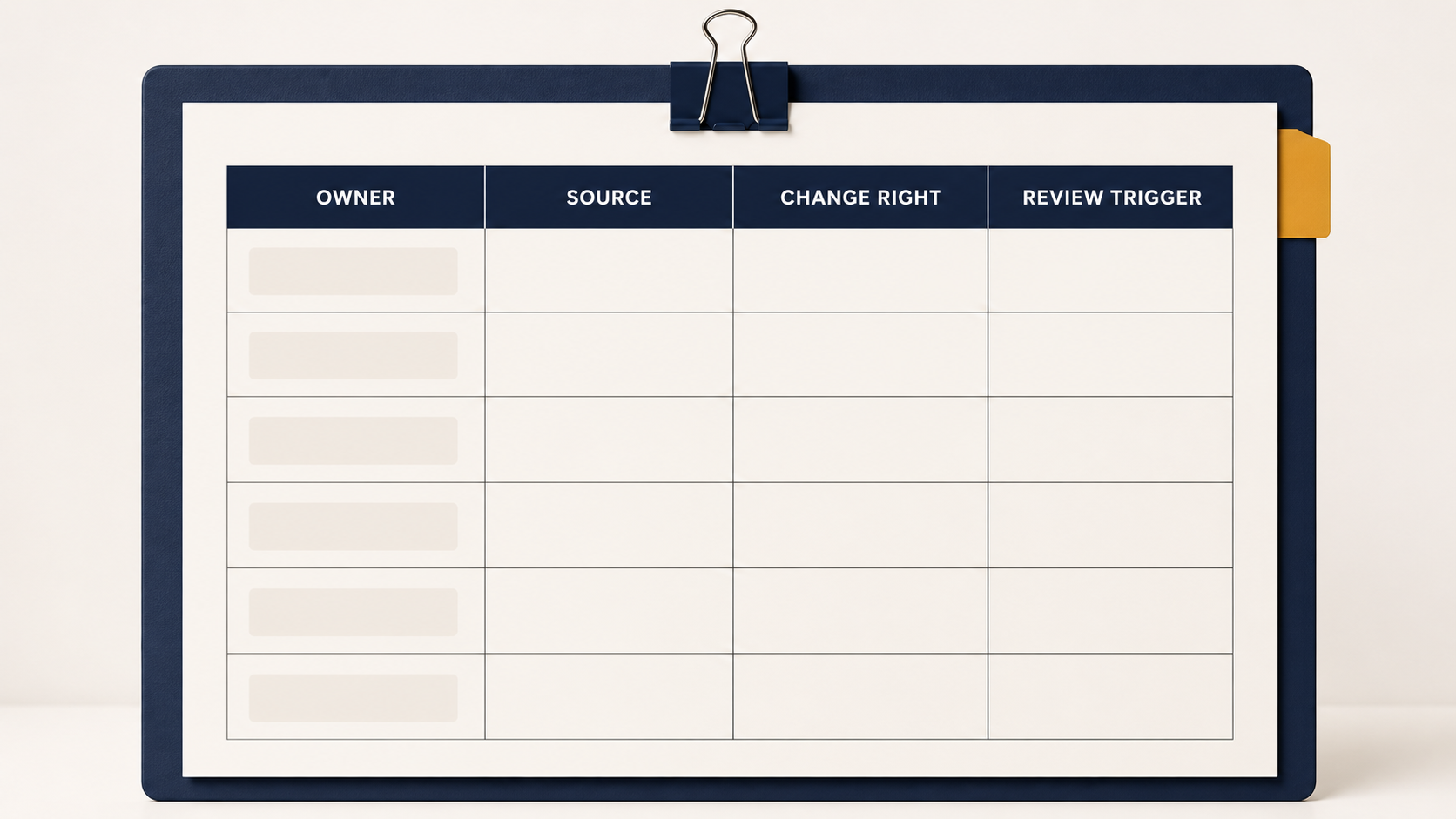
A China-facing course card should be treated as a responsibility grid, not a block of marketing text. Every public field needs four things: an owner, a source of truth, a right to change it, and a trigger that tells the team to review it.
The quick answer
Before a course pilot, list each public field—audience, learning goal, module outline, subtitle state, delivery route, validity period, support path and version note. For each one, assign the person or role who confirms factual accuracy, identify the approved source, define who can change it, and name the event that makes it stale. A field without all four is not ready to publish.
The same person can own several fields in a small team. The point is not bureaucracy. The point is to stop “someone will update it” from becoming an invisible risk.
A course card is a set of different promises
Course pages often look like one unit. Operationally, they contain several different claims:
- a learning claim: what a participant will be able to practise or understand;
- an audience claim: who the material is and is not for;
- a content claim: which modules, assets or examples are included;
- a language claim: which subtitles, voice, interface terms or local examples are present;
- an access claim: where and for how long a participant receives the material;
- a support claim: what happens if the learner is stuck;
- a version claim: which source revision the page describes.
Each promise can change for a different reason. An updated transcript may require a subtitle review. A revised exercise may require a learning-goal review. A new delivery arrangement may require the access copy to change. Bundling them under “content” ensures that one of them will be forgotten.
The field-owner grid
Use this grid before any external review or publication. Roles are examples, not titles you must adopt.
| Public field | Fact owner | Source of truth | Who may change it | Review trigger |
|---|---|---|---|---|
| Learning goal | Subject-matter owner | Approved lesson specification | Subject-matter owner, with editorial review | Exercise or assessment changes |
| Intended audience | Product owner | Approved offer and exclusions | Product owner | Buyer segment or product format changes |
| Module outline | Course editor | Current curriculum map | Course editor | Module added, removed or reordered |
| Subtitle/language state | Localization editor | Approved subtitle package and terminology record | Localization editor | Source video, UI or terminology changes |
| Delivery route | Operations owner | Tested access-and-delivery record | Operations owner | Platform, access or handoff path changes |
| Validity period | Offer owner | Approved commercial/operating decision | Offer owner | Product terms or pilot design changes |
| Support path | Service owner | Bounded support scope | Service owner | Contact route, time window or exclusions change |
| Version note | Release owner | Version record | Release owner | Any field above changes |
The grid is deliberately plain. It does not need a new platform. A shared record is enough if the team can see the current owner and the evidence they rely on.
The rule that prevents most stale pages
No one edits a public field merely because they noticed a mismatch. They flag the mismatch to the field owner, who confirms the source and approves the change. This can feel slower in the moment. It is much faster than issuing corrections after a learner, partner or buyer has relied on inaccurate information.
There is one exception: an obvious typo that changes no factual claim can be corrected by the editor under a recorded editorial rule. But a change from “includes a live review” to “includes a recorded module” is not a typo. It changes the offer.
Why the sources matter, even when they do not supply the answer
Bilibili Classroom’s content guidance is useful because it distinguishes fields such as learning goals, target audience, course highlights, outline consistency, video or subtitles and validity period. It does not prescribe a universal course card. It simply makes visible something course teams already know: these are different information objects.
Tencent Cloud’s subtitle-template documentation likewise separates ASR subtitles, OCR extraction, subtitle-file translation and terminology or template parameters. That does not determine a particular course’s localisation workflow. It does show why “the subtitles are done” is not a sufficient status update when the source, terms and visual text may have moved independently.
Xiaoe-Tech’s public merchant material separates content, users, feedback, orders and channels. It does not promise that an overseas product can use a specific route. The narrow operational lesson is that content facts and operational facts should not share an unowned field on a landing page.
A scenario: the old objective survives the new exercise
An instructor changes a course exercise from “write a prompt” to “produce a sourced workflow review.” It is an improvement. But the existing course card still says participants will “master prompt writing,” and the Chinese subtitles still use an earlier term for the task.
Without owners, each team member can plausibly say the other person should update it. With the grid, the course editor flags the curriculum change; the subject-matter owner confirms the revised objective; the localization editor checks the term; the release owner increments the version note. The page only changes after the four factual surfaces agree.
That is not red tape. It is a way to keep a public promise attached to its evidence.
What to ask at a pre-launch review
Instead of asking, “Does the page look good?” ask five sharper questions:
- Which field would be most harmful if it were one version behind?
- Who can confirm the wording from an approved source today?
- What change would make this field stale tomorrow?
- Does the named owner have the authority to change the field, or only notice the problem?
- Can the page distinguish a planned feature from a current, tested part of the offer?
The answers often expose gaps in access, support or delivery before a reader has to discover them. For a separate end-to-end check, see the access, payment and delivery test script. For the broader question of what must change beyond translation, see localising an expert product for China.
When a full grid is excessive
A one-person internal lesson with no external listing can place all fields under one owner. The owner should still know what source they are relying on and what makes it stale. A large external launch, by contrast, may need a more detailed change record and a formal review point.
The grid is not a contract, a platform checklist or an approval guarantee. It is a small operational control for truthful public information.
Make the source visible to the reviewer
At review time, do not accept a field owner saying “that is the current version” without a link, approved file or tested record behind the statement. The owner does not need to keep every working draft. They do need to point to the current source that makes the public field true. This small rule is what turns ownership from a name on a spreadsheet into a usable correction path.
It is especially helpful when a delivery route or live component is being discussed. A planned element belongs in a planned-status field; it should not be silently presented as a current course component because the page needs to feel complete.
What this cannot prove
It cannot prove that a course will be approved, that a platform account is available, that learners will complete the course, or that the product will sell. It also does not replace rights review, a tested delivery path or a training-effectiveness evaluation.
It does give every public claim a place to go when it needs correction.
Sources
- Tencent Cloud intelligent subtitle template documentation
- Xiaoe-Tech merchant instructions
- Bilibili Classroom course content standards and overview
A bounded next step
If you are preparing one existing course for a controlled China review, request a private validation review. Begin by identifying the most consequential public fields and their owners; do not treat an attractive course card as proof that the operating path is ready.