
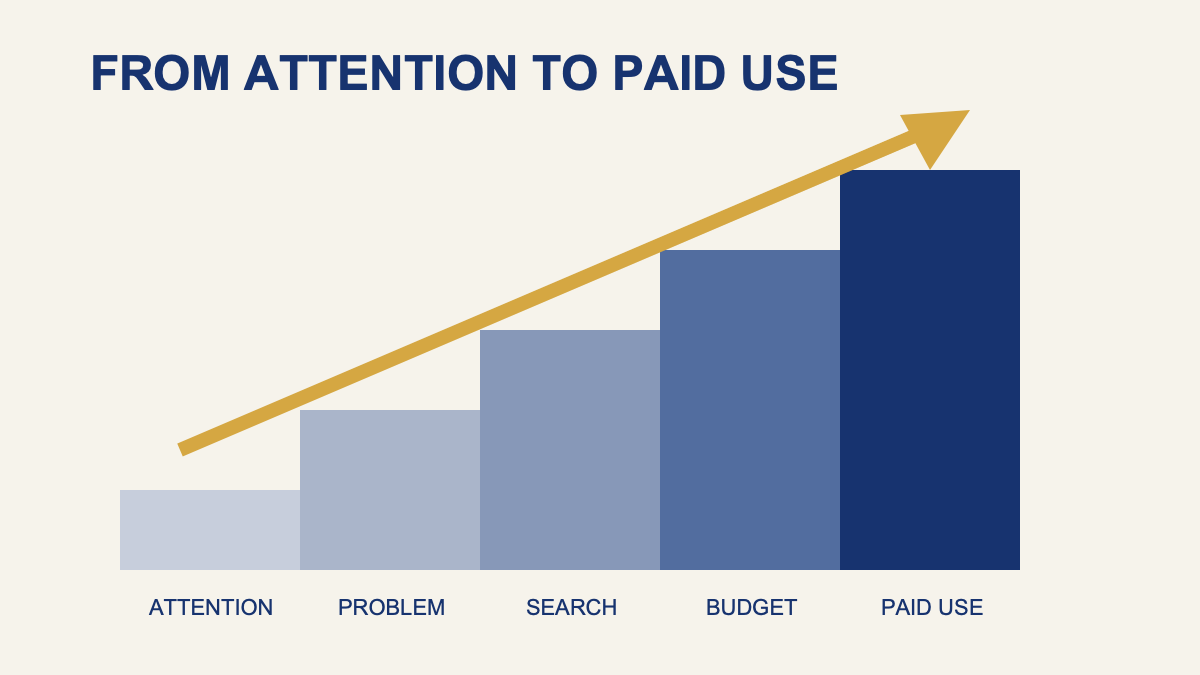
Short answer: China does not “need overseas experts” in the abstract. A credible opportunity starts when a named buyer has a costly problem, recognises the gap in their current alternative, and can use a version of the method through a route that can actually be tested.
“What does China need?” sounds like a request for sectors: AI, leadership, wellness, software. For a creator deciding whether to spend months adapting an asset, it usually hides a more personal question: is there a situation where my method would be chosen instead of something already available?
The population size cannot answer that. Neither can a popular keyword.
The claim this article makes
Demand should be treated as a falsifiable chain: buyer, problem, current alternative, delivery condition and observable next action. Break one link and the team should reduce the claim, not expand the product.
This is an OriBridge research template, not a market forecast. It is designed to keep attention, buyer need, budget and paid use from being collapsed into one attractive story.
A specific scene beats a large category
Consider an overseas expert whose method helps product teams make better decisions with AI tools. “China is interested in AI” is not a buyer problem. It says nothing about who is stuck, what they currently do, or why the expert’s method is needed.
A more useful hypothesis is narrower:
A product-operations lead needs a repeatable way to decide which AI-generated output requires human review; existing generic tool training does not give the team a usable review workflow.
This might be wrong. That is its strength. A team can ask whether the buyer recognises the situation, what they do now, who owns the consequence and whether a bounded workshop or decision guide would be usable.
The five links in a demand hypothesis
| Link | Question to answer | Evidence that is stronger than attention | What it still cannot establish |
|---|---|---|---|
| Buyer | Who feels the cost and who can act? | A named role describing the recurring situation | Market size |
| Problem | What becomes costly or risky? | Specific language, behaviour or decision moment | Purchase intent |
| Alternative | What do they do now? | A real workaround, local provider or internal process | That the alternative is inadequate |
| Delivery condition | What must change for the method to be usable? | A testable language, workflow, tool or support requirement | Broad technical compatibility |
| Next action | What small action would clarify the hypothesis? | A bounded conversation, invitation or authorised test | Revenue or repeatability |
The important move is to write the alternative down. A genuine Chinese problem does not mean the overseas product is the best response. The buyer may prefer an internal process, an existing local trainer, a tool, or no paid solution at all.
Attention is a clue, not a purchase order
The public Douyin E-commerce Learning Centre itself shows that short video, livestream, traffic operations, customer service, orders and fulfilment are separate operating topics.1 That does not measure learning demand. It is a practical reminder that visible attention and an operable buyer journey are different things.
An article, video or search query can show that people notice a topic. It cannot by itself establish that a defined buyer has a budget, values an overseas method, can use its delivery route, or has permission to buy it. Treat attention as a lead for research, not a verdict.
When an overseas method is more likely to add something
The strongest starting point is usually not “foreignness.” It is a decision rule, operating method or specialised perspective that is difficult to substitute with generic content. The method must still survive four questions:
- Can the buyer describe the same problem in their own working language?
- What is the local or internal alternative, and why might it be insufficient here?
- Which examples, tools, workflows or support assumptions would have to change?
- What is the smallest permitted test that could disconfirm the idea?
If the answer to the fourth question is “translate the whole course and launch,” the hypothesis is not ready. The test is too expensive to teach the team anything quickly.
A counterexample: the topic is real, the offer is wrong
Suppose a foreign creator has a four-week cohort course about career transition. The broad topic may attract attention, but a particular buyer may instead want a short Chinese-language workshop, employer-supported advice, or free local content. The problem can be real while the product–buyer–delivery match is not.
The right response is not to argue that the market “does not need” the creator. It is to narrow the claim and test a different fit—or pause.
What to do with a promising but incomplete signal
Do not declare demand. Draft a one-page hypothesis:
- Buyer and moment of cost;
- Current alternative;
- The part of the overseas method that may add value;
- Delivery dependency that could break the offer;
- One bounded next action;
- A stop condition.
For delivery conditions, continue with How to Localize an Expert Product for China. For the first route, see Choose the China Route That Can Prove You Wrong Fastest.
The useful question is not “What does China need from overseas experts?” It is “Which named buyer might need this method enough to test it, and what would prove us wrong?”
This article cannot estimate market size, certify demand, set price, establish legal rights, confirm tool access or approve commercial distribution. If you need an evidence-bounded starting point, request a validation review.
Source and limit
-
Douyin E-commerce, Official Learning Centre, checked 2026-09-01. Used only to distinguish public content visibility from the separate operational surfaces of a commerce route. It is not evidence of demand for any expert product. ↩