
The handoff looked finished.
An overseas course creator had marked a promotional video as containing altered or synthetic content on YouTube. The China-side editor had the exported video, a translated voice track, a new thumbnail and a PDF worksheet. Everyone could see the YouTube label.
Nobody could answer four smaller questions: Which parts were generated? Had the original metadata survived the export? Who had checked the voice and likeness rights? What would the person pressing “publish” need to declare on the next service?
The problem was not a missing checkbox. It was a missing asset record.
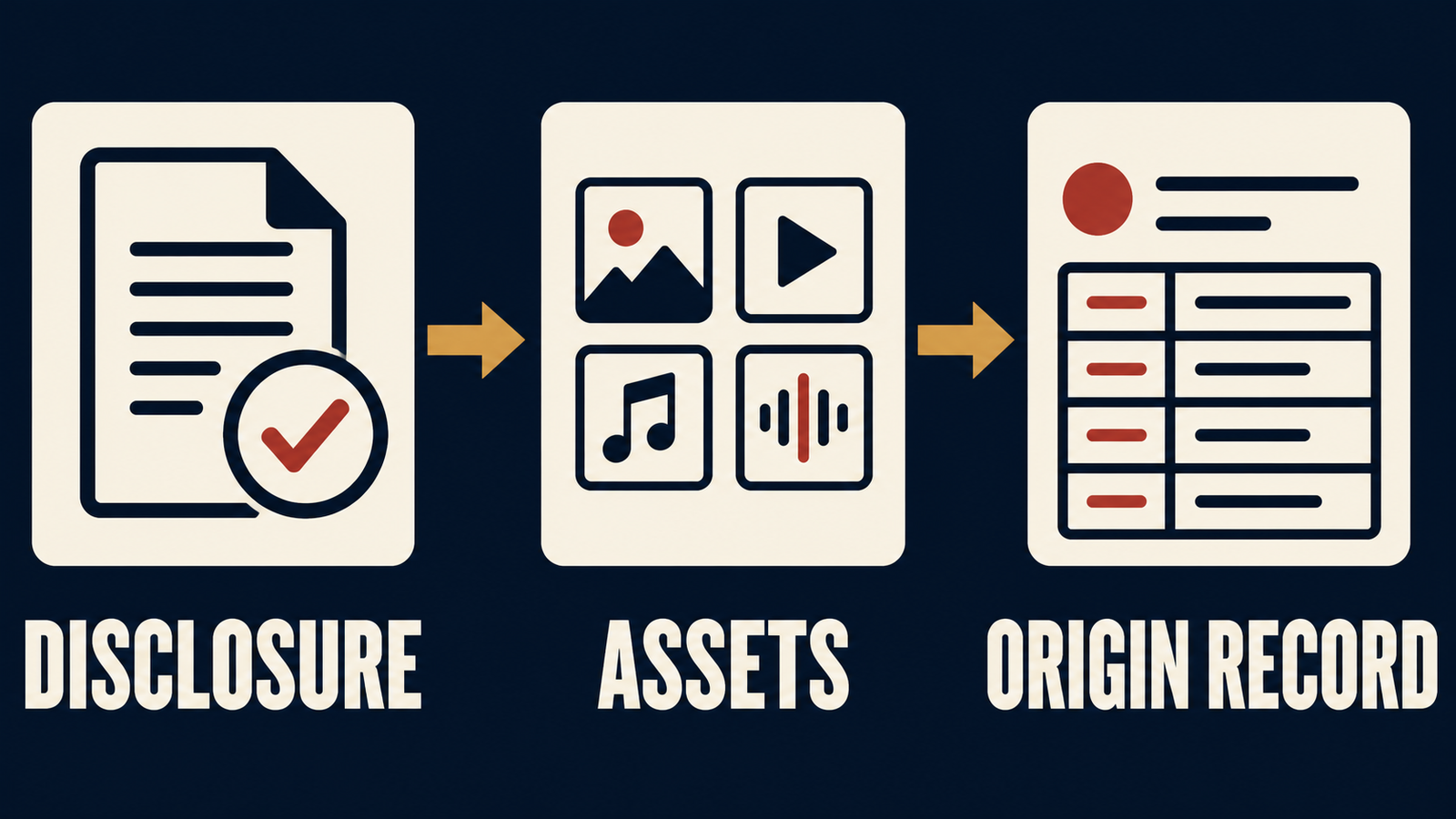
A platform disclosure is a publishing action. A content-origin record is a transferable asset record. You need both, but they do different jobs.
What the YouTube label actually tells you
YouTube asks creators to disclose meaningfully altered or synthetically generated content when it looks realistic—for example, content that makes a real person appear to do something they did not do, changes a real event or place, or creates a realistic scene that did not occur.
Its own examples also show the boundary. Minor aesthetic edits and production assistance such as using generative AI for an outline or script do not automatically receive the same treatment. In 2026, YouTube also made some AI labels more prominent and described using internal signals to help identify relevant content.
That is useful viewer-transparency information about a particular YouTube publication. It does not establish a portable inventory of every AI-assisted element in the source package. Nor does an automatically applied label verify the asset’s origin, rights, factual accuracy or treatment by another platform.
Keep the YouTube disclosure in the handoff. Just do not ask it to prove more than it proves.
Why the China-side question is different
China’s Measures for Labeling AI-Generated and Synthetic Content describe a chain of roles. The text addresses providers of generation and synthesis services, network information content dissemination services, and users publishing generated or synthetic content. It distinguishes visible and metadata-based labels, and it describes user declarations and service-provided labeling functions within its stated scope.
That structure is not a Chinese version of YouTube’s upload checkbox. It raises a set of route-specific questions:
- What is the asset and which version is being published?
- Does an original visible label or metadata signal exist?
- Has editing, translation, dubbing, cropping or transcoding changed it?
- Which service will actually disseminate the content?
- What declaration or labeling function does that service currently provide?
- Who is responsible for checking and recording what was done at publication?
Those questions cannot be answered by pointing back to a YouTube page. They also cannot be answered once for every China route. The intended publishing service and its current rules still need to be checked before use.
Build the record before adapting the asset
Use a small handoff record, not a legal memo. The record should let an editor identify the file, understand how it was made and know which questions remain open.
| Record field | What to capture | What it does not prove |
|---|---|---|
| Asset identity | Asset ID, file name, version, date, original location and file hash if available | A hash does not prove ownership, truth or compliance |
| AI involvement | Tool or provider if disclosable; generated or altered step; text, image, audio or video elements; any realistic person, voice, event or place | A self-description is not independent verification |
| Existing signals | Visible disclosure, export metadata, C2PA data if present, screenshot and capture date | Signals may not survive editing or be accepted elsewhere |
| Human review | Reviewer, date, factual checks and unresolved issues | Human review is not platform or regulatory approval |
| Rights status | Source and current status of music, images, voice, likeness and course material | Recording a source does not create permission |
| Intended route | Target service, planned use, declaration or labeling function to verify, and publication owner | A planned route is not proof of eligibility or acceptance |
| Publication receipt | Final asset version, declaration used, visible result, date and retained evidence | A receipt does not prove every underlying claim is true |
This is an OriBridge editorial tool. It is not an official form and it is not a substitute for the intended service’s current instructions or professional advice.
A five-minute test that catches the handoff gap
Put the source package on a blank screen: video, thumbnail, audio track, transcript and downloadable worksheet.
Ask a person who did not make them to answer:
- Which files contain generated or materially altered content?
- Which versions were actually used on YouTube?
- Which labels or metadata were present before export?
- What changed during localization?
- Which questions must be verified again for the intended China publication route?
If the answer to the first four questions is “check the YouTube page,” the package is not ready for a clean publishing handoff. If the answer to the fifth is “the label already covers it,” the team is confusing one platform’s viewer notice with a cross-platform release decision.
The record saves time only when it travels with the asset
Do not leave this information in a chat thread or in one editor’s memory. Put the record beside the source package and give the next reviewer a stable asset identifier. When a thumbnail is redrawn, a voice track is replaced or a transcript is condensed, create a new version row rather than silently overwriting the old description. The record is then useful to a producer, translator and publisher without claiming that any of them has cleared the next route.
The practical benefit is a smaller handoff question. Instead of asking “is this video okay for China?”, the operator can ask “does version 3 contain an altered voice, what remains of the original signal after the edit, and who must verify the intended publication step?” That question can be answered or escalated. The original one cannot.
The counterexample is a plain lesson video where AI only helped brainstorm an outline and no generated or altered media made it into the exported asset. In that case a heavy record can create noise. Capture the limited involvement honestly, keep the record proportionate, and still check the route-specific instructions before publishing.
The counterexample matters
Suppose the creator used an AI tool only to brainstorm a title and outline, then wrote and recorded the lesson without generated or altered media. YouTube’s guidance treats some production assistance differently from realistic altered or synthetic content.
That does not allow this article to declare the China route exempt from any declaration or verification. It means the record should be proportionate: capture what actually happened, avoid inventing AI involvement that did not occur, and ask the intended service the right question.
A lightweight record can be one page. The point is traceability, not paperwork.
What this record cannot prove
It cannot decide whether a particular creator, service or publication falls within a specific legal provision. It cannot prove that a Chinese platform will accept the creator, asset, YouTube disclosure, C2PA data or metadata. It cannot guarantee that a signal will survive download, editing, transcoding or upload.
It also cannot clear copyright, music, voice, likeness or privacy rights; verify a marketing or teaching claim; establish platform eligibility; or make an asset safe to publish.
Those are separate decisions. The record prevents them from disappearing inside a vague note that says “AI label done.”
The release record is not a substitute for a change-authority record or a dependency audit. Pair it with the course dependency and terminology inventory when a person must approve a revised claim, asset or term, and with the localization-debt dependency ledger when an AI-assisted asset depends on a tool, account or support handoff.
If you have an AI-assisted course or creator asset and need to identify the unresolved handoff questions before a China content test, request a scoped China-fit validation review.
Sources and boundaries
- YouTube Help, “Disclosing use of altered or synthetic content”, rechecked 2026-08-21. Used for YouTube’s creator-disclosure scope and examples only.
- YouTube Blog, “Improving AI labels for viewers and creators”, rechecked 2026-08-21. Used for the 2026 label-presentation and detection update only.
- Cyberspace Administration of China and co-issuing authorities, “Measures for Labeling AI-Generated and Synthetic Content”, rechecked 2026-08-21. Used for the stated role and labeling framework within its scope.
- Cyberspace Administration of China, Q&A on the measures, rechecked 2026-08-21. Used for the official implementation explanation only.
OriBridge editorial judgement: preserve the asset’s origin and publication decisions before asking a new route to inherit them.