
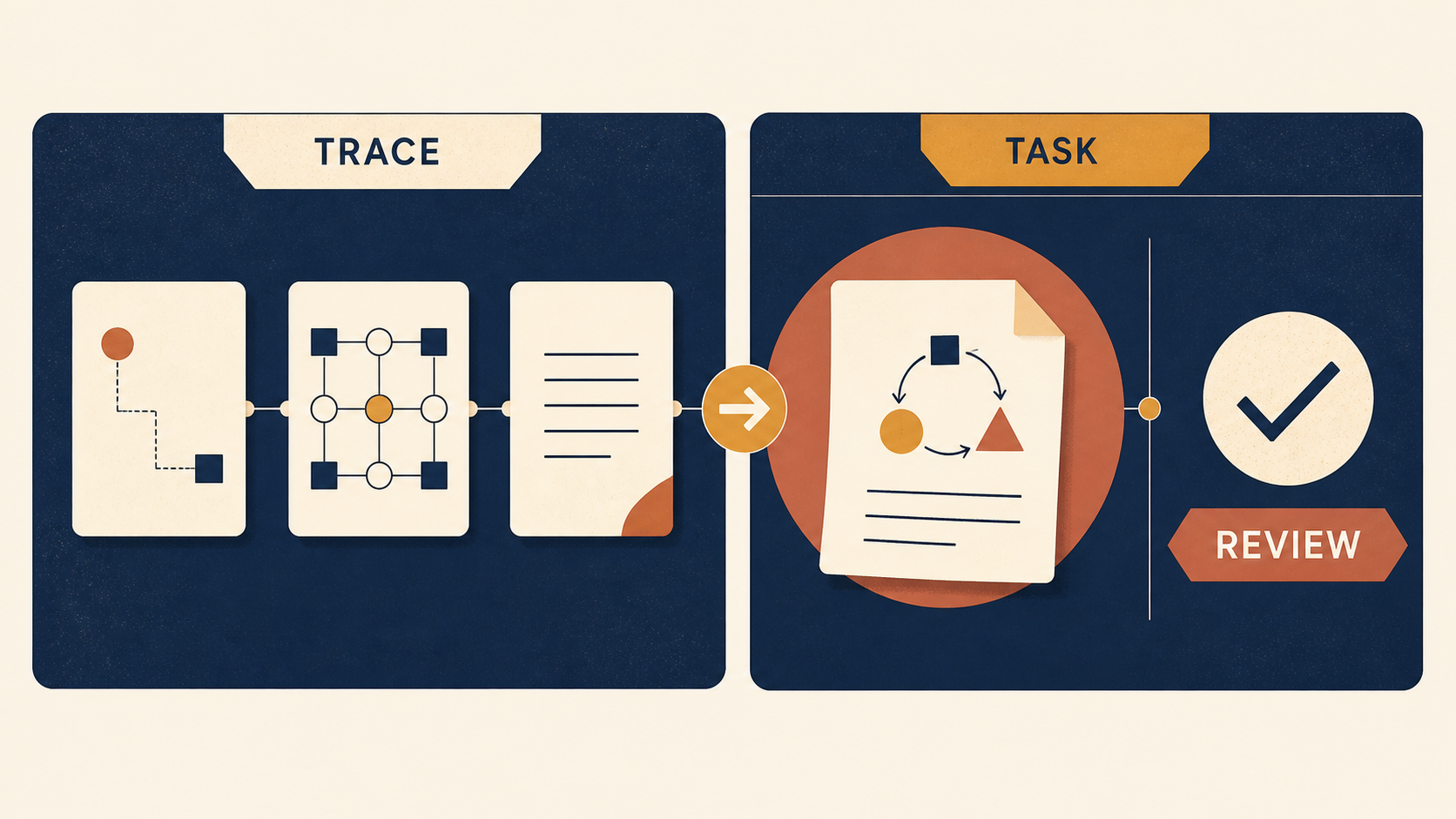
An application trace can be wonderfully specific. It may show a retrieval span, a tool call, token count, latency and an error. That precision makes it tempting to use the trace as proof that a workshop exercise worked or that a consulting intervention created value. It is not that kind of record.
The trace answers a technical question: what happened inside a configured system? A workshop or consulting record answers a human question: who completed what task, under which conditions, and who reviewed the result? Keep both. Do not let one borrow the conclusion of the other.
What belongs in a trace
Alibaba Cloud application-observation documentation describes chains such as vector retrieval, LLM calls and tool calls, together with latency and token metrics. Tencent Meeting statistics distinguish meeting, transcription, intelligent-minutes and viewing counts. These pages show why a technical record needs precise labels. A count of calls is not a count of learners; a completed span is not a completed exercise.
A trace may help answer whether a retrieval node ran, whether a tool timed out, or whether a prompt reached a model. It can support debugging and a narrow technical acceptance condition. It cannot by itself say whether the retrieved source was sufficient, whether a learner understood the result, or whether a client adopted the workflow.
A two-record design
Keep a technical trace and a delivery evidence card side by side:
| Technical trace | Human delivery record |
|---|---|
| retrieval/tool/model spans | task prompt and expected output |
| latency, token and error fields | learner or team context |
| request and response identifiers | reviewer and rubric |
| system configuration | exception and follow-up decision |
Use a common reference ID if needed. That makes a failed tool call explainable without pretending that the failure is the workshop result.
Fictional scenario
Consider a workshop exercise in which learners must produce a source-linked answer. The fictional trace shows retrieval succeeded, a tool call returned in 1.8 seconds, and the model produced a response. The exercise evidence shows that the learner did not identify whether the sources actually supported the recommendation. The trace is complete; the learning task is not passed.
That is not a contradiction. It is the reason the records are separate. The system ran as configured, while the human workflow still needs teaching or review.
The counterexample
If a consulting contract narrowly promises technical fault diagnosis, a trace may be part of the acceptance package. For example, an agreed deliverable might identify where a tool call failed under a specified test. In that case the trace supports the technical claim. It still does not prove that a later workshop improved skills or that a client deployed the fix.
Do not turn metrics into adoption
Meeting views, transcript counts and AI-minutes usage can show that a product surface was used or counted. They do not show that the user accepted a recommendation, learned a method or changed a business process. Similarly, zero errors in a sample trace do not prove general reliability. State the sample, configuration and test condition.
For the broader product boundary, see Product Portability Audit. For human task evidence, see AI-Agent Workshop Evaluation. For access and delivery path evidence, read End-to-End Access, Payment and Delivery Test Script.
What the sources cannot prove
The official pages support technical trace or meeting-statistics concepts. They do not prove model correctness, learner achievement, consulting value, customer adoption, ROI, market demand, platform availability for a particular account, privacy compliance or authorization. Those claims need separate evidence and, where relevant, specialist review.
A review sequence
First confirm what the trace was configured to observe. Then identify the human task that matters. Finally, record who reviewed the task and what remains uncertain. If no human task exists because the service is pure debugging, say so. If a workshop exists, do not use the trace as its certificate.
If you need a bounded review of technical and human evidence for a China-facing AI workflow, submit a validation request. It does not promise performance, adoption or learning results.
Sources and evidence boundary
- Alibaba Cloud Application Observation — checked 2026-08-24. Supports trace spans and technical metrics; does not prove human outcomes.
- Tencent Meeting Cloud Meeting Statistics — checked 2026-08-24. Supports distinct usage statistics; does not prove adoption or learning.
A trace-to-delivery handoff
State the trace reference, configuration window and missing spans, then open the human record: task, participant context, expected output, reviewer and result. If the technical run failed before the learner could attempt the task, mark the task “not observed,” not “failed.” If the system ran but the output was unusable, record technical success and a human-task exception separately. This avoids calling a clean trace a successful workshop or calling a learner failure a system failure. A localization question may arise even when latency is excellent; send it to editorial review rather than asking the trace to answer it.
What the Chinese documentation actually contributes
Alibaba Cloud’s application-observation documentation describes technical chain elements such as vector retrieval, large-language-model calls and tool calls, with latency and token metrics. Those fields can help an engineer reproduce a fault or compare two configurations under a declared test. They cannot establish that a retrieved source was authoritative, that the response was useful to a learner or that a consultant’s recommendation was adopted.
Tencent Meeting’s statistics documentation likewise separates meetings, transcription, intelligent minutes and viewing counts. A meeting count is not an attendance-quality score. A transcript-view count is not evidence that the viewer understood or acted on the content. If a report uses one of these numbers, copy the metric name and observation window exactly. Do not rename it “engagement” unless a separate measurement design defines that term.
Executable handoff fields
Use a shared reference ID, but keep two records. The trace record should contain configuration version, request ID, node or span, start/end time, error state and redaction status. The delivery record should contain task ID, intended audience, prompt or exercise version, expected output, reviewer, rubric result and next action. Add “not observed” when the human task could not be attempted. Add “technical evidence unavailable” when a delivery result exists but the trace was not retained. These states are more informative than one green or red outcome flag.
A fuller scenario and counterexample
In a fictional workshop, retrieval returns three passages and the tool call completes. The learner cites one passage but draws a conclusion none of the passages support. The trace shows a functioning chain; the review record shows an evidence-reading problem. The intervention might be a source-checking exercise, not a faster model. Conversely, if the contract is only to locate a timeout in a client’s application, the trace may be sufficient for that narrow technical acceptance. It still should not be reused as a certificate of workshop learning.
Preserve the handoff
When a trace and a workshop record share an ID, keep the access rules and retention decision for each record clear. Technical logs may contain prompts, tool arguments or identifiers that should not be copied into a teaching recap. A learner-facing summary can describe the task and result without exposing a raw log. The separation is therefore useful for both interpretation and ordinary operational control.
At review, ask two different questions: did the configured system run, and did the intended human task meet its rubric? A “yes” to the first question does not answer the second. A “no” to the first may explain why the second could not be attempted. Recording the dependency keeps a failure useful without inflating it into a verdict.