
“Will I keep access forever?”
It looks like a copywriting question. It is usually an operations question, a product question and sometimes a question nobody has answered yet. That is why a polished FAQ can create more risk than a missing one: it turns an internal assumption into a public promise.
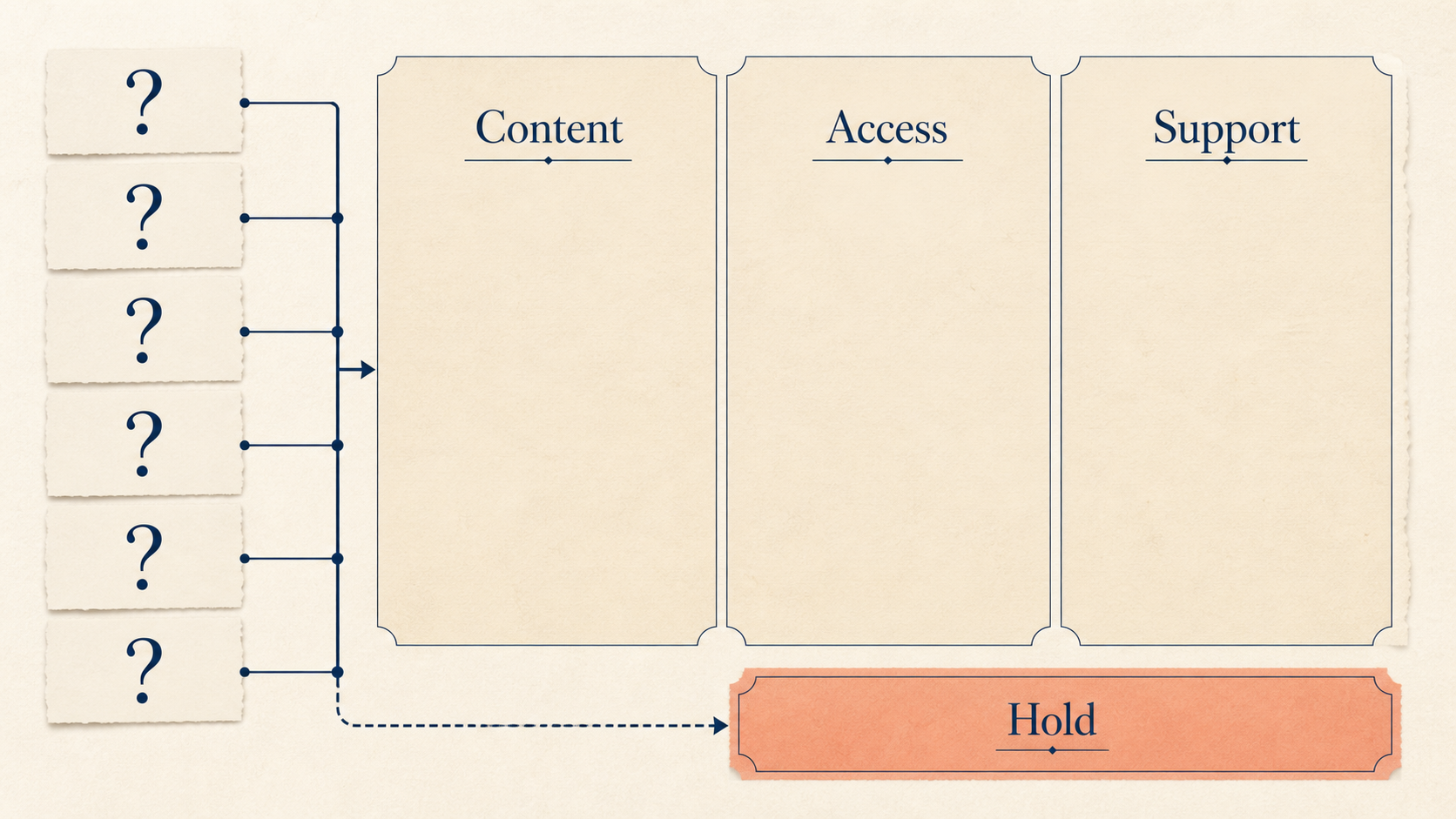
Treat every FAQ line as a commitment matrix. Before an answer appears on a China-facing course page, assign it to one of three owners: content fact, access and delivery, or operations support. Give that owner a source and a change trigger. If neither exists, the answer is not ready for public wording.
Three kinds of questions, three kinds of responsibility
| Question a learner asks | Type of answer | Who should confirm it? | What can change it? |
|---|---|---|---|
| What will I learn? | content fact | course lead | outline or module revision |
| How do I enter the course? | access / delivery | operations owner | link, account or delivery-path change |
| When will questions be answered? | operations support | support owner | staffing or service-scope change |
The categories can overlap. A question about a live session may involve course content, a delivery link and support coverage. In that case, do not squeeze it into a single reassuring sentence. Break it into the specific facts that can be confirmed.
A constructed page review
Consider three familiar draft answers:
“Permanent access, weekly updates, and live Q&A included.”
The first phrase needs an access owner and a defined basis. The second needs a version or editorial owner. The third needs an operations owner and a support scope. If the team cannot name those people or records, the correct next step is not softer marketing language. It is a hold.
This is particularly important when a team is using a new content or delivery path. Course payment friction can identify where a buyer stopped; it does not justify inventing a delivery promise. A training procurement brief is likewise not an unlimited support obligation.
Build the matrix in thirty minutes
Export the current FAQ into a table with five columns: visible question, proposed answer, owner, source of truth, and trigger for review. Add a sixth column—safe to publish?—with only yes, narrow it, or hold.
“Narrow it” is an underrated decision. Instead of claiming that every course will receive weekly updates, write only what the team can currently verify: for example, that a named module is reviewed when its stated dependency changes. Instead of saying “live support,” say what support channel exists and what it is intended to handle, if that is known.
The goal is not to make the FAQ legalistic. It is to make it legible and durable. An honest narrow answer often reads better than a confident sentence that the delivery team cannot honour.
Use four answer states
The final column in the matrix should make the editorial decision visible:
| State | What the editor does |
|---|---|
| Confirmed | publish the narrow answer with its owner recorded |
| Needs narrowing | remove the part that exceeds the available evidence |
| Needs operational decision | keep it off the page until the responsible team decides |
| Out of scope | route it to a controlled support or commercial conversation |
This does not make a FAQ evasive. It prevents false precision. “Support is available” can sound generous while concealing an unanswered question: through which route, for what category, and with which response expectation? A narrower answer can be more helpful: “Use the listed support route for access issues; course-content questions are handled through the published session format.” Only publish that sentence if those paths have been confirmed.
The promise audit
Read the page aloud and underline every modal verb: will, can, includes, always, forever, weekly. For each, ask whether it is a content fact, a delivery condition or an operating commitment. Then ask who would know tomorrow if it stopped being true.
This exercise catches wording that seems harmless in isolation. “The course includes updates” may be a genuine editorial plan, or it may be a leftover phrase from a draft. “Available after purchase” may be true for one delivery path and untested for another. The FAQ must not be the place where these distinctions vanish.
How the matrix changes the launch sequence
Build the FAQ early, before final layout. It exposes facts the landing page will need anyway: course scope, prerequisites, delivery route, update policy and support boundaries. Once the owners have checked those fields, the FAQ becomes a compact maintenance list. A change in any source fact opens the corresponding answer for review.
This is complementary to an end-to-end access, payment and delivery test. The test asks whether a route works. The matrix asks whether the page says only what the route and team can support. Neither substitutes for the other.
A counterexample: closed client projects
An approved enterprise project can have a tightly scoped FAQ drafted against its signed scope and client-approved terminology. In that situation, a generic public matrix should not overwrite the controlled document. The matrix is primarily for public-facing material where several internal teams may accidentally make separate promises.
It cannot provide legal, refund, tax, contractual or platform-policy advice. It does not prove account privileges, payment methods or access duration. Its limited, useful purpose is to make a public answer earn its confidence before a learner relies on it.
Keep a source beside the sentence
The simplest maintenance habit is to retain a link or internal record next to each FAQ answer. “Who is this for?” should point to the approved audience statement. “What is included?” should point to the current course outline. “How is access provided?” should point to the confirmed learner route. A reviewer should be able to ask where the sentence came from and receive a concrete answer, not a recollection.
When that source changes, the associated FAQ line is not automatically wrong. It becomes due for review. The editor then decides whether to retain, narrow, change or remove it. This avoids accidental promises surviving from an earlier version of the offering.
What a good hold looks like
Sometimes the best public answer is a transparent boundary: “Availability and delivery details are confirmed for the specific review path before launch.” That is better than guessing a duration, a platform function or a service level. It should not be used to hide basic information that the team ought to know; it is a temporary boundary for facts genuinely awaiting confirmation.
The matrix helps distinguish those two cases. If a question is fundamental to a purchase decision and remains unresolved, the right outcome may be to delay the page, not write a clever disclaimer.
For a practical final check, ask a person outside the drafting team to read only the FAQ. If they infer a benefit, duration or support promise that no owner recognizes, revise the wording before publication. The reader’s inference is part of the public commitment, even where the team did not intend it.
That review also exposes a useful publishing decision: sometimes a question belongs on the course page, sometimes in controlled pre-sale correspondence, and sometimes nowhere until the operating path exists. The point is not to answer every imaginable question. It is to answer the questions that materially affect a reader’s decision without borrowing certainty from a different team or a different version of the product.
What official platform material can—and cannot—add
Platform help pages commonly distinguish course outline fields, subtitles, validity, purchase settings, update frequency and promotional links. That is a useful reminder that a course page has multiple moving parts. It is not a menu of promises an overseas provider should make. These pages do not establish refunds, contract rights, account eligibility, payment availability or service levels.
When not to use a public matrix
For a closed enterprise project with a client-approved FAQ and contract language, follow the agreed project language rather than maintaining a public generic FAQ. And do not use this article to answer legal, refund or rights questions; those require the appropriate approved route.
A commitment matrix cannot make an unverified promise true. It can stop that promise from reaching a learner before the team is ready to support it.
Check payment language against China course payment friction, distinguish the offer from a training procurement service scope, and verify operational claims with the end-to-end test script.
Use a validation review to test the public questions that matter before a course page turns them into commitments.