
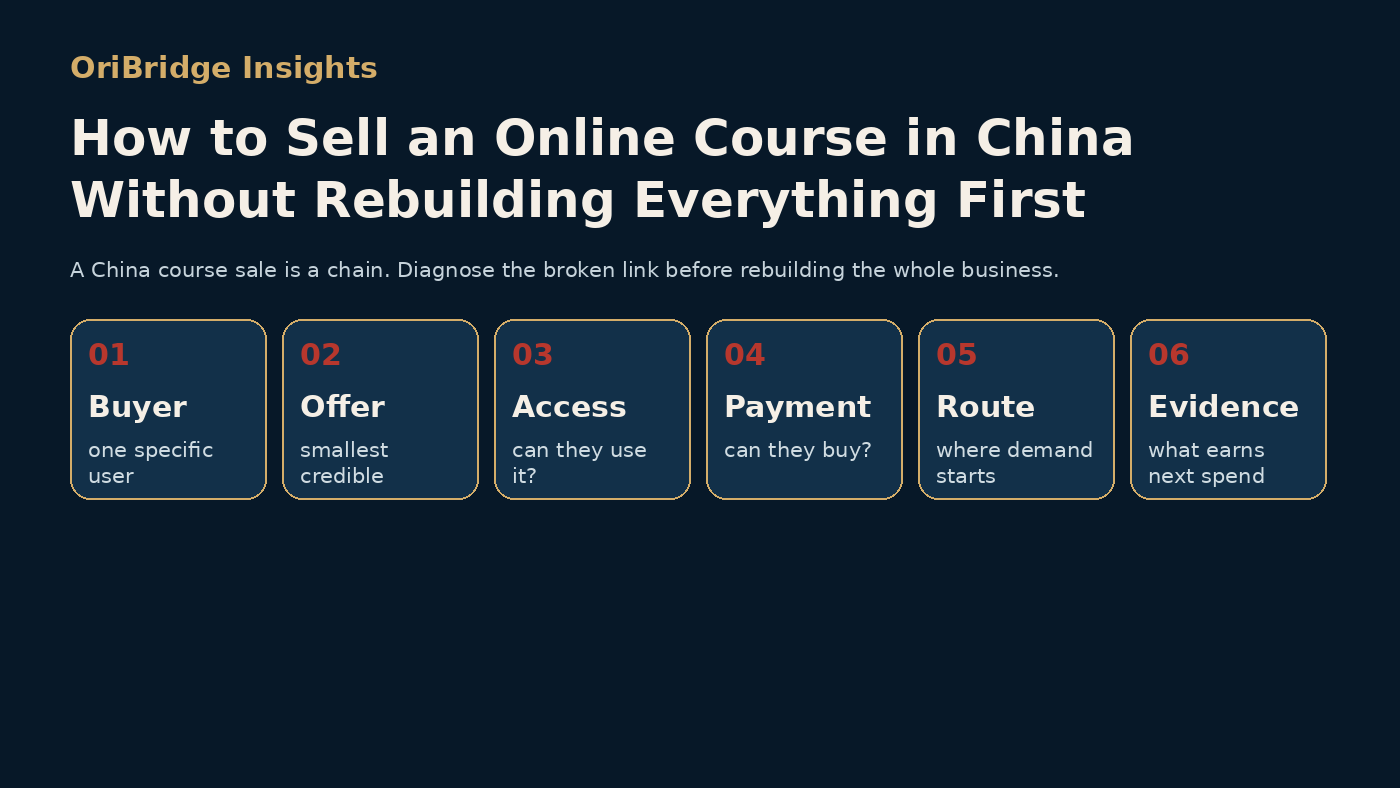
A course owner has a polished English sales page, a library of recordings, and a question that sounds operational: How much of this should we translate first?
It is usually the wrong first question.
The first question is whether a particular person can discover the offer, recognise their problem in it, trust it, reach it, pay if that is in scope, begin the promised learning action, and get help when something ordinary goes wrong. Translation may be part of that path. It is not the path itself.
Start with one buyer, one bounded promise, and the first unknown that could make the route fail. Do not rebuild a whole course to answer a question that a smaller, authorised test could settle.
Can an overseas expert sell an online course in China without setting up a Chinese company?
The useful first step is not to give a blanket yes-or-no answer about company formation. A course creator can design a bounded evidence test of one buyer, one offer, and one access, payment, and delivery chain before making a larger establishment decision. Any paid route or local operating model still needs case-specific legal, tax, payment, platform, and authorization review; this article does not certify one.
What are practical alternatives to a WFOE for a small China sales test?
Do not choose a company structure before deciding what the first test must prove. Four routes may deserve evaluation: a no-transaction demand test; a narrowly scoped test of an existing cross-border route; an authorised local partner or enterprise arrangement; or a China entity when the evidence and operating need justify one. These are questions to assess, not pre-approved legal routes.
| What the team needs to learn | Route to evaluate | What it does not prove |
|---|---|---|
| Whether a defined buyer recognises the problem | An approved concept, interview, or invitation with no sale | Payment, delivery, market demand, or permission to operate |
| Whether the current journey survives under intended conditions | A recorded test of the existing access, account, payment if authorised, delivery, and support chain | That the same route works for every buyer, product, entity, or platform |
| Whether a local commercial route is workable | A written, product-specific review with an authorised partner, enterprise buyer, or relevant platform | That a logo or conversation creates authorization, eligibility, or buyer demand |
| Whether durable local operations justify establishment | Entity, tax, licensing, payment, employment, and compliance advice for the actual business model | That forming an entity fixes a weak offer or missing buyer evidence |
China’s Ministry of Commerce publishes a current foreign-investment guide, while the National Development and Reform Commission and MOFCOM publish the foreign-investment negative list. Those sources define parts of the investment framework; they do not certify a particular online course, transaction, platform account, tax treatment, licence, data flow, or promotion route. Confirm the actual model with qualified advisers and the relevant providers before accepting payment or making a public offer.
- Ministry of Commerce, Foreign Investment Guide of the People’s Republic of China (2025 Edition), checked 2026-08-25.
- NDRC and MOFCOM, Special Administrative Measures for Foreign Investment Access (Negative List) (2024 Edition), effective 2024-11-01 and checked 2026-08-25.
The seven links are a map, not a claim that the route works
Think of a China-facing course journey as seven linked questions:
- Discovery: where might this particular buyer first encounter the offer?
- Relevance: can they recognise a specific job or problem in the promise?
- Trust: what proof helps a first-time buyer judge the expert and the boundary of the claim?
- Access: can the intended person reach the relevant page, identity step, material, or invitation under the stated conditions?
- Payment: if a paid test is authorised, can the proposed checkout be tested as one recorded route?
- Delivery: can the learner complete the first action that the offer promises?
- Support: when an invitation, role, material, or question goes wrong, who restores the path?
The links should not be read as a funnel template. They are a way to stop five different failures being labelled “China demand.” A prospective buyer who never recognises the problem needs a different next test from one who reaches a checkout but cannot tell who owns the next step.
The source boundary matters here. A platform help page can document one named function or operating surface. It cannot establish that a particular entity, course category, account, promotion route, payment route, or learner journey is available, compliant, or commercially viable. Those answers belong to a documented test for the actual offer.
Begin with the buyer and the first honest offer
“Chinese learners” is not a buyer description. It is a population label.
An early test becomes useful when a course owner can name a person and the job they are trying to finish. An operations lead may be trying to make one recurring workflow reviewable. A manager may need a team to practise one difficult conversation. A specialist may need a bounded production skill before a deadline.
That choice changes what is being sold. A flagship course might be the eventual product, but it is not automatically the first honest offer. The first offer could be one workshop with a finished work product, a small diagnostic, a representative module, or a scoped team session. The point is not to make the product cheaper. It is to make one meaningful outcome observable.
A shorter format is not an excuse to promise an incomplete version of a longer programme. It must still name a complete, honest outcome.
Then ask whether the learning action survives the move
The hidden risk is often not the lesson script. It is the action the learner is supposed to take after the script ends.
Picture an overseas AI course whose first useful exercise asks a learner to create an account, use a named tool, download a workbook, share a result, and get feedback. A Chinese subtitle track could make the explanation understandable while leaving the exercise impossible, misleading, or unsupported. In that situation, the next task is not “translate faster.” It is to identify which dependency changes the promised result and who may approve any change.
The published Localizing an Expert Product for China explains why links, tools, examples, assets, and support can matter as much as words. Its companion, Course Dependency and Terminology Inventory, is the place to record what cannot silently drift.
Neither article certifies that a route is available or that an alternative tool is equivalent. They help a team see which question must be resolved before the course is promised.
Keep payment inside the map, not at the centre of every diagnosis
Payment is one link. It is not evidence that the offer is relevant, trustworthy, deliverable, or authorised.
If a buyer reaches checkout, the team still needs to distinguish a payment-path question from a trust question, an identity question, a delivery question, or an enterprise buying process. Do not solve this by adding a list of wallet logos or declaring that a domestic platform is required. The only responsible question is whether a specific, authorised offer can complete its stated route under recorded conditions.
Do not change the course or the price until the team can name the last confirmed buyer action and the owner of the next handoff. For a route-specific check, use the published End-to-End Access, Payment, and Delivery Test Script.
A limited counterexample: sometimes the existing route is already enough
Not every course entering China needs a new checkout, a local platform, or a full Mandarin build.
Consider a narrow international professional cohort whose existing course environment, payment route, first learning action, and support handoff have already been tested for the intended participant conditions. The programme may still need a clearer China-facing explanation or a different example. But rebuilding the payment and delivery stack before a recorded failure would add moving parts without answering a live question.
This is deliberately a limited counterexample. It does not prove that any overseas route works in China, that a provider is eligible to sell, or that a learner will pay. It simply prevents “localise everything” from becoming the default response before the team has identified the first actual constraint.
For a specialist with a small audience, the smallest useful test may be narrower than a full course launch. Testing a Second Market for Niche Expertise sets out that version of the problem.
Run the smallest test that can change the next decision
Choose one route, not a launch calendar full of routes. Write down the buyer, the promised action, the conditions that must be true, the owner of each handoff, and the observation that would make the team continue, revise, or stop.
For example, a bounded test might reveal one of four things:
- the buyer understands the problem but the offer is too broad;
- the offer is credible but the first learning workflow has a dependency gap;
- the learning path is coherent but the next commercial step is unowned; or
- the route is technically and operationally ready enough to justify a deeper validation.
None of these is a market-wide conclusion. Each is a better second decision than translating a full library on the strength of a general impression.
The broader distinction is covered in A Good Product, a Buyer, and a Channel Are Three Separate Tests: a strong course, a real buyer problem, and a working route are separate propositions.
What this article cannot prove
This is an entry framework, not a China market verdict. It cannot prove that:
- an overseas creator, entity, account, course category, or payment route is eligible or available;
- a platform page, account, checkout, invitation, email, or delivery journey will work for a particular person in mainland China;
- a translated module, alternative tool, workshop, or local partner will produce learning, demand, sales, or a compliant route; or
- a smaller first test creates permission to translate, distribute, sell, or adapt a creator’s materials.
Those claims require the actual permissions, sources, and route-specific evidence. A useful first test reduces one uncertainty; it does not erase the rest.
One unresolved responsibility question often remains: should the existing platform carry the route, or should a local operator own selected links? Overseas Course Platform or Local Partner? separates those operating jobs without assuming either route is available.
The next move is smaller than the whole course
If you have a mature course or expert product, do not start by handing over the full library. Start by naming the buyer, the first completed action, the most consequential unknown, and the authority needed to test it.
Then request a scoped China validation review. Bring the unresolved parts. A credible review makes them visible before the production budget becomes committed.
Sources and scope
- OriBridge published methodology: the four related articles linked above are used as related published OriBridge guidance. They do not prove a reader’s platform availability, payment eligibility, market demand, or rights position.
- Named vendor documentation: Xiaoe Tech merchant instructions is an official vendor help surface. It can support only a description of a named vendor’s documented product surface as checked on 2026-08-24; it cannot prove account eligibility, a particular checkout route, availability, legal compliance, or commercial demand for a reader’s course.
- No Stripe, Xiaoe Tech, payment-method, fee, or platform-eligibility conclusion is retained in this high-level entry article. Those facts, if needed, belong in a separately sourced, route-specific diagnostic with current verification and the appropriate payment/legal boundary review.