
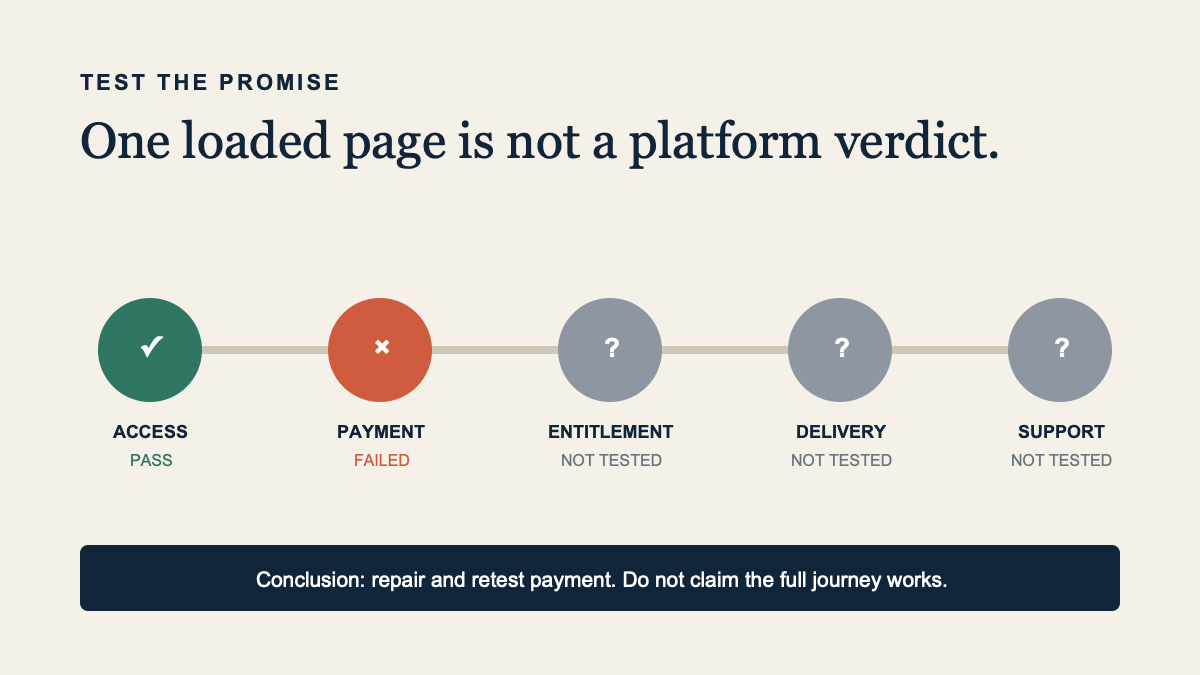
Short answer: a platform page loading in China does not validate a course route. Test the specific promise a buyer is being asked to rely on—such as receiving an invitation, paying, entering a workshop, or getting the first lesson—and record where that promise breaks.
An overseas educator hears that a learner can open the landing page. The team then spends two weeks comparing platforms. Later it discovers that the actual offer depended on a verification email, an entitlement handoff and a live-session link. Nobody tested those three things together.
That is not a platform-selection failure. It is a promise-definition failure.
The claim this article makes
The useful first China platform test is an offer card, not a provider scorecard. A provider can expose several product surfaces; a buyer only notices whether the promise made to them happens. The test should therefore begin with a named buyer, one promised action, the systems required to make it happen, and a result that changes the next decision.
This is deliberately narrower than “Does Maven work in China?” Maven’s current documentation shows that Student Home can contain course content, events and community, while its B2B guidance describes separate ways multiple seats can be purchased.1 Those documents identify product surfaces and conditional workflows. They cannot certify an overseas seller’s account, a China route, a payment method, or a learner’s actual experience. For the decision before this one, see Overseas Course Platform or Local Partner?.
Start with the sentence the buyer could repeat
Before opening any dashboard, write a sentence such as:
A named learner receives an invitation, enters one scheduled workshop, completes the first exercise, and can ask one support question.
That sentence immediately makes missing work visible. It implies an invitation route, identity or enrolment, an event link, a learning asset and support ownership. It does not necessarily imply a public checkout, subscription, marketplace listing or livestream.
A small offer card
| Field | What to write | What it prevents |
|---|---|---|
| Buyer | A named role and circumstance | Treating “China users” as a test subject |
| Promise | The first outcome the buyer is entitled to expect | Calling a page load a delivery pass |
| Required surfaces | Form, message, identity, payment, access, session, support—only when needed | Testing a generic provider instead of the route |
| Excluded surfaces | For example, no public checkout in this pilot | Scope creep disguised as validation |
| Evidence | Sanitised timestamps or system records | “It worked for me” anecdotes |
| Decision | Proceed, repair and retest, or pause | An endless checklist with no consequence |
The card is an OriBridge editorial tool. It does not grant platform eligibility, distribution rights, payment access, or a legal basis for processing personal data.
What a platform test can—and cannot—answer
| Test question | A dated test can observe | It cannot prove |
|---|---|---|
| Can the learner reach the offer? | Whether the stated page and required dependencies opened in the recorded environment | Broad availability for all users |
| Can the learner complete the promised first action? | A recorded pass, partial pass, fail, or not-tested result | Product demand or willingness to pay |
| Does payment connect to entitlement? | Whether that exact authorised attempt created the promised access | Eligibility of every payment method or entity |
| Can support resolve a break? | A response path and time under the test conditions | A scalable support operation |
This distinction matters because payment-method documentation is conditional. Stripe says payment-method support depends on factors including business location, currency and product; its documentation is a reason to test the exact configuration, not a prediction of the result.2
A useful failure is more valuable than a vague pass
Imagine two results.
Illustrative test record A: an operator opens a course page through a particular network. The team writes “platform available.”
Illustrative test record B: a named test learner receives the invite, reaches the registration page, but the required confirmation message does not arrive within the stated threshold. The record says “communications checkpoint: FAIL; payment and course access: NOT TESTED.”
Result B feels less satisfying, but it tells the team what to repair. It also stops the team from rewriting course content to solve an email-delivery failure.
The first failed promise should choose the next test. If a buyer does not understand the offer, revisit the offer. If an order exists but entitlement does not, inspect the handoff. If a learner reaches a live room but cannot complete the promised interaction, redesign delivery. The companion end-to-end access, payment, and delivery test script is for that record; this article is for defining what deserves testing before the record begins.
When not to use a public buyer journey
An enterprise pilot may use a sponsor, named participants, a scoped agreement and controlled enrolment. Forcing it through a public consumer checkout would test a route the buyer was never going to use. In that case, the offer card should explicitly exclude public checkout and test the actual enterprise handoffs.
The reverse is also true: a self-serve course should not be declared ready because an operator manually corrected one enrolment. Manual repair may be acceptable for a bounded pilot, but it is evidence about a manual control—not proof of a self-serve route.
The conclusion worth carrying forward
A platform is not a promise. The first useful test is the smallest buyer promise that would make a later commitment irresponsible if it failed.
Do not use this article to select a provider, claim China availability, approve an account, or infer buyer demand. Use it to define one honest route, then run the end-to-end test script. If payment is part of the promise, keep its diagnostic separate in When Checkout May Be Hiding a China Course Signal. If you need an independent review before testing a wider route, request a validation review.
Sources and limits
-
Maven Help Center, Student Home and How to Facilitate B2B Sales on Maven, checked 2026-09-01. These support narrow descriptions of Maven surfaces and workflows only. ↩
-
Stripe, Payment method support, checked 2026-09-01. This supports the conditional nature of payment-method support, not the result of any OriBridge or reader test. ↩