
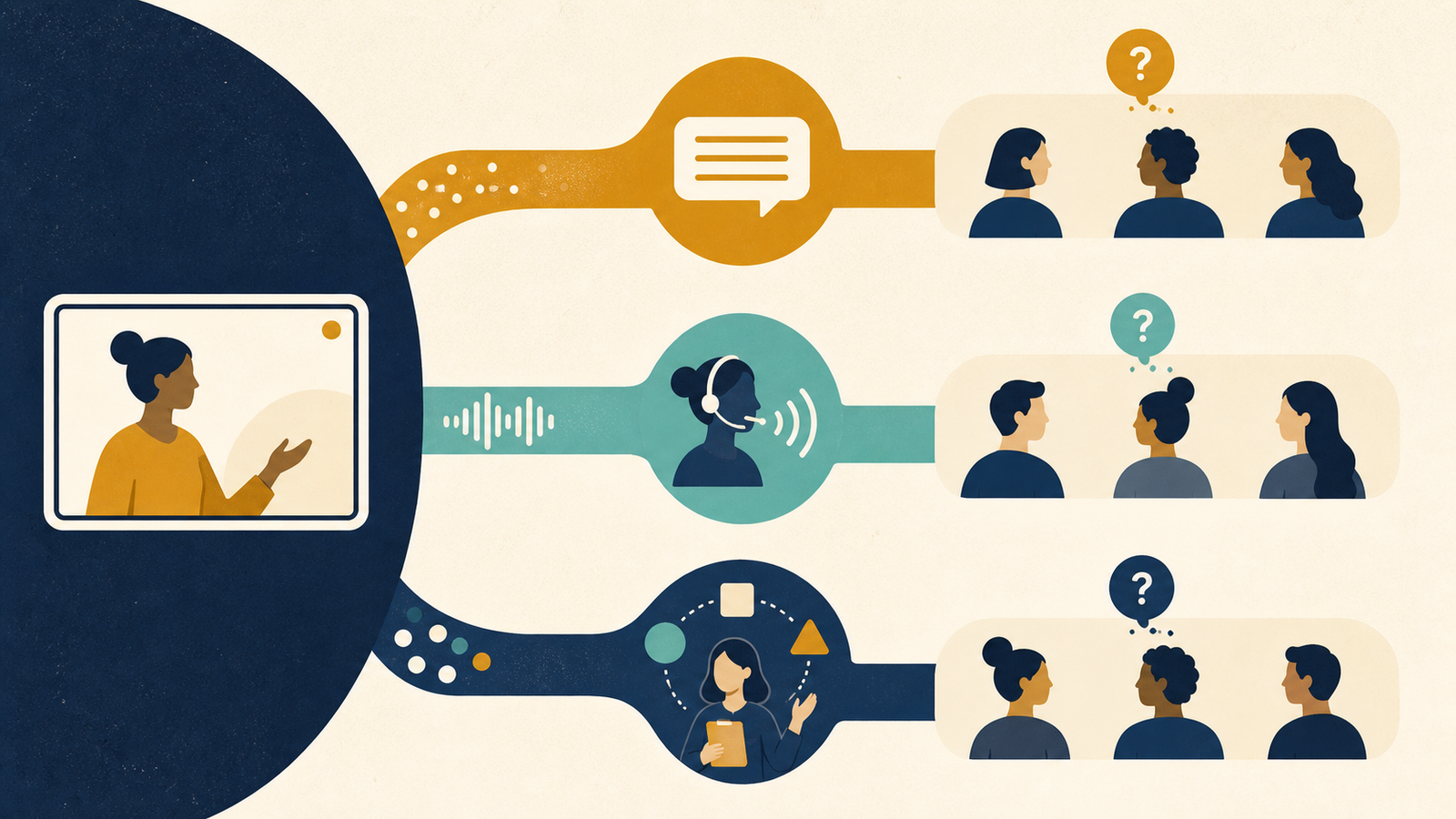
Captions help a participant follow speech. Interpretation helps a participant ask a question. Facilitation helps the group repair a misunderstanding and continue. Those are different jobs, so a live China-facing cohort should assign an owner for each before it buys or configures a language tool.
That distinction sounds small until a workshop is moving quickly. A caption can render “agent memory” accurately enough as words on a screen, while a participant is still unsure whether it means a product feature, a company knowledge base or a teaching metaphor. The technical transcript is present; the learning moment is not yet repaired.
An illustrative hour, not a case study
Imagine a 60-minute AI workshop with an overseas instructor and Chinese-speaking participants. The lesson asks teams to inspect an automated workflow. Captions appear in Chinese. During a demonstration, one participant asks whether “memory” stores company policy or conversation history.
An interpreter can carry the question to the instructor and return the answer. A facilitator can notice that half the room has made the same assumption, pause the demo, redraw the workflow and ask for a concrete example. If the original instructor is speaking quickly, captions remain useful for reference. None of the three functions replaces the others.
The scenario is illustrative. It does not claim that a particular provider, cohort or client achieved a result. Its purpose is to expose a design decision that a tool purchase tends to hide.
Start with the moment that can fail
Use three columns in the delivery brief:
| Learning moment | Minimum job | Named owner |
|---|---|---|
| Following the instructor | Speech appears as readable text | Caption workflow and editor |
| Asking a question | Meaning crosses languages both ways | Interpreter or bilingual channel |
| Repairing confusion | Someone changes the example, pace or instruction | Facilitator with authority to pause |
The owner can be one person in a small workshop, but the responsibilities should remain visible. If the instructor is expected to notice every confusion while teaching in a second language, write that as a risk rather than assuming it will happen.
This is not a request for perfect fluency. It is a request to decide what must remain possible when the lesson leaves the script. A prerecorded, self-paced video may have no live question owner. A cohort with exercises and discussion does.
What the technical documentation actually establishes
Tencent Cloud MPS documentation describes functions for captions in live and offline video, multilingual translation, terminology or hotword configuration and rendering choices. Its intelligent-caption integration documentation also describes prerequisites such as account or service-role configuration and task/result paths for one route.
These documents are useful for an inventory. They show that captioning is a workflow with configuration and outputs, not a magical “turn on Chinese” switch. They do not prove that an overseas operator is eligible to use a particular service, that a feature is available under a particular account, or that machine captions are accurate enough for a lesson.
The CAC Interim Measures for Generative AI Services are a separate boundary source. They define a scope for public-facing generative AI services and describe provider obligations in that scope. They are not a live-class design manual and do not establish that a particular caption or interpretation route is legally sufficient for a specific release.
Keep those statements separate. A product document can support “this function is documented.” It cannot support “your cohort will work” or “this route is approved for your business.”
Captions: the reference layer
Captions are strongest when the learner needs to check wording, follow a sequence or revisit a term. They can help a participant keep up with an instructor’s pace and give an editor a record of where terminology may need a glossary.
They are weaker as the only language plan when the lesson depends on quick questions, social cues or a change in example. A caption might translate a sentence while preserving its surface grammar but not the intended distinction. A hotword list can improve consistency; it cannot decide which meaning the teacher should use.
Before the session, choose a small set of terms that carry the exercise. Test those terms in the actual caption route, not only in a vocabulary spreadsheet. Record the original phrase, displayed translation, intended learner action and a reviewer’s decision. This becomes a release record for the session rather than an assertion that every caption is correct.
Interpretation: the bridge for questions
Interpretation is valuable at the point where a learner needs to interrupt, clarify or challenge. It should have access to the exercise context, not merely a word list. If the interpreter is only translating live speech, define who decides when a question needs to be restated for the group.
There is no universal requirement that every overseas workshop hire an interpreter. A bilingual audience may prefer a moderated chat, and a small expert group may share enough working language to continue. The decision depends on the learning action and the cost of delay. Record the assumption in the test brief, then test it with a real exercise rather than a welcome message.
Facilitation: the owner of repair
Facilitation is not translation with a different job title. The facilitator watches the group, notices silence or repeated errors, and can change pace, examples or instructions. That authority should be explicit. Otherwise a bilingual helper may see confusion but feel unable to interrupt the expert.
A facilitator can also protect the source instructor from being treated as the only support channel. They can collect unresolved questions, label which answer is known, and mark a question for follow-up. The output might be a short correction log, not a promise of ongoing consulting.
For an initial test, define three observable moments: one terminology check, one participant question and one exercise handoff. After the session, compare the intended action with what participants actually did. This is a delivery observation, not proof of learning or conversion.
A decision map for the first cohort
Choose captions as the primary layer when the product is mostly demonstration or explanation, the learner can pause, and questions can be handled asynchronously. Add interpretation when the value depends on live questions, nuance or participant-specific examples. Add a facilitator when the cohort must perform an exercise, discuss a workflow or receive a changed explanation in real time.
Those choices can overlap. “Add a facilitator” does not mean “remove captions.” It means the release plan now contains a named human for the moment a machine output cannot settle.
Do not infer that a larger language stack is automatically better. Extra roles add coordination, cost and failure points. If the lesson is a short prerecorded clip with no discussion, a live-cohort plan is the wrong abstraction; caption quality and an accessible support route may be enough.
Write the release record before production
For each lesson, record:
- the learner action that must survive translation;
- the terms that need a checked glossary;
- the caption, interpretation and facilitation owner;
- the fallback if the live language route fails;
- the unresolved questions to review after the session.
This record also prevents a common mistake: claiming that “Chinese language support” was delivered when only subtitles were produced. Language support is a set of moments and responsibilities, not a single media file.
For broader dependency questions, read Localizing an Expert Product for China. For format choice, see Workshop vs Full Course China Test. For a route-level check, use How to Test a Course Platform in China Without Guessing. The existing Course Dependency and Terminology Inventory is useful when a lesson depends on a technical workflow rather than language interaction.
What not to claim
Do not write “AI captions make the cohort accessible” without specifying the learner action and test conditions. Do not write that Tencent documentation proves a foreign account can use the route. Do not use a regulatory source to announce approval. Do not treat a smooth first session as evidence that a language plan will work for a different audience, topic or pace.
The safer conclusion is narrower: a live cohort has at least three language moments, and a release plan should name who owns each. That conclusion remains useful even when the final decision is to run a small session in English with a bilingual support channel.
OriBridge can help map a live workshop into a bounded language and delivery test, with the evidence boundary written down before production. Request a China validation discussion if your current plan says “captions included” but does not say what happens when a learner is still confused.
Sources and evidence boundary
The Tencent Cloud MPS product functions and intelligent-caption integration, checked 2026-08-23, support only the documented functions and prerequisites described above. The CAC Interim Measures support only its stated regulatory scope and provider obligations. None of these sources proves account eligibility, caption accuracy, learning outcomes, conversion, or legal sufficiency for a particular release.