
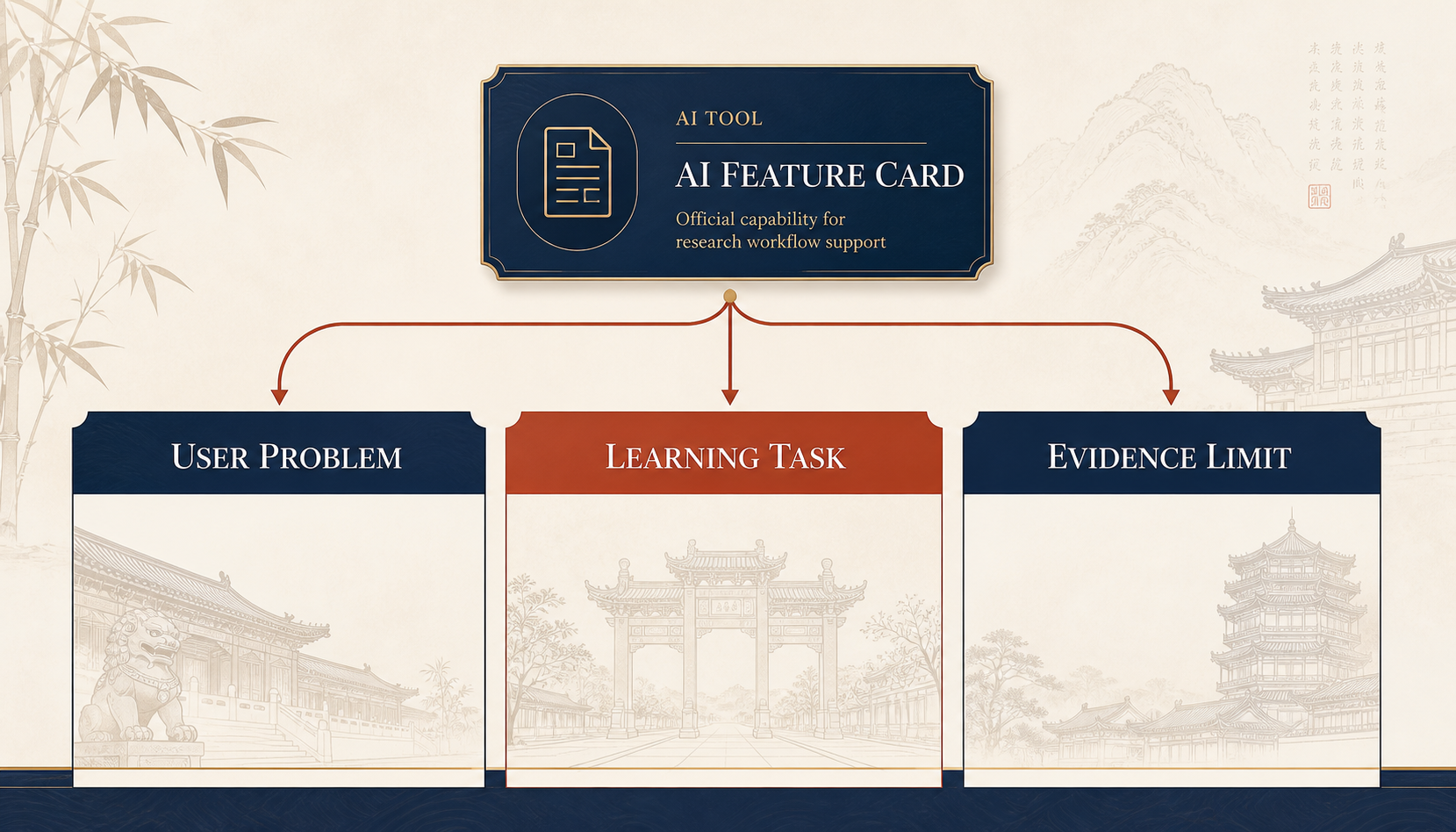
An official feature page appears, and the editorial calendar immediately gains a new idea: “China’s latest AI workflow trend.” The page says that a workflow can use a model, an API, a knowledge base or an MCP node. The team turns that capability into a headline about what Chinese users want.
That is not research. It is a category error.
A product page tells you what a documented tool surface contains. A content map should tell you which reader problem deserves explanation, what learning task can make the problem concrete, and what evidence could change the topic. The feature page belongs in the first column, not the last.
The feature is an observation, not an audience
Alibaba Cloud Model Studio documentation describes workflow applications assembled from components such as models, APIs, knowledge bases and MCP nodes. It is a useful source for identifying distinct workflow objects and configuration questions.
It does not tell you that overseas experts can use a particular account, that a feature is accessible to a Chinese learner, that a product is replacing another product, or that an audience wants a course about it. It certainly does not establish that the feature is “the trend” in a market.
This distinction is easy to lose because feature pages are concrete. They have headings, diagrams and technical nouns. Buyer problems are often less polished: a team cannot tell which part of an AI workflow failed; a manager needs an accountable review step; an instructor’s exercise assumes an account or tool that learners do not have. The latter are content opportunities only after evidence and scope are stated.
A four-column content intake
When a new China AI feature appears, place it into a short intake rather than directly into the calendar.
Capability observed
Copy the narrow function described by the first-party page. “The documentation lists model, API, knowledge-base and MCP nodes” is an observation. Include the URL, date checked and the exact product surface.
Do not write “the platform supports complete agent deployment” if the page only documents one workflow component. Keep nouns attached to the action and condition the page actually describes.
User problem proposed
Write a problem in the language of a person doing work. “A team cannot explain why retrieval returned an irrelevant source” is a problem hypothesis. “China needs better AI” is a market slogan.
The problem can come from an authorized interview, a documented support question, an existing course dependency or a clearly marked editorial hypothesis. The feature page alone cannot supply it.
Learning task
State what a reader would do if the article or workshop were useful. They might map a workflow’s dependencies, compare a retrieved source with a model summary or record the conditions under which a tool call failed.
The task should be narrower than “learn the tool.” A good task can be observed without claiming that the reader improved a business outcome. It also reveals whether the feature is central or merely an optional example.
Evidence boundary
Write what the sources do not prove: account access, eligibility, interoperability, accuracy, popularity, reach, demand, purchase or learning results. This is not defensive boilerplate. It stops the feature page from silently becoming the buyer brief.
Why the research fields should not be merged
Zhihu’s commercial content preparation handbook separates observations such as industry, product, competition, reputation and audience. The document is an older public resource and must not be treated as a current platform guarantee. Its useful editorial lesson is narrower: content preparation contains different kinds of questions, and they should not be compressed into one “topic” field.
Product documentation belongs with product observation. Audience belongs with audience evidence. Competitive context belongs with a comparison record. Reputation or public discussion belongs with its own source and date. A feature can connect these rows, but it cannot replace them.
The difference matters for overseas experts. A tool update may be relevant to a course because it changes a dependency or a demonstration. It may also be irrelevant if the course teaches a durable evaluation method and the tool is only an optional example. The editorial decision should follow the learner action, not the novelty of the release.
A feature-to-topic example
Consider a new MCP-related workflow feature. The first record says only what the official page documents: a workflow can include a tool or service with specified inputs and outputs. The next question is not “Should we write about China MCP trends?” It is “Which existing reader problem would this feature help us explain more precisely?”
One answer might be dependency confusion. An AI workshop exercise asks learners to call a tool, but the source lesson never states the account, service, input schema or expected output. A feature page can help identify the work units that need documenting. It cannot prove that a particular substitute works for a Chinese learner.
Another answer might be evaluation. The reader needs to compare a tool result with an expected action and record failure conditions. In that case the article is about workflow evidence, not a product announcement.
If no reader problem survives after the capability is described, do not force a new URL. Update an existing internal tool dossier or research record instead. A living dossier is more honest than a sequence of short pages whose only difference is the date of a feature launch.
The headline test
Before approving a feature-led topic, delete the product name and ask whether the question still makes sense. “How do I document the dependencies behind an AI exercise?” is a durable problem. “What does [tool] now do?” may be a useful product note but not necessarily an independent reader need.
Then ask whether the answer can be checked. A content page should identify the source observation, the reader’s task, the limitation and the next action. It should not promise that the feature is better, cheaper, more available or more popular without separate evidence.
The existing When Topic Popularity Is Not Buyer Demand handles the broader attention-versus-demand trap. This article focuses on official tool documentation entering an editorial system, rather than on search language or a community screenshot handoff.
For product dependencies, use Localizing an Expert Product for China. Its question is what must change for the learner journey; the present intake asks whether a new feature deserves a new content problem at all.
A short decision sequence
Run the intake in this order:
- Archive the official capability with URL and date.
- Name one reader problem that is not simply “wanting the feature.”
- Define one learning or decision task.
- List the evidence that is missing.
- Decide whether to update an existing page, create a brief or stop.
The order prevents the feature page from dictating the topic before anyone has identified the reader. It also makes a stop decision productive. “No independent problem yet” is a valid outcome.
When a feature page really is enough
There is a limited counterexample. If the editorial purpose is a dated internal product dossier—what the documentation says, which fields are configured and when the page was checked—the feature page may be sufficient for that narrow asset. The dossier should not be presented as an audience map or a demand conclusion.
Likewise, a course specifically about reading AI product documentation can use a feature page as the teaching source. The learning task is then to interpret the page, compare its conditions and state what remains unproven. The source still does not become evidence of market demand.
The editorial judgment
China AI tool documentation is valuable precisely because it gives concrete capability observations. Keep that value by refusing to ask it to answer a different question. A feature page can trigger research; it cannot finish the content map.
OriBridge can help convert a fast-moving tool page into a bounded research brief with a reader problem, learning task and evidence boundary. Request a China validation discussion if your editorial calendar is being driven by release notes rather than by decisions readers need to make.
Sources and evidence boundary
The Alibaba Cloud Model Studio workflow documentation, checked 2026-08-23, supports only its documented workflow components and configuration surfaces. The Zhihu commercial content preparation handbook, checked 2026-08-23, supports only the observation that content preparation can separate industry, product, competition, reputation and audience fields; it is a historical resource and does not establish current platform functionality. Neither source proves a trend, user demand, account access, eligibility, reach, content performance or commercial result.