
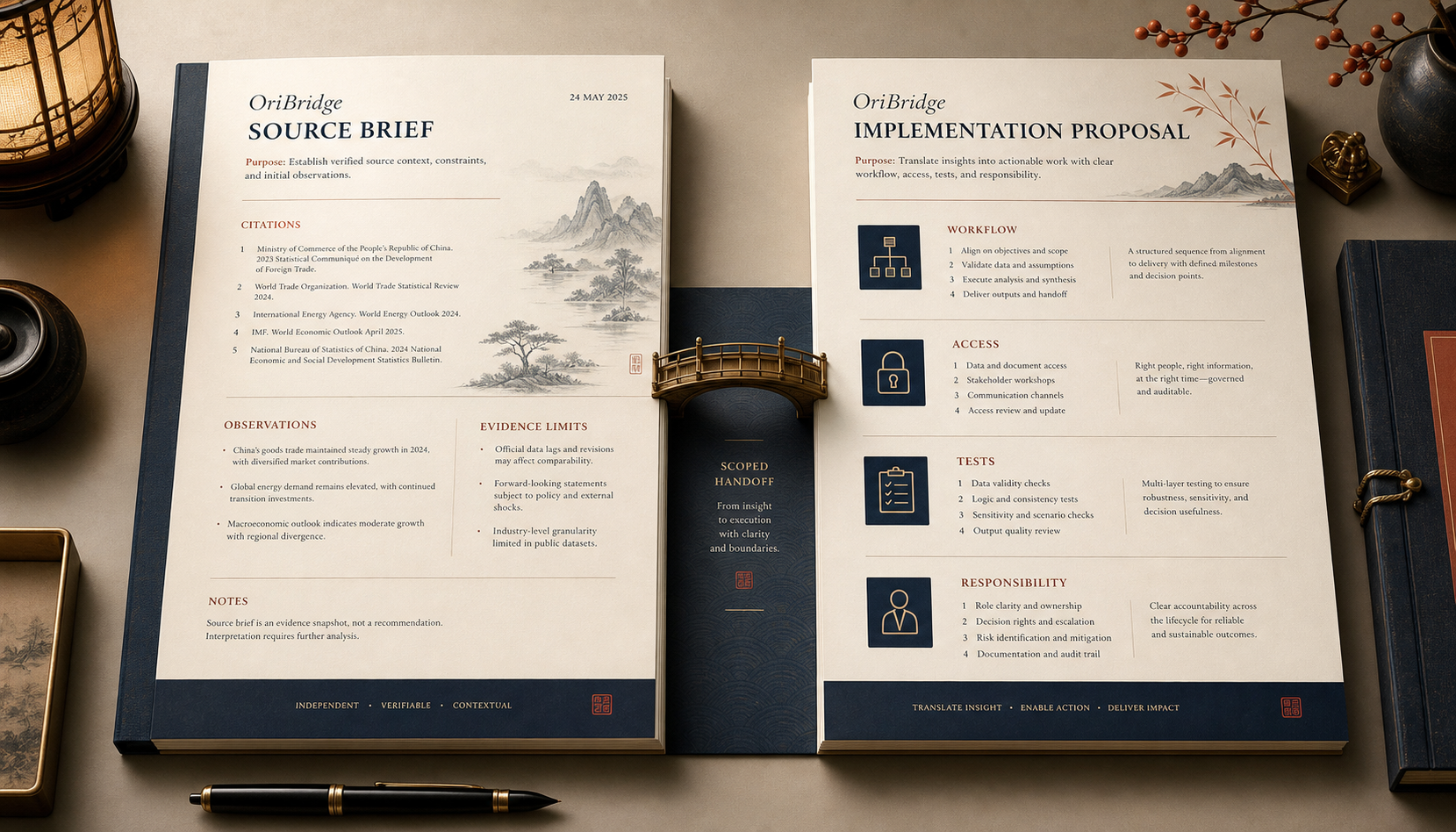
The request sounds small: “Can you give us a one-page briefing on China AI tools?” An overseas consultant delivers a clear landscape note. Then the follow-up arrives: “Great. Now connect the workflow, train the team, and keep it running.”
The second request is not a minor extension of the first. A briefing describes information. An implementation proposal commits to a defined change in a defined environment. Confusing them turns a research note into an accidental promise about access, deployment, support and responsibility.
The handoff moment where scope changes
Consider a client asking what Chinese AI workflow products can do. A responsible briefing might contain dated official links, documented components, observed inputs and outputs, open questions and a list of claims not supported by the sources. It can help a team decide what to investigate next.
An implementation proposal must answer different questions: Which workflow is being changed? Who owns the accounts and data? Which model, API, knowledge base or MCP service is in scope? What can the team access? What is the test case? Who approves the result? Who supports the system after handoff?
The words “we can connect this” move the work into a new category. They should trigger a new scope document rather than silently expand the briefing.
What the official workflow page can and cannot tell you
Alibaba Cloud’s Bailian workflow documentation describes workflows that can include model, API, knowledge-base and MCP nodes. It describes configuration and input/output conditions, and it gives a reader a way to see that these objects are dependencies rather than one interchangeable “AI feature”.
That is valuable briefing material. It can support the sentence: “A proposed workflow should identify which component performs retrieval, which component invokes a tool, and what input/output contract is expected.”
It cannot support: “This overseas expert can deploy it for a client,” “the workflow will work with the client’s data,” or “the platform is an appropriate supplier route.” Documentation is not an access test, a data review, a contract or a delivery receipt.
A briefing has an observation boundary
A strong briefing separates four layers:
Observed: what the official page names, shows or requires.
Interpreted: what that information might mean for the expert’s product or research question.
Unknown: access, versions, credentials, data conditions, service limits, support and operational ownership.
Next check: the smallest evidence needed before a new conclusion is allowed.
For example, the briefing may observe that a workflow has model and knowledge-base nodes. It may interpret that as a reason to inspect a course exercise’s dependency table. It should mark access and reproducibility unknown. The next check might be an authorized technical test, not a promise to the client.
An implementation proposal has a responsibility boundary
The implementation document should not simply copy the briefing’s links into a longer PDF. It should define a work package. A minimal version may include:
- the workflow and user job in scope;
- the environment and access owner;
- the data or sample inputs that may be used;
- the expected output and acceptance check;
- fallback behaviour when a dependency is unavailable;
- training, documentation and support responsibilities;
- what is explicitly excluded.
If these fields cannot be filled, the work may still be research. It is not yet an implementation commitment.
A public project can show scope without becoming a market claim
The National Open University teacher-training procurement intention is a useful public scope example. In that specified project, platform operation, attendance, live-stream support, replay upload, assignments and reports appear alongside training. It shows that a particular public project can list training and operational work as different items.
It does not prove that every Chinese organisation buys training this way. It does not establish a standard fee, a private-company requirement, or qualification for an overseas expert. It should inform how a consultant reads a scope document, not how they build a lead list.
That distinction is especially important when a briefing is used in a commercial conversation. Public procurement evidence can clarify what one document asked for. It cannot silently become “the China market wants implementation support.”
A scene from an avoidable scope failure
An expert sends a two-page note listing Chinese AI tools and their documented workflow components. The note says it is for exploration. During the meeting, the buyer points to one component and asks for a pilot. The expert replies, “That should be straightforward.”
Now four unstated promises exist: access will be possible, the data can be used, the workflow can be connected, and the expert can support it. None came from the note. The safer response is to open a separate implementation discovery step with its own questions, assumptions and stop conditions.
The briefing remains useful. It becomes the input to the next decision rather than a disguised statement of capability.
When a briefing is the right product
A briefing is appropriate when the client needs orientation: a dated map of documented capabilities, terminology, evidence limits and questions for internal owners. It may be a paid research asset or an internal preparation document. Its value is clarity about what is known and what should be checked next.
It should not be embarrassed about being bounded. A briefing that refuses to claim deployment may be more useful than a report that lists vendors and implies a route nobody has tested.
When the implementation proposal should wait
Wait when the request has no defined user job, data boundary, access owner, test case or acceptance condition. Also wait when the only evidence is a marketing page and the client has not authorised a controlled test. The correct next step may be a product portability audit, a technical discovery call, or a separate evidence review.
Do not fill the gap with a generic “implementation roadmap”. A roadmap without an environment and owner is a diagram of assumptions.
A simple decision split
Use this test before accepting the work:
If the client asks, “What do these tools document, and what should we investigate?” the output is a briefing.
If the client asks, “Can you make this workflow run for this team, with this data, under these conditions?” the output must be an implementation proposal or a scoped discovery phase.
If both questions appear in one meeting, write two deliverables with two acceptance criteria. Do not make the first one carry the second one’s risk.
The sentence worth carrying forward is: a tools briefing can clarify the next decision; it cannot make an implementation promise by implication.
If you need to separate research, implementation discovery and delivery scope for a China-facing expert product, request a China validation review. Bring the original request and the tool sources; keep deployment assumptions visible.
Related reading
- A China Training Procurement Brief Is a Service Scope, Not a Course
- Product Portability Audit
- An AI Workshop Seat Price Is Not a Tool Budget
- A Model Evaluation Is Not a Workshop Outcome
Sources and evidence boundary
- Alibaba Cloud Bailian: Workflow applications, checked 2026-08-23. Describes model/API/knowledge-base/MCP workflow objects and conditions; does not establish implementation access, success or supplier qualification.
- National Open University teacher-training procurement intention, checked 2026-08-23. Shows work items in one specified public project; does not establish general demand, price or delivery route.
Image brief: A desk with two clearly separated documents: a dated source briefing and an implementation proposal with workflow, responsibilities, access conditions and tests. No vendor logos, prices or deployment success badges. Alt text: “A China AI tools briefing and an implementation proposal shown as separate deliverables.”