
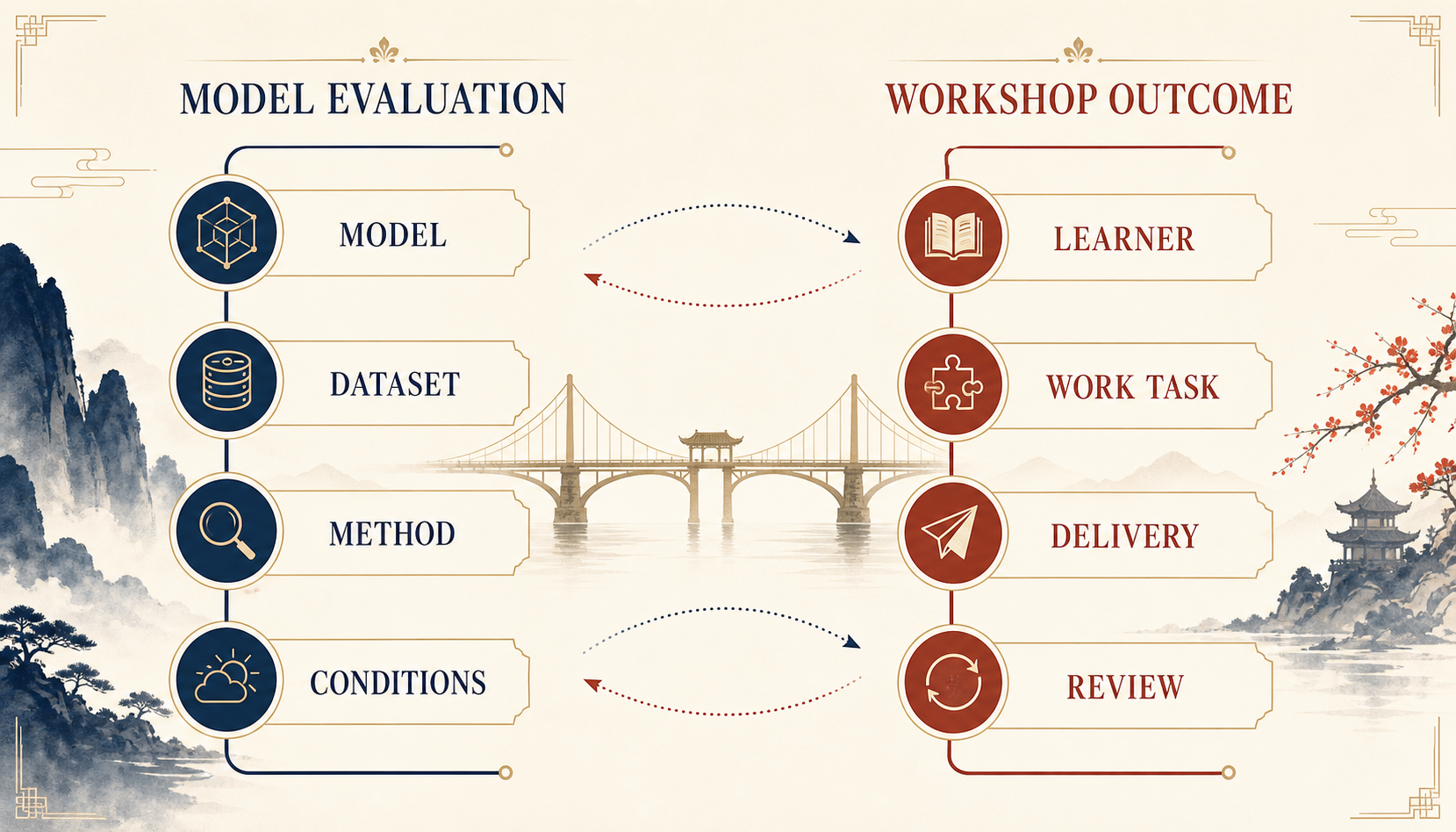
An enterprise sales deck contains a clean number: a model scored well on an evaluation. The next slide proposes a workshop for the client’s team. The visual connection is easy to understand and easy to overstate.
A model evaluation answers a technical question under specified conditions. A workshop outcome answers a learning and delivery question: who completed what work, with which materials and constraints, and how was the result checked? The first can inform the second, but it cannot stand in for it.
Two evidence tracks, two kinds of uncertainty
Volcengine’s official documentation for creating model-evaluation tasks separates the evaluation object, dataset, evaluation method, inference mode and cost. That separation is more important than any isolated score. A score without its object and conditions is not portable evidence.
A workshop needs a different record. It should state the intended learner, the work they must complete, the tools or materials available, the time and support conditions, and the evidence a reviewer will inspect. A team may learn how to read an evaluation report; a benchmark may be one of the materials. But a benchmark result does not show that participants can interpret it, apply the method to their own work, or complete a defined deliverable.
The two records can sit beside each other. They should not be merged into one promise.
What a model evaluation can legitimately support
An evaluation result can support a technical background statement if the source preserves its conditions. For example: a documented task distinguishes a dataset from an evaluation method; a platform distinguishes batch and online inference; a cost field belongs to the configured task rather than to a complete training programme.
That information may help an expert decide what a workshop should explain. It may reveal why a course exercise needs to name the dataset, the method and the inference mode. It may expose an assumption that was hidden in a generic claim such as “the model performs better.”
It does not support the following without additional evidence:
- “This model is the right choice for a client’s workflow.”
- “The client’s team will learn the method.”
- “The workshop will produce a business result.”
- “The score proves enterprise demand.”
- “A public project document is a normal route for an overseas expert.”
These statements concern selection, learning, business impact, demand and procurement. They are different questions.
What a workshop outcome has to name
Start with the learner’s action. “Participants will compare two evaluation methods on a supplied dataset and explain one limitation” is a workshop outcome. It is observable and narrow. “Participants will understand model quality” is not yet an outcome because the work and review condition are missing.
Next define the delivery conditions. Will the exercise use a prepared dataset, a live platform, a local notebook, a supplied worksheet or a discussion only? Does the facilitator review a written comparison, a recorded walkthrough, a configuration file or a verbal explanation? If the tool or account is unavailable, what is the fallback?
Then define what counts as acceptable evidence. A completed table may show that the participant recorded conditions. It may not show that their recommendation is correct in every environment. The evidence should match the claim. A workshop can teach a way to reason without promising a universal technical answer.
A procurement document is not a customer case study
The National Open University teacher-training procurement intention is useful as a bounded public example. In that specified project, platform operations, attendance, live-stream support, replay upload, assignments and reports appear as distinct work items alongside training. This shows that a particular public project can separate teaching from operational support.
It does not prove that private companies have the same requirement. It does not establish a normal price, an overseas supplier route, a qualification, or a demand signal for a model-evaluation workshop. It is a scope example, not a buyer testimonial.
The distinction matters when an expert’s deck says, “Chinese institutions already buy this.” The document may support only the sentence, “This specified public project described these work items.” Anything broader needs its own evidence.
A slide that should be split in two
Imagine a workshop proposal about evaluating AI systems. One slide shows a model’s evaluation score. The next says, “Your team will leave with a reliable evaluation process.”
Split it.
The technical slide should identify the model, dataset, method, inference mode, date and source. It should state that the result is limited to those conditions. The workshop slide should identify the participant, the exercise, the supplied materials, the review method and the unresolved limitations.
The proposal becomes less dramatic but more credible. A buyer can now ask whether the technical evidence is relevant to the exercise and whether the exercise is relevant to their work. Those are productive questions. A single blended claim hides both.
The tempting shortcut: benchmark as curriculum proof
An expert who teaches evaluation may reasonably use a benchmark report in class. That is a material choice, not proof of learning. If the course objective is to teach how to inspect an evaluation, the report can be an example. The instructor still needs to specify what participants do with it and how the work is checked.
The reverse shortcut is equally risky. A successful workshop exercise may show that a group completed a comparison on a supplied dataset. It does not prove that the model is superior outside that dataset or that the exercise predicts future production results.
A counterexample: when the evaluation is the product
There is one narrow case where the evaluation itself may be the deliverable: an expert is commissioned to design or run a defined evaluation task, not to sell a learning outcome. Even then, the model, data, method, inference mode, access and report scope must be named. The assignment is an evaluation service or research asset, not automatically a workshop.
If a workshop teaches participants to perform that evaluation, create a second work package or a separate learning description. The boundary protects both parties from assuming that a technical report includes facilitation, practice, feedback or ongoing support.
A practical two-column review
Before putting an evaluation result into a China-facing workshop proposal, create two columns:
Technical evidence: model, dataset, method, inference mode, source date, cost object and limitation.
Learning evidence: learner, task, tools, delivery conditions, review artifact, fallback and non-guaranteed result.
If a sentence appears in both columns without changing, inspect it. “The model scored 82” belongs to technical evidence. “Participants can interpret a score under stated conditions” belongs to learning evidence and requires a separate activity and review.
The sentence worth repeating is: a benchmark can be workshop material; it is not workshop evidence.
If you are separating technical proof from a proposed China-facing workshop promise, request a China validation review. Bring the evaluation conditions and the intended learner work as two documents.
Related reading
- AI Agent Workshops in China Need Workflow Evaluation, Not Tool Demos
- A Workshop Quote Needs an Operating Layer in China
- A China Training Procurement Brief Is a Service Scope, Not a Course
Sources and evidence boundary
- Volcengine: Create model evaluation tasks, checked 2026-08-23. Describes evaluation objects, datasets, methods, inference modes and cost fields; does not establish a best model or workshop outcome.
- National Open University teacher-training procurement intention, checked 2026-08-23. Shows work items in one specified public project; does not establish general demand, price or overseas supplier qualification.
Image brief: Two-track editorial diagram: model, dataset, method and inference conditions on one side; learner, work task, delivery condition and review evidence on the other. No score comparisons or vendor logos. Alt text: “A model evaluation setup and a workshop outcome shown as two separate evidence tracks.”