
At 9:12 on a Monday morning, the draft is ready. The thumbnail still needs work. A comment is already asking when the next video will land.
By lunch, yesterday’s post has started sliding out of view.
There is nothing wrong with publishing. For many experts, content is how people first discover the work. The problem begins when the business has no memory: every week’s attention has to be rebuilt from scratch.
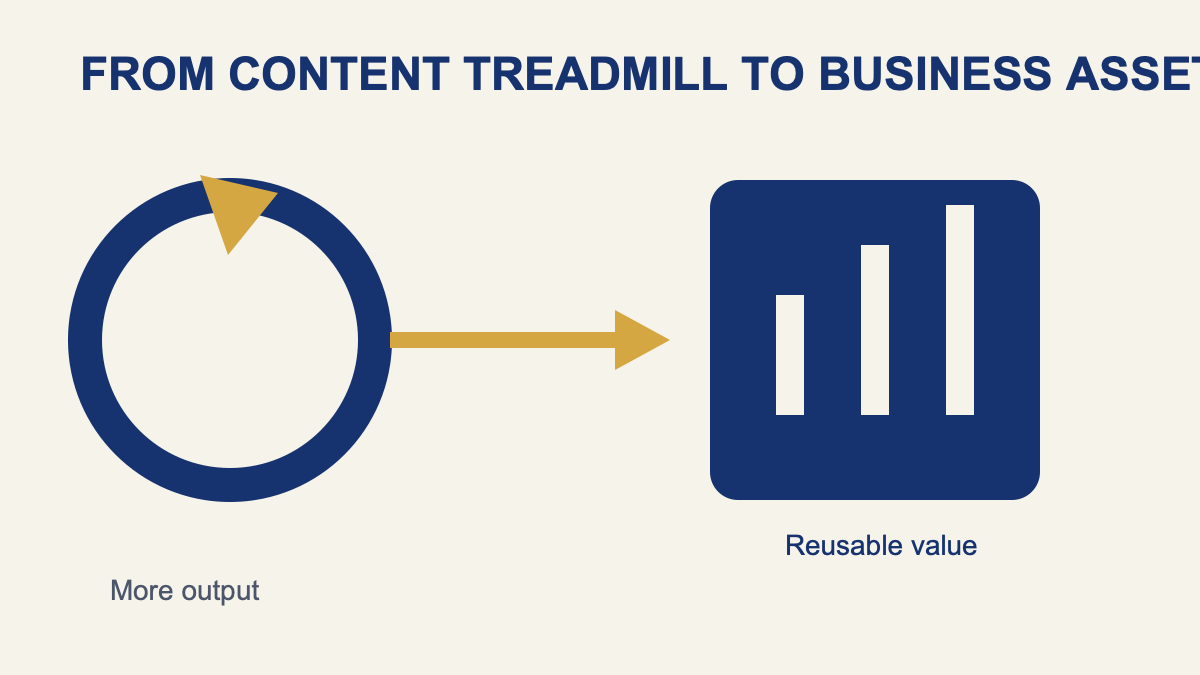
If your business resets to zero every time you stop publishing, the problem is not simply that you need more content. You need to identify which parts of your existing work can keep creating value after the feed moves on. The useful move is not to turn every post into a course. It is to find ideas that answer a recurring problem, contain distinct judgment, form a usable sequence, and can legally be reused. Those pieces can become a guide, workshop, diagnostic, template, module, or licensed asset. More output can increase reach; reusable structure is what gives the business a chance to compound.
The feed rewards freshness. A business needs memory.
Patreon’s State of Create is useful here because it documents the pressure creators feel inside distribution systems. Its sample includes more than 1,000 creators and more than 2,000 fans. The study reports that many creators feel pressure to publish continuously and want more direct ways to reach fans.
That does not prove every expert should publish less. A researcher launching a book, a creator building a new audience, and a consultant filling an event may all need sustained publishing.
It does explain why “just post more” can become a structural trap.
A post is usually designed for a moment. A business asset is designed for another job after that moment has passed.
| Expiring reach | Reusable business asset |
|---|---|
| Gets attention now | Solves a recurring problem later |
| Depends on distribution today | Can be deliberately found, sold, delivered, or licensed |
| Makes sense only in its original context | Retains value after context is explained |
| Needs the creator to recreate the idea | Gives someone a usable structure |
| May contain third-party material casually | Has rights clean enough to reuse |
A folder full of old content is not automatically an asset library.
Storage is not structure.
The Asset Test: four questions before you make something new
Take ten pieces from your archive—not the ten with the most views, just ten that represent your work. If that archive feels like a pile rather than an asset, use the five-part back-catalog inventory before creating anything new.
Then ask four questions.
1. Does the problem repeat?
A recurring question in comments, email, sales conversations, workshops, or client work is a stronger asset signal than a one-time spike in attention.
A post about a temporary product launch may be excellent content and a poor long-term asset. A post explaining why managers repeatedly fail to hand off AI-generated work safely may keep earning relevance because the decision keeps returning.
You are looking for recurrence, not nostalgia.
2. Is there judgment that a generic summary would lose?
“Five tips” are easy to copy. Trade-offs are harder.
Look for the parts where you say:
- this works unless;
- this is the popular answer, but here is when it fails;
- this metric looks good, but it hides the real problem;
- I would not use this method when these conditions are present.
That is usually closer to the commercial value of expertise than another paragraph of explanation.
3. Can the idea become a usable sequence?
A buyer does not pay for your archive. They pay for help moving from one state to another.
Three strong articles can become a workshop if they form a sequence. A set of examples can become a diagnostic if they help someone classify a problem. A recurring checklist can become a toolkit if the buyer can use it without reading your entire history.
The move is from content unit to decision unit.
4. Are the rights clean enough to move it?
This question gets ignored until a creator tries to translate, license, bundle, or distribute old material.
A piece may include a guest contribution, client screenshot, stock image, third-party clip, licensed dataset, confidential example, or platform-specific permission.
If another person or company would need to adapt or sell the material, rights are part of product design—not a footnote after the product is built. OriBridge’s public content-rights boundary separates review, adaptation, publication, advertising, sales, and distribution permissions for exactly this reason.
Repurposing and asset building are different businesses
Turning one webinar into ten short clips is repurposing. It can reduce production cost and extend distribution.
But the commercial model has not necessarily changed. You still have ten things that depend on attention.
Asset building asks a different set of questions:
Who uses this? What decision do they need to make? What is the smallest useful sequence? What evidence or exercise helps them apply it? What happens if the creator is not present? What needs to be updated? Who has permission to operate it?
Those questions can produce a course. They can also produce something smaller and better: a diagnostic workshop, a field guide, a template, a short paid module, or an enterprise session.
Not every expert needs a flagship course.
The adjacent revenue question is not simply how to repurpose more. It is how to let fewer, stronger assets keep working after the daily feed moves on. Less Daily Content, More Durable Revenue develops that distinction without assuming that publishing can stop.
A second market should not become a second content treadmill
International expansion can repeat the same mistake in another language.
An expert is already tired of producing content in English, sees another market, and imagines a second set of social accounts, translations, posts, and livestreams.
That is not diversification. It is duplication.
A second-market test is more interesting when it tests whether an existing asset can do new work. That asset still needs a relationship path that survives changes in platform reach; the Portability Test separates those layers.
Suppose you have years of material about managing remote technical teams. The China question is not “How do we translate the archive?” It is:
- Which problem is already proven?
- Which part of the method survives a different work environment?
- Which examples need explanation or replacement?
- Can a defined Chinese buyer understand the value?
- What is the smallest authorized asset that can produce a real signal?
China is one possible setting for that test. It is not a recovery market for work that has no evidence at home, and it does not guarantee a new revenue stream.
If the method is weak, translation makes the weakness bilingual.
If the method is strong, a second context can reveal which parts are truly durable.
The next-content rule
Before you add the next production sprint, classify the idea.
Publish it if the value is mainly timely attention.
Archive it if it is useful but context-bound.
Productize it if it solves a recurring problem in a repeatable sequence.
Test it in another context only when the asset already has enough evidence to deserve the test.
The point is not to stop creating. It is to stop asking every new piece of content to carry the whole business for twenty-four hours and then disappear.
A durable expert business still publishes. It simply remembers what it learned.
Next step: If you have a mature course, workshop, toolkit, or body of public content and want to test whether one asset could travel into China without rebuilding everything, start with one product and one decision.
Sources
- Patreon, State of Create — creator/fan research; verified August 10, 2026.
- Epidemic Sound, The Future of the Creator Economy Report 2025 — professional-creator research; verified August 10, 2026.
- OriBridge, Content Rights & Authorization — first-party operating boundary; verified August 10, 2026.