
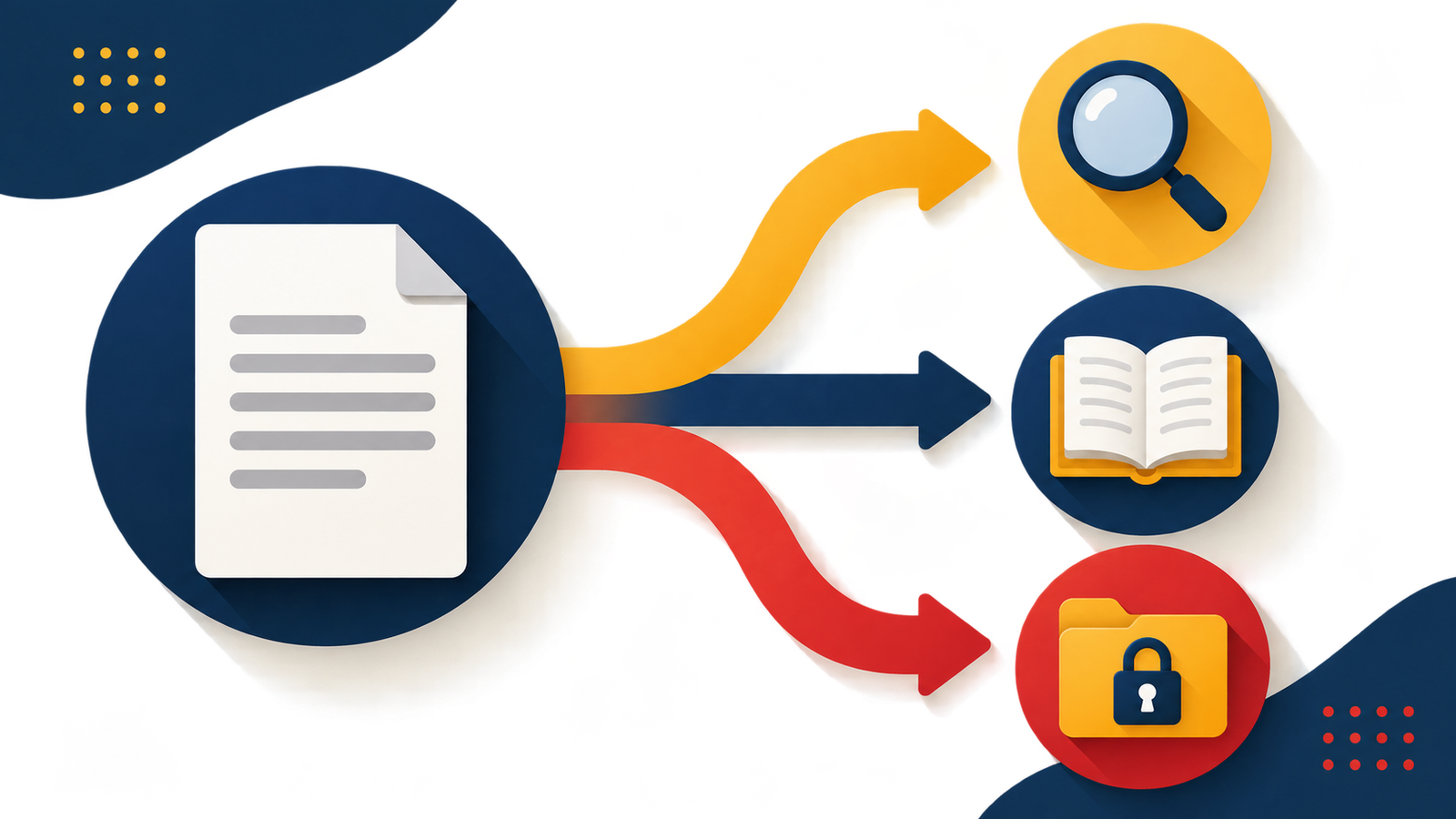
The same document can be a useful doorway, a finished resource, or material that should never be public. Treating those roles as identical is where teams lose control.
The PDF that was meant to collect emails
An overseas instructor has a practical PDF: an AI workflow diagnostic, a workshop worksheet, or a short playbook. In a familiar marketing setup, it becomes a lead magnet. Someone enters an email address, downloads it, and receives a follow-up sequence.
Now imagine the team wants to use that material to learn whether the underlying problem is interesting to Chinese readers. The instinct is to upload the same PDF somewhere public and call it “content distribution.” That can be the wrong move.
A course PDF is not automatically a lead magnet in China. Before it is published, decide whether it is a searchable problem entry, an independent resource, or controlled course material. Each role has a different purpose, a different version boundary, and a different rights question.
Three roles that look alike in a file folder
The file extension does not tell you what the asset is for. Use the role instead.
1. A searchable problem entry
This is a small, public resource that helps a reader name or diagnose one problem. Its job is discovery. It should stand on its own long enough for a reader to understand the issue, without giving away the paid course’s essential sequence or relying on hidden context.
An example might be a one-page “Where does your AI workshop depend on a named tool?” checklist. It gives a reader a clear question to ask. It does not need to reproduce a full course module.
2. An independent resource
This asset completes a modest task by itself: a worksheet, a decision table, a glossary, or a short diagnostic. Its job is usefulness. It needs an owner, a version, a statement of intended use, and a next step that does not pretend the document is the full product.
This is the most easily neglected role. A PDF that gives no complete value is only a teaser. A PDF that gives away the entire paid core may make later product positioning and rights management harder. The better question is: what small decision can this document help a reader make without replacing the course?
3. Controlled course material
This includes core lessons, licensed examples, client-sensitive worksheets, or material whose use depends on enrollment, a specific facilitator, or a permission boundary. Its job is delivery, not public discovery. It may need to remain private even if public exposure would produce more downloads.
That is a business judgement before it is a distribution decision.
What Baidu Wenku changes—and what it does not
Baidu Wenku publicly presents a creator surface for publishing content and describes support for formats including Word, PDF, PPT, Excel, TXT, and images. Its organisation page also refers to continuous content production and to having copyright or sublicensing authority over uploaded content. Those pages are relevant because they show a public document-distribution surface and an explicit rights expectation. See the Baidu Wenku creator/product page, its format help, and the organisation zone.
They do not prove that any overseas creator can open an account, pass a review, earn revenue, obtain search traffic, or publish a particular document. Nor do they turn an uploaded file into a safe rights decision.
The operational lesson is narrower and more useful: a document can be a public knowledge asset, not merely an attachment. Once you see that, you can decide deliberately whether it should be one.
A scene: the diagnostic that exposes the wrong next step
Consider a hypothetical 12-page “AI workflow audit” created for a paid cohort. A team publishes it unchanged. The first pages make sense only after a facilitator’s explanation; later pages contain the real paid methodology; one screenshot includes a third-party tool account. Readers who do download it cannot finish the exercise, while the team has made its strongest course material hard to version and harder to withdraw.
The document failed because it was asked to do three incompatible jobs at once.
A better public version might be two pages: one practical question, a few plain-language prompts, a clear version date, and an invitation to assess the next decision. The full audit remains a controlled course asset. The public PDF is not a miniature course; it is a useful, bounded entry point.
Make the role visible before you distribute it
For every candidate PDF, keep a short asset card:
| Field | Why it matters |
|---|---|
| Asset role | prevents one file from being used as discovery, delivery, and sales collateral by accident |
| Reader problem | makes the public version answer one recognisable question |
| What the resource completes | prevents a “download” that cannot be used without missing lessons |
| What remains controlled | protects core course material and licensed or sensitive elements |
| Rights and permission owner | identifies who can approve public release and later updates |
| Version and withdrawal owner | makes corrections or removal possible if the file changes |
| Intended next step | ensures the document leads to a real decision rather than an empty download |
This mirrors the wider discipline of a Course Dependency and Terminology Inventory: before adapting an asset, know what it depends on and who owns the decision to change it.
When not to publish a PDF
Do not publish a document merely because it may be discoverable. Material containing client information, restricted third-party content, the core of a paid course, or unresolved permission questions should not be made public to test interest. The same caution applies to a document that will mislead a reader unless it comes with live facilitation.
In those cases, a public article that explains the problem at a high level may be safer than releasing the original file. A content test should not quietly become an uncontrolled distribution of course IP.
The useful test is not download volume
If a public document is appropriate, define its role before you measure it. A large download count may mean a broad curiosity signal, a giveaway audience, or automated retrieval. It does not by itself demonstrate that people want the full course or that a paid route exists.
Pair the document with one clear next step and a way to distinguish a general reader from someone who wants to discuss China readiness. For a broader decision about channels, see How to Reach Chinese Buyers Without Being Everywhere. For the separate question of whether attention reflects a buyer problem, see When Topic Popularity Is Not Buyer Demand.
What this article cannot prove
This article does not establish publication eligibility, copyright ownership, sublicensing rights, platform approval, revenue, ranking, downloads, or learner acquisition for any document or creator. Those questions need asset-specific rights review and route-specific testing.
One next step
Before turning a course attachment into a public China-facing resource, request a scoped China market validation conversation. Start by classifying one document into one role. That decision is more useful than uploading the same PDF to every available surface.
Sources and update record
- Sources: Baidu Wenku creator/product page; Baidu Wenku upload and format help; Baidu Wenku organisation zone.
- Need evidence: a route-specific rights review and controlled observation before claiming public access, review approval, discovery, revenue, or demand.
- Original contribution: the searchable-entry / independent-resource / controlled-material asset-role framework.
- Verified: 2026-08-21.
- Next review: 2027-02-21.