
Skip to content
OriBridge东方桥

China Distribution

How Overseas Experts Can Reach Chinese Buyers Without Building Every Channel

A four-stage path from discovery to a measured buyer handoff.

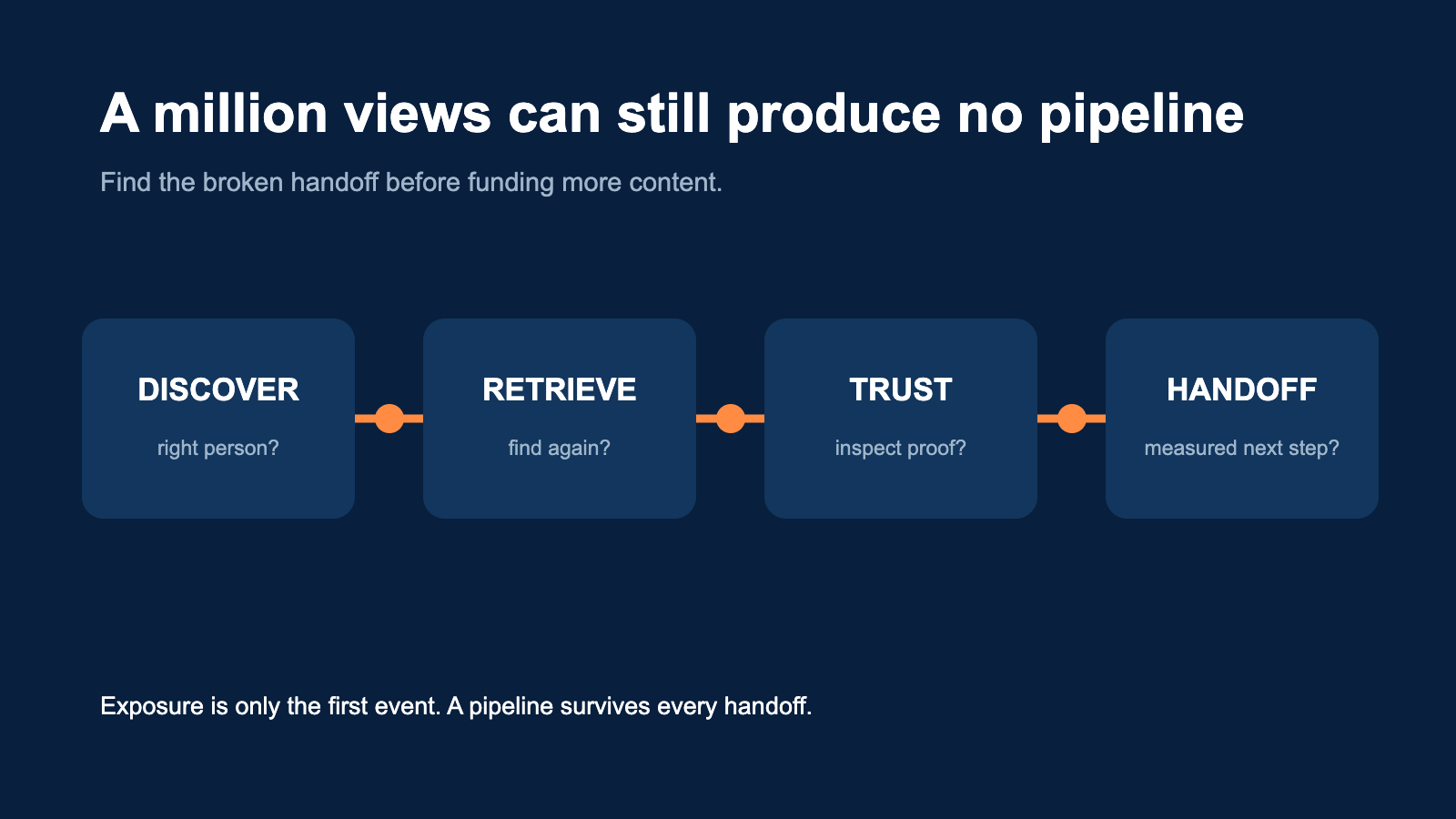
A million views can still produce no pipeline

The weekly report looked excellent: ten short videos, 600,000 views, a rising comment count. The sales report was empty.

The team treated this as a conversion problem and proposed fifty more videos. That would have been a very expensive way to avoid the diagnosis.

Views record an exposure. A pipeline records that a relevant person found the expert again, decided the claim was credible, and completed a next step that someone could actually follow up. Between those two events sit several handoffs. Lose one, and a viral clip can be commercially silent.

The following is an illustrative composite, not a customer case. Its purpose is to show where to look before funding a larger China content engine.

The post that travelled farther than the business

An incident-response educator works with a local content operator. The clips are short, practical, and easy to share. One explains a familiar mistake: an escalation happens late because nobody has agreed who may act. It travels well.

What does not travel is the educator’s identity. Posts use two Chinese renderings of the name and sometimes name only the operator. The profile says the educator has worked with “leading companies,” but offers no inspectable work sample or method. The bio points to a broad English-language checkout page. No one owns the incoming enquiries; the operator sees messages, the educator sees views, and neither sees a qualified conversation.

There may be nothing wrong with the clip. The business path is broken in four different places.

For a concrete discovery experiment, How to Market an Online Course on Douyin separates recognition, proof and movement instead of treating every post as a direct sale.

1. Discovery: did the right person encounter it?

Discovery is the narrowest handoff. It asks whether the content appeared in front of the kind of person who might have the stated problem—not merely whether it entered many feeds.

Kuaishou’s 2025 results describe the scale, engagement and commercial activity of its own ecosystem.1 Douyin’s developer documentation describes a particular sharing capability: shared content can include topics and, where permission is granted, a Mini Program attachment.2 These are two documented platform mechanisms. They do not establish organic reach, qualified audience composition, or conversion for an overseas expert on either platform.

That boundary is worth stating plainly. “Chinese platforms have discovery and handoff mechanisms” is too broad for the available evidence. The stronger, more useful claim is smaller: a platform feature or a large platform company gives you a testable route, not proof that the route will carry your buyer.

For the composite educator, 600,000 views answer only that the clips were exposed. A useful next check would be whether any viewers match the relevant role, whether the video was found through the target problem, and whether the same qualified viewers return.

2. Retrieval: can they find the expert after the feed moves on?

An interested buyer rarely acts while the video is still playing. They close the app, mention an idea in a meeting, and later try to find the person who said it.

That is the point at which inconsistent names, drifting titles, and operator-first accounts become a business problem. Retrieval requires stable naming, a recognisable description of the method, and one durable place for the next useful asset. It does not require owning every social account. It does require that a buyer can reconnect the useful idea to the person and proof behind it.

YouTube’s creator guidance distinguishes signals such as new and returning viewers and what else an audience watches.3 Those measurements do not transfer mechanically to another platform. They are a helpful reminder of the underlying question: was this a one-time impression, or can a person intentionally return?

A practical retrieval test is almost embarrassingly simple. After a delay, ask a few people who fit the intended role to find the expert, the method and the longer evidence without being given a link. If they remember the clip but cannot retrieve its source, the content has created attention for the platform, not a usable route for the business.

3. Trust: is there anything a buyer can inspect?

Reach is not trust translated into another language. Follower counts do not explain what an expert has done, which claim is verifiable, whether the examples fit the buyer’s work, or whether the method depends on inaccessible tools.

The remedy is not a louder biography. It is an inspectable proof asset: a source-linked bio, a worked example, an annotated rubric, a public talk, a clear methodology note, or a carefully labelled illustrative scenario. If a claim cannot be checked, it should be narrowed or removed.

Kit’s 2024 report is a survey of 1,000 creators, commissioned and published by Kit; it is useful creator-economy context, not a market-wide conversion benchmark.4 It cannot tell us how trust transfers to a Chinese buyer. That transfer must be tested against the buyer and offer at hand.

In the composite case, one modest evidence page about incident-response decision criteria may do more than another month of generic clips. It gives a prospective buyer a reason to return and something concrete to share internally.

4. Handoff: what happens after interest?

The final break is often called “conversion,” but that word hides operational details. The handoff is the route from interest to a conversation, diagnostic, sample, checkout, or referral. It fails when the page is inaccessible or unfamiliar, the form asks too much, the CTA is too large for the trust available, the offer is designed for a different buyer, or no owner responds in the buyer’s working day.

For an enterprise-facing offer, a click is not the finish line. Better events include a request for a relevant evidence pack, a completed diagnostic, an introduction to a stakeholder, or a buyer conversation tied to a real problem. The chosen event should be small enough for the buyer to take and meaningful enough to alter the team’s next decision.

This is also why channel expansion should not become a demand for more daily content. A smaller set of retrievable, inspectable assets can compound more reliably; Less Daily Content, More Durable Revenue covers the asset-side decision.

Repair one break, then test again

The composite team should not immediately publish fifty more clips. It could run a smaller probe instead:

  1. Choose one role, one recurring decision and one next action.
  2. Publish a few pieces with the same name, attribution and problem language.
  3. Link them to one bilingual proof asset or bounded diagnostic—not a generic consumer checkout.
  4. Record who owns enquiries and what counts as a qualified response.
  5. Review the path: exposure, retrieval, proof engagement, then the handoff.

If qualified people cannot be identified, change discovery. If they cannot find the source again, repair retrieval. If they return but do not engage with proof, revise the evidence. If they engage but cannot take the next step, fix the handoff. Each failure calls for a different intervention; “more content” is only one possibility.

There is a useful counterexample. A technical explanation may receive 800 views, be saved by a few target managers, shared internally, and result in one well-scoped diagnostic request. That is not enough to forecast a market. It is, however, better evidence of a working path than a million undifferentiated impressions.

Stop conditions are part of distribution work

Pause scaling when target roles cannot be recognised in the audience; when the expert cannot be found again; when trust relies on unsupported claims; when lead ownership and response are undefined; or when repeated controlled probes generate views but no buyer-relevant handoffs. The appropriate conclusion may be to change platform, proof, buyer, or offer. It may also be that the product should not use a China content route at all.

The Portability Test provides a related distinction between platform reach and relationships a business can deliberately maintain. For another useful caution, a niche expert may need the right buyer rather than a mass audience.

What this article cannot prove

Neither platform scale nor a documented sharing feature proves that an account will grow, that a buyer will trust an offer, or that a content operation will make money. This diagnosis cannot forecast acquisition cost, content-market fit, account durability, or China-side legal and operational feasibility. It is a way to make the next test smaller and more legible.

Next step: If views are growing but buyer conversations are not, send OriBridge one public profile or content link and the buyer you hope to reach. We can help identify the first broken handoff before you build a publishing calendar around it.

What the Chinese platform documents do—and do not—tell you

Chinese platform documentation is useful for separating account identity, content distribution, live activity, and transaction operations. It is not a shortcut to a buyer or an operating permission. For example, Xiaohongshu’s professional-account guidance describes the professional account as a commercial-activity identity and distinguishes content/live distribution from the store’s transaction role. China’s network-transaction rules also treat selling services through social and live activity as a transaction context with information and after-sales responsibilities. These are route-design facts, not proof that an overseas expert can open every feature or that a post will convert.

  • Platform fact: an account, a content surface, a live surface, and a transaction surface may be different operational objects.
  • Decision boundary: before choosing a channel, record which entity operates it, what the buyer receives, how price and service information is shown, and who owns after-sales work.
  • Not proven: eligibility for an overseas entity, buyer demand, reach, conversion, payment settlement, or legal compliance for a particular product.

Sources


  1. Kuaishou Technology, “Kuaishou Technology Announces Fourth Quarter and Full Year 2025 Financial Results”, checked 2026-08-12. Supports company-reported platform context only. 

  2. Douyin Open Platform, “Android 分享”, checked 2026-08-12. Supports the described developer sharing mechanism, including topics and permission-dependent Mini Program attachments; it does not support reach or conversion claims. 

  3. YouTube, “Understand Your Audience on YouTube”, checked 2026-08-12. Supports the described audience signals in YouTube’s own product context. 

  4. Kit, “State of the Creator Economy Report 2024”, checked 2026-08-12. A first-party survey of 1,000 creators; used as limited creator-business context only. 

  5. Xiaohongshu E-commerce Learning Center, “小红书专业号和店铺关系规则解读”, read 2026-08-16. Supports the distinction between professional-account identity, content/live distribution, and the store transaction role; it does not establish overseas-entity eligibility or demand.
  6. State Administration for Market Regulation, Network Transaction Supervision and Administration Measures (2025 revision), read 2026-08-16. Supports the narrow social/live transaction and information-disclosure boundary; it is not a route, tax, or legal opinion.
Scroll to Top