
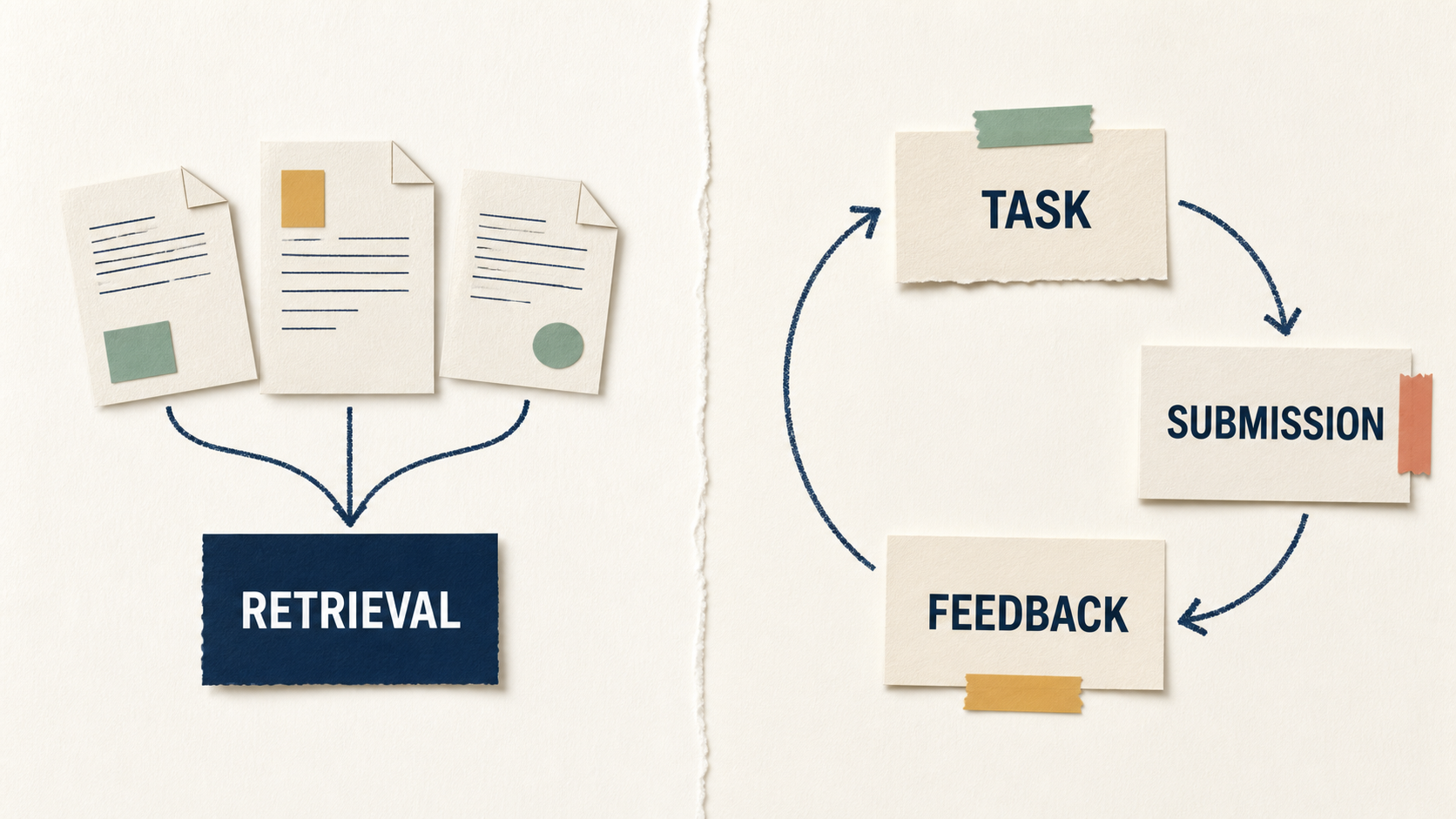
Putting PDFs, slides and FAQs into a knowledge base is tempting. The interface can return an answer quickly, so the team starts calling it an AI tutor. But retrieval is not teaching. A learner still needs to know what problem to solve, what evidence to use, what counts as a good submission and what to do when the answer is uncertain.
Alibaba Cloud and Volcengine publish documentation for knowledge-base configuration. Those documents are relevant because they show a distinct product surface for documents and retrieval. They do not establish that the retrieved answer is correct, that course materials may be used, that learners will improve, or that any particular account/path is available.
Write the learning job first
Before importing a single file, write four lines:
- Task: What is the learner trying to produce or decide?
- Starting evidence: Which documents, data or constraints may be used?
- Judgment point: Where must the learner evaluate rather than copy an answer?
- Check: What visible output lets a teacher or reviewer see whether the task was completed?
For example, “Ask the tutor about AI strategy” is not a learning job. “Compare two supplier claims, cite the underlying documents, identify one uncertainty and propose a next verification step” is. The knowledge base may support that task; it does not create it.
A scene with sixty pages
An instructor uploads sixty pages of notes. The assistant can find a paragraph about research methods. A learner asks, “What should I do next?” The answer may quote a useful passage, yet it cannot tell whether the learner is preparing a market brief, practising source evaluation or requesting operational support. Those are different jobs with different feedback.
If the instructor instead assigns a source-check exercise, the knowledge base becomes one input in a designed workflow: ask, inspect the cited material, flag gaps, submit a conclusion. The course has a task. This is a constructed example, not evidence about model performance.
When a knowledge base is the right endpoint
For an internal support team that needs to retrieve a fixed SOP, a knowledge base may be the complete product. The user already knows the job, the acceptable documents and the escalation route. No artificial course layer is needed.
It is a poor endpoint when the real problem is teaching newcomers how to reason, practise and receive feedback. In that case, first decide what the course changes; then test whether retrieval helps deliver one part of it.
Keep the boundaries visible
Do not claim that a knowledge-base prototype proves China demand, local tool quality, legal permission, course readiness or learner outcomes. It only tests a limited retrieval path. Track source ownership and terminology through a course dependency inventory, and treat workshop outcomes as separate from tool evaluation in this AI-agent workshop guide.
If you are deciding whether an existing expert asset can support a bounded China-facing learning test, request an OriBridge validation discussion. The first deliverable should be a learning job and evidence trail—not a promise that a document chatbot is already a course.
Build a retrieval test before you name a tutor
A responsible first test is deliberately small. Pick one learning task that has a finite source set. Ask a reviewer to use the same question twice: once with the underlying materials open and once through the knowledge-base interface. Record not only whether an answer appears, but whether the answer identifies its evidence, preserves essential qualifications and says when the materials do not answer the question.
The result should be a retrieval observation, not a marketing claim. “The prototype returned an answer that cited the intended document under this test condition” is a defensible record. “The AI tutor teaches the course” is not.
Separate four learner states
It helps to write the lesson flow as four states rather than one chat box:
- Orientation: the learner learns the task and the limits of the materials.
- Attempt: the learner asks, searches or works through the exercise.
- Challenge: the learner checks a cited source, ambiguity or missing premise.
- Review: a human or defined rubric assesses the submitted work.
Knowledge retrieval can contribute to the attempt state. It cannot silently replace the other three. This is especially important when the material has been adapted across languages: a fluent answer can hide a changed assumption.
The source-rights question arrives early
An expert may be entitled to teach an idea but not to upload every slide, client example, licensed illustration or third-party article into a new system. The article is not legal advice and does not decide permission. It does make the missing decision visible: identify which source materials are approved for which use before they are treated as a training corpus.
That is why an inventory must include source owner, version, intended use and review owner, not merely file name. A document that is acceptable as a reference for a facilitator may be unsuitable for learner-facing retrieval.
A counterexample: support is not a lesson
A product team may use a knowledge base to help support staff find an approved answer to a recurring technical question. The staff already know when to escalate and which output is acceptable. In that narrow setting, designing exercises and learner reflection would add friction without value.
The error is not using a knowledge base. The error is borrowing the language of education when the job is operational support—or borrowing the language of support when a novice needs a designed learning path.
The handoff record
For each prototype, retain five items: the learning job, permitted source set, questions tested, observed failure modes and the decision that follows. If a result is ambiguous, label it ambiguous. That record makes it possible to improve the lesson or abandon the prototype without pretending that an interface experiment proved a market.
Before the next iteration
When a prototype changes, do not merely add more documents. Ask which part of the learning job failed. Was the task unclear? Was the source set incomplete? Did the learner need an example, a rubric or a human escalation point? Adding documents to a weak task can make answers longer while leaving the learner equally lost.
Version the test card with the material set and the exact question. That makes it possible to compare two observations without claiming that a changing system has been fully benchmarked. It also makes a later localization review possible: a reviewer can see whether a change came from translation, source selection, task design or a different retrieval configuration.
The practical rule is simple: the knowledge base should make a well-designed task easier to perform. If it becomes the only explanation of what the learner should do, the course design is unfinished.
That is the honest threshold for moving from prototype to teaching asset.
A review question for the instructor
Before release, ask a person unfamiliar with the materials to complete the task and explain why they trusted or rejected an answer. If they can only repeat the chatbot response, the design has not created a judgment step. If they can point to a source, explain a limitation and submit a bounded conclusion, the prototype has generated useful teaching evidence. This is not a learner-outcome study; it is a practical editorial check.
Request a bounded learning-job review before treating a retrieval prototype as a course.
Do not hide uncertainty in the interface
The learner should be able to say, “The materials do not establish that conclusion.” Design a visible route for that answer: an uncertainty flag, a request for additional material or a referral to a human reviewer. Without it, the system quietly rewards confident completion even when the source set is incomplete. The route is part of the learning design, not a technical afterthought.
For adapted material, that route matters twice. The original may be ambiguous, and the localized explanation may introduce another ambiguity. A reviewer who sees the uncertainty can correct the task or the source package; a polished answer alone cannot reveal either problem.
This is why the course brief should specify who owns the answer when the materials are insufficient. A system that cannot say “unknown” is poorly prepared to teach research, diagnosis or any other work that depends on evidence.
That is a teaching outcome worth designing deliberately.