
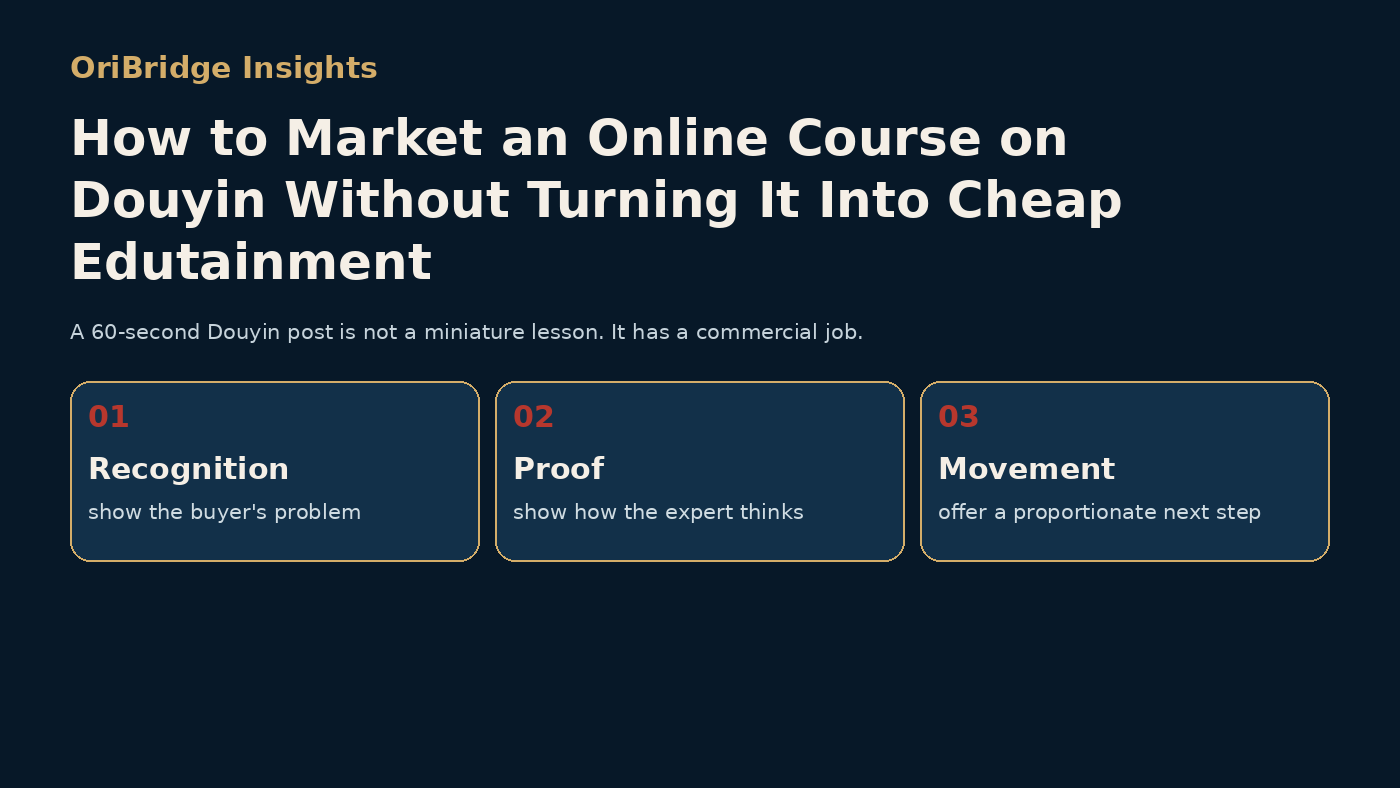
Short answer: a short video should not compress a premium course into free tips. Its first job is to make a costly problem recognisable, show how the expert thinks about it, and invite only the next action the viewer has enough reason to take.
The anxiety is understandable. An expert has built a serious method. Douyin can look like a place where everything must be faster, louder and cheaper. The wrong response is either to dump the curriculum into clips or to hide all the reasoning until someone pays.
There is a third option: use the clip as evidence of judgment.
The claim this article makes
Premium positioning survives short-form content when each piece does one job—recognition, proof or movement—instead of pretending to be the course. These are OriBridge editorial labels, not Douyin product features or growth guarantees. For the broader channel decision, see Reach Chinese Buyers Without Building Every Channel.
A scene a buyer can recognise
Imagine a leadership adviser whose paid work helps teams make decisions across functions. “Three leadership principles” is a neat title but a weak first clip. It gives an unfamiliar viewer no reason to care.
Try a sharper moment: “Your cross-functional meeting may end in agreement because nobody owns the decision after the call.”
The clip does not give away the workshop. It names a cost. The next clip might show the adviser’s diagnostic question: “Which decision changed owner when the meeting ended?” That is proof of reasoning. Only then might a reader be invited to a relevant method note or a bounded diagnostic.
Three jobs; three different claims
| Job | What the piece gives the viewer | What the team is trying to learn | What it must not claim |
|---|---|---|---|
| Recognition | Language for a problem moment | Whether the problem is legible to the intended audience | Market size or purchase intent |
| Proof | One visible reasoning move | Whether the expertise feels specific and credible | Training outcome or qualification |
| Movement | A proportionate next step | Whether that next action is acceptable | Conversion, eligibility or revenue |
The labels keep the team from using one metric to answer every question. A recognition clip can be useful even if it does not sell. A movement invitation is not evidence that the delivery route is ready.
A twelve-piece test is a planning device, not a posting quota
Choose one buyer problem and one permitted next action. Prepare four different moments for each job: four recognition pieces, four proof pieces, four movement pieces. Change only one meaningful variable at a time—problem framing, proof form, or invitation—not the buyer, presenter, channel mechanics and CTA all together.
Stop early if the first few pieces show that the problem is too broad or the proof is misunderstood. Twelve clips are not a platform rule, a recommended frequency or evidence of demand. They are a ceiling that stops a team from creating interchangeable “content” while learning nothing.
The China-specific lesson: content is not the whole operating route
The current public Douyin E-commerce Learning Centre groups education around account setup, short video, livestream, traffic operations, creator collaboration, customer service, order management and fulfilment.1 This is useful as a boundary: short-form content, live interaction, amplification, customer support and order fulfilment are different operating surfaces.
It does not prove that an overseas creator can open an account, advertise, livestream, sell a course, accept payment, issue a refund, or use any platform feature. A real test must check the exact entity, account, asset rights, operational owner, next-step route and stop condition.
When Douyin is not the next move
If the buyer is a training sponsor who needs a clear team outcome, while the expert has no Chinese proof asset and nobody owns follow-up, short-form visibility could manufacture curiosity without supporting a decision. A narrowly scoped workshop proposition, a direct conversation, or a decision guide may be more useful first.
The problem is not that Douyin is low quality. The problem is asking a channel to repair an unmade offer decision.
What this article cannot prove
This article cannot prove channel suitability, account eligibility, traffic, payment, delivery, rights or revenue. It is a framework for an authorised, bounded content test. For the business route around the content, see Choose the China Route That Can Prove You Wrong Fastest.
The conclusion worth keeping
Do not ask a short video to sell the whole course. Ask it to earn the right next minute of attention by making one hard problem—and one piece of expert judgment—visible.
If you need help designing the route around the content, request a validation review.
Source and limits
-
Douyin E-commerce, Official Learning Centre, checked 2026-09-01. The page exposes distinct educational categories for operating work. It does not establish eligibility, availability, recommendation, traffic, sales, payment, fulfilment or compliance for an overseas expert product. ↩