
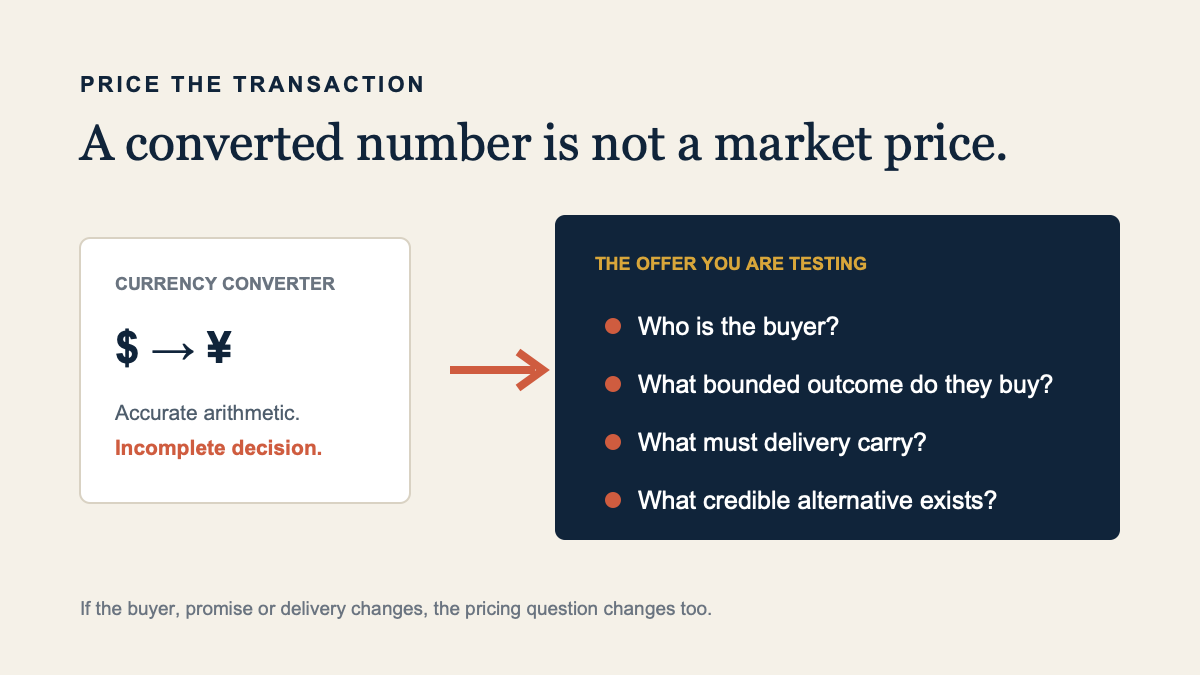
An expert puts a USD course price into a currency converter, rounds it down, and calls the result a China test price. The number looks tidy. The offer does not.
Perhaps the original course was a multi-week English cohort sold to people who already knew the instructor. The proposed test is now a Mandarin-supported team session, with a different buyer, a different decision-maker, preparation work, a local host, and a follow-up question. Those are not two currencies for the same transaction. They are two different things being sold.
The useful rule is simple: price the changed transaction, not the old number in a new currency. This article does not provide a China price, purchasing-power benchmark, or a promise about what any buyer will pay. It is a way to decide whether a proposed test is defined well enough to budget honestly.
Begin with the question the test is meant to answer
Before discussing a fee, write one sentence that makes the uncertainty visible:
A named buyer may pay for a bounded offer because it helps them complete a named piece of work, compared with a credible alternative.
The sentence is deliberately awkward. It exposes vague offers quickly. “Test demand in China” is not a buyer question. “See whether operations leaders will pay for a two-hour diagnostic workshop that leaves each participant with one reviewed workflow brief” is closer. It may still be wrong, but it can be tested.
Four missing terms commonly get hidden inside a price conversation:
- Payer. Is this a self-funded learner, a department manager, or a procurement-led organisation?
- Work product. What can the buyer point to afterwards: a map, a decision record, a pilot brief, or only a feeling of having learned something?
- Delivery burden. Who prepares, facilitates, supports, follows up, and resolves access or language issues?
- Decision rule. What result would make the team revise, pause, or broaden the next test?
If those four terms are unsettled, a price is not evidence. It is just a number attached to an unfinished hypothesis.
Before a negotiation, put a scope card above the spreadsheet: buyer, included work, excluded work, and decision rule. One illustrative card might name a department sponsor; include one preparation call, one workshop, and one decision note; exclude recruitment, platform operation, and ongoing implementation; and stop if the buyer cannot identify the promised work product. This is negotiation preparation, not a rate card or evidence of a China market price.
Separate a market price from a test budget
A market price is a claim about a repeatable transaction. A test budget is a decision about how much uncertainty the team is prepared to purchase.
That distinction changes the conversation. A first test can be deliberately narrow: a buyer interview series, a small workshop, or an access-and-delivery rehearsal. None of those automatically establishes a retail price. They can reveal that the buyer is wrong, the promise is unclear, the operating work is too large, or the route cannot be verified yet.
For example, an illustrative example, not an OriBridge quotation or a market benchmark: a team might set aside USD 1,500 for a tightly scoped interview-and-workshop test. The useful question is not whether USD 1,500 is “the China price.” It is whether the budget names the work it covers—research, preparation, facilitation, language support, administration, and a written decision record—and whether the team will learn something that changes a next move.
If the test only produces a pleasant call and a vague intention to continue, it was not inexpensive because the number was low. It was expensive because it bought little information.
Build a budget that can be challenged
Use a short table before negotiating a number. It is not a rate card.
| Budget line | Question to ask | What it does not prove |
|---|---|---|
| Expert preparation | What must be tailored for this one promise? | That a full localisation is needed |
| Facilitation and language support | Who owns the room, questions, and interpretation? | That any particular platform or account is available |
| Operations | Who handles invitations, reminders, attendance, and follow-up? | That a channel can generate buyers |
| Buyer-facing scope | What is included and what is explicitly excluded? | That the buyer will accept the proposal |
| Evidence record | What observation changes the next decision? | That the market has been validated |
This makes an important counterexample easier to see. If an existing cross-border buyer is purchasing the same standardised English product through the same route with the same support, keeping a global list price can be coherent. Currency conversion is then presentation, not strategy.
But when the delivery model changes, the number must carry the changed work. A lower price cannot repair a workshop that promises too much, an undefined owner for learner support, or a buyer who cannot approve the purchase.
Procurement documents are a scope signal, not a price sheet
Two Chinese public procurement notices for training-related services illustrate a useful limitation. Their listed requirements may combine elements such as design, teaching, organisation, materials, assessment, or acceptance. That supports one narrow observation: a buyer’s service brief can contain more work than “put a course online.” It does not tell an overseas expert what to charge, what an organisation will pay for a different offer, or whether the same requirements apply to a proposed China test.
The practical lesson is to read a public brief as a checklist for questions, not as a competitor price list:
- Which parts are actual delivery work?
- Which parts would require a separate owner?
- Which would be outside a first test?
- What would the buyer need to approve before any broader scope?
If a proposal quietly bundles content adaptation, live delivery, account operation, paid promotion, customer support, and ongoing maintenance, it is not a small test merely because the fee is modest. It is an undefined service package.
The fixed-contract counterexample
Some experts do not need this framework. They already have a clear fixed contract: the same buyer, the same asset, the same delivery responsibility, and a documented route. In that situation, a new market may require compliance and operating checks, but it does not automatically require inventing a new test price.
The framework is for a different situation: when the offer changes faster than the team can describe it. There, forcing a public price too early can create a promise that delivery cannot support.
Do not confuse transparency with certainty
An honest buyer-facing page can say what is included, what is excluded, who does the work, and how the next decision will be made. That is transparency. It is not certainty about demand.
This distinction matters when teams are tempted to hide undefined work inside polite language: “light support,” “flexible adaptation,” or “full local assistance.” Each phrase can make a price look simpler while leaving the delivery obligation unbounded. Replace it with a named limit. For example: one preparation call, one live session, one written decision note, and no platform-operation or ongoing implementation work. The scope can later expand, but it should expand because evidence supports it—not because a number was already announced.
The same discipline protects the buyer. They should not need to infer whether translation, content adaptation, recruitment, technical setup, or learner support has been silently included. A test that cannot explain its boundary is not ready for a price conversation.
If a local operator or course partner will share revenue, the percentage still does not define the deal. The revenue-split calculation guide shows which receipts, deductions, attribution rules, records and exceptions both sides must be able to calculate.
A better first conversation than “What should we charge?”
Ask these five questions instead:
- What single buyer decision are we trying to observe?
- What exact work is inside this test, and what is outside it?
- Who is accountable for each delivery layer?
- What would make us stop rather than add more work?
- Which cost is an experiment cost, and which would recur in a real offer?
The point is not to make budgeting bureaucratic. It is to prevent a converted list price from hiding a new product design problem.
If the buyer, promise, delivery work, and stop condition cannot be stated on one page, do not publish a market price. First define the smallest China test worth pricing.
Sources and boundaries
- Hengqin training-service procurement notice, checked 2026-08-24 — supports only the service-scope items listed in that notice.
- Jiangmen training procurement notice, checked 2026-08-24 — supports only the service-scope items listed in that notice.
- Maven: pricing a course and B2B sales, checked 2026-08-24 — platform-specific examples of different transaction designs, not China pricing evidence.
Related reading: a China training brief can buy a service, not just a course, a workshop seat price is not a tool budget, and a test plan needs stop conditions.