
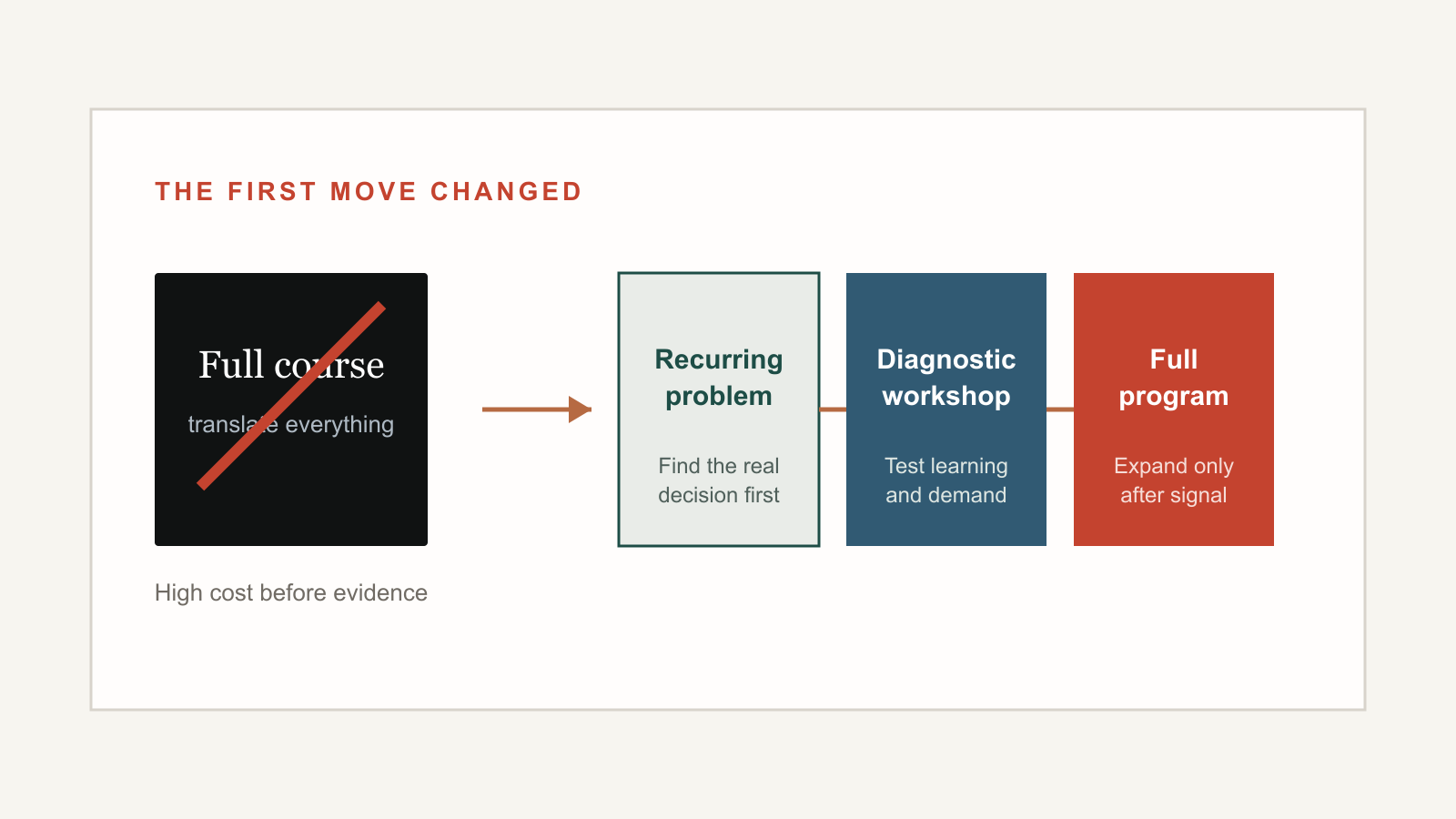
You have a complete course. It works at home. Learners finish it, recommend it, and understand what they are buying. Then someone asks whether it could work in China.
The expensive answer is obvious: translate the modules, redesign the slides, make a landing page, and open a sales channel.
That sequence assumes the course is the thing that needs testing. Often it is not.
The first China decision is usually narrower: which uncertainty would make further work rational? A finished curriculum may eventually be the right product. But it is a poor first experiment when nobody has yet separated four different questions: whether people recognize the problem, whether the proposed format makes sense, whether a route can carry the promise, and whether the experience can actually be delivered.
This is an illustrative framework, not a client case or evidence that a particular course will sell in China.
Do not let a complete curriculum choose the experiment
Imagine a specialist who teaches managers how to run difficult cross-functional projects. The course has eight modules, downloadable tools, live discussion, and a polished English checkout page. A China plan begins with the phrase “localize the course.”
But the first useful question might be much smaller: would a Chinese team leader recognize a particular handoff failure as urgent enough to spend time discussing?
If the answer is unclear, translating module five is premature. If the answer is yes but the preferred format is unclear, a full self-paced build is premature. If buyers respond but the access and support path is uncertain, a large launch is premature.
The work is not to make the course smaller for its own sake. It is to put the unknowns in an order that prevents one large production decision from hiding several smaller unanswered ones.
The four questions that should be separated
1. Is there a recognizable problem?
This is not the same as asking whether a topic is popular. “Leadership,” “AI,” or “career growth” can attract attention without identifying an expensive, recurring problem. Start with a sentence a prospective learner might use in their own work: “Our handoffs keep stalling after the decision meeting,” not “I want to learn better collaboration.”
An early content probe, a short diagnostic prompt, or a moderated discussion can test recognition. It cannot prove a market size or willingness to pay. It only tells you whether the opening problem is legible enough to deserve the next test.
For a route-specific example, Zhihu’s Knowledge Plan documentation describes a content-and-product surface with its own publishing rules and workflow. That is useful as a reminder that a content probe is a surface-specific activity, not a universal demand reading.1 A response on one surface is evidence about that response, not a census of China.
2. What is the smallest format that can test the promise?
The promise “become better at complex projects” may need a different first format from “learn a named software workflow.” A short live clinic can reveal whether people can apply a decision method. A checklist can reveal whether the vocabulary lands. A carefully bounded workshop can reveal whether questions are coherent enough for a cohort.
Do not treat “shorter” as automatically safer. A thin teaser with no usable outcome can create polite engagement and no learning signal. The smallest useful format is the one that asks the learner to do one observable thing: diagnose a case, choose between two options, or return a completed artifact.
Xiaoe Tech’s official instructions describe its own knowledge-product and operational environment.2 The source does not prove that any foreign course is eligible, appropriate, or likely to convert there. It does show why a “format” decision cannot be separated from the specific system in which the format will be configured and delivered.
3. Can the route carry the actual promise?
Discovery, payment, enrollment, community, and support are separate jobs. A route that introduces an idea may not be the route that hosts the learning experience. A route that can display an offer may still leave unanswered questions about buyer identity, enrollment steps, or follow-up.
WeChat’s service documentation illustrates that a service environment has its own account, interface, and implementation conditions.3 Read that narrowly: it is evidence that the environment is not a blank destination. It is not evidence of access, eligibility, commercial fit, or a recommended architecture for your product.
The practical question is therefore not “Which China platform should we use?” It is “Which part of the promise must this route make possible in the first test?” Write that part down before choosing a tool.
4. Can the experience be delivered without inventing new obligations?
A course that relies on a US payment service, an English-only community, third-party templates, or a particular AI tool may be excellent. It still needs a delivery inventory before it is represented as a China-ready offer.
List what the learner must receive, access, submit, and understand. Then mark each item as: available to test, needs confirmation, or cannot be offered yet. This is a readiness exercise, not legal advice and not a workaround for any platform condition.
For more detail on separating dependencies from translation, see Course Dependency and Terminology Inventory.
For a separate planning tool that records a test and its stopping condition, see China Test Plan and Stop Conditions Template.
Choose the first move by what it can falsify
The best first move is not the one that looks most like a launch. It is the one that could honestly make you stop.
| If the unanswered question is… | A first test could be… | A useful negative result would be… |
|---|---|---|
| Do people recognize the problem? | one problem-led piece plus a response prompt | readers cannot connect the wording to a real work situation |
| Does the method make sense in use? | a bounded exercise or clinic | participants cannot complete the task without extensive translation or coaching |
| Is the format plausible? | a short workshop or sample lesson | the expected outcome does not justify the required time or setup |
| Is delivery feasible? | a controlled access-and-support walkthrough | a required step cannot be confirmed or creates an unacceptable support burden |
These are illustrative tests. They are not a formula for demand, a promise of sales, or permission to use any platform.
This order is deliberately different from the buyer-role question. The article Buyer–Problem–Alternative–Delivery Worksheet helps define who might buy and what alternative they use. This article asks what you should test first when a finished course makes every possible next step feel urgent.
A counterexample: when full localization is the right first move
Sometimes the four questions are already answered. You may have a clearly identified buyer group, a confirmed delivery environment, rights to adapt all course assets, and evidence from an existing partner or controlled audience that the course format itself is understood. In that situation, repeatedly running tiny probes may be slower and less respectful than preparing the complete experience.
The framework is not an argument against full localization. It is an argument against using production scale as a substitute for decision order.
What this framework cannot prove
It cannot establish Chinese demand, confirm that a platform accepts a product, determine compliance requirements, validate a price, or grant rights to translate and distribute material. It also does not prove that a small test will predict a larger launch. A small test can only reduce one chosen uncertainty if its result is recorded honestly.
Start with one sentence
Before commissioning a translation, complete this sentence:
“If this first China test fails, we will learn whether the uncertain part was ___, not whether the entire course was good or bad.”
If the blank cannot be filled, the first move has not been chosen yet.
Need a structured way to separate a course’s China questions before committing to a larger adaptation? Request a China validation discussion.
Sources and limits
-
Zhihu, Knowledge Plan manual, accessed 2026-08-24. Supports only that this is a distinct Zhihu product/publishing environment; it does not prove demand or suitability. ↩
-
Xiaoe Tech, Help and instructions, accessed 2026-08-24. Supports only that the provider has its own knowledge-product operational documentation; it does not establish eligibility, payment availability, or results. ↩
-
WeChat Developers, Service guide, accessed 2026-08-24. Supports only that a WeChat service environment has documented implementation conditions; it does not establish access, compliance, or commercial fit. ↩