
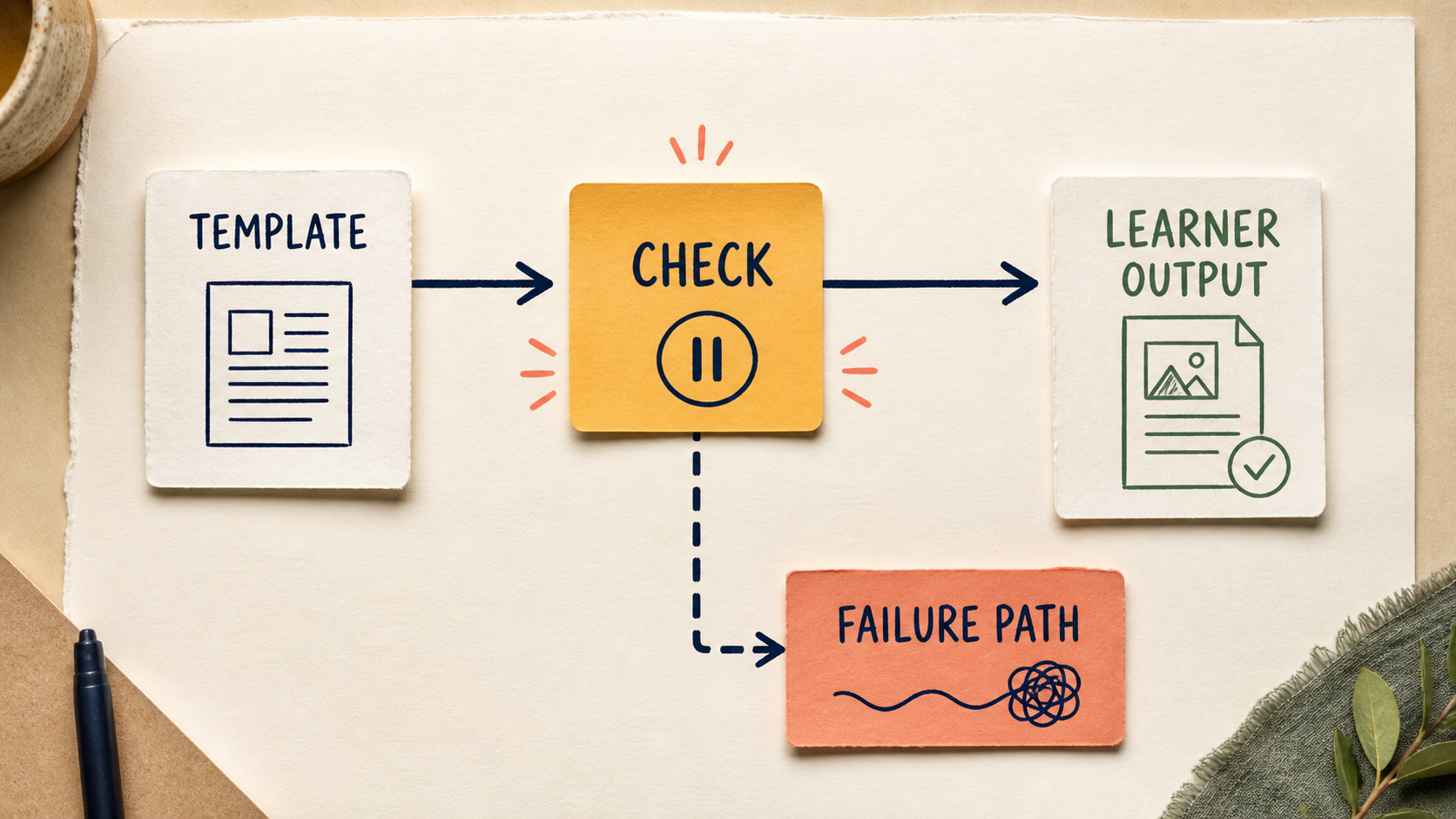
A workflow template can be impressive: input enters, tools run, and an answer appears. That is a demonstration of a path, not proof that a learner understands when to use it, where it fails or how to challenge its output.
Public documentation for Chinese AI application and connected-search products describes configurable capabilities. That is useful context, but it cannot establish that a template is reliable, suitable for teaching, available to a particular user or valuable to a buyer. The course designer still has to create the method.
Add the missing four layers
For every template included in a course, add a method card:
- Task boundary: what question is this workflow for—and what question is it not for?
- Input test: what source, format, freshness and permission assumptions must be true?
- Stop-and-check rule: which output requires the learner to inspect evidence instead of accepting it?
- Reviewable output: what must the learner submit so a reviewer can distinguish copying from judgment?
Take a workflow that gathers web results into a table. The copied template can return rows. A teachable method asks the learner to name the decision, inspect the source behind each row, mark unsupported claims and say when further research is required. The workflow is then an instrument, not the lesson.
Why the failure path is the lesson
Teams often teach the happy path because it is easy to record. But a learner meets the unhappy path first: a source is stale, a tool output lacks provenance, a prompt changes scope, or a result looks complete while answering the wrong question. Explain one of those failures in the course. It gives the learner permission to stop rather than automate a mistake.
This does not mean every internal runbook must become a course. For trained operators following a fixed SOP, a template can be the right level of instruction. The distinction matters when the goal is to teach a new person how to make decisions in a changing environment.
A compact exercise
Give learners the same template and two inputs: one adequate, one deliberately incomplete. Ask them to produce a source-backed conclusion, identify the missing evidence and choose either “proceed,” “ask for clarification” or “stop.” The score should depend on the judgment and evidence trail, not whether the automation ran.
Do not claim that a template’s presence proves model quality, enterprise adoption, China-market fit or course demand. For a real workshop design, separate the model evaluation from the promised learning result; see AI agent workshop evaluation. For tool and terminology dependencies, use the course dependency inventory. OriBridge can help define a bounded method test; it cannot truthfully turn a copied workflow into a proven course outcome.
Design the lesson around a decision, not a diagram
The strongest teaching sequence often begins before the workflow. Give the learner a situation with a consequence: a team needs to compare two public claims before choosing a pilot, but one source is undated and the other is secondary. Ask what must be verified before any automation begins.
Only then show the workflow. The learner can see why the input fields matter. A search connector is not a green light to accept the first result; it is a way to surface material that still needs judgment. A table is not a conclusion; it is a place to record uncertainty.
This structure makes an important distinction. A template teaches repeatability. A method teaches responsible repeatability: the conditions under which repetition is safe, and the signal that tells the learner to stop.
The failure library
Every teachable workflow should include at least three named failure modes drawn from its own task boundary. For a research-oriented workflow, they might be:
- a result without a recoverable source;
- a source that is too old for the decision;
- an answer that quietly changes the reader, geography or time frame.
For each failure, document the observable sign, the learner action and the escalation point. This is more useful than a warning saying “always verify.” It tells a novice what verification looks like.
A classroom check that cannot be faked by copying
Ask each learner to submit three things: the workflow output, one rejected item with a reason, and a short statement of the next uncertainty. A copied template may produce the first. It cannot reliably produce the other two unless the learner has understood the task.
The reviewer should assess the evidence trail, not reward the longest answer. If the learner stops because a source is missing, that can be the correct result. This changes the emotional incentive: stopping is not failure when it preserves the integrity of a decision.
When the template should remain internal
Some templates encode operational details that are too volatile, too sensitive or too dependent on a specific team’s access to become a public teaching method. Others are only useful when paired with a live reviewer. In those cases, call the asset an internal runbook and train the designated operator directly. Do not publish a generic course lesson merely because the automation looks marketable.
The same caution applies across borders. Documentation may describe a configuration surface, but it does not prove that a learner can access it, that data can be used in a lesson, or that a course has a viable China route. Those require separate tests and permissions.
The method card to retain
Keep one card with task boundary, inputs, hidden assumptions, failure signs, stop rule, reviewer and acceptable output. When the underlying tool changes, review this card before re-recording the lesson. It preserves the teaching logic even if the nodes, labels or interface change.
Make updating a teaching decision
When a tool label or model option changes, teams often re-record the screen and call the lesson updated. First compare the old and new method cards. If the task boundary, source standard and stop rule are unchanged, the update may be visual. If the tool changes what evidence is returned or what the learner must judge, the exercise and rubric need review too.
That distinction prevents a cosmetic update from silently changing the method being taught. It also gives the instructor a defensible reason to pause publication until the new failure path has been checked. A current-looking video is not automatically a current lesson.
For a course team, this record is an asset: it lets a new editor explain the learning logic without guessing from the automation graph.
A final editorial check
Read the lesson without running the tool. Can a learner state the decision, identify the first disqualifying condition and describe the output a reviewer expects? If not, the material is still a product demo. Add the missing decision language before adding another screenshot. The goal is not to make the workflow look difficult; it is to make the learner’s responsibility unmistakable.
That test is also a useful protection against AI-flavoured training copy. It requires a concrete judgment and a visible consequence, not generic advice to “use the tool responsibly.”
Keep the assessment aligned
If the lesson asks learners to judge source quality, do not assess them only on whether every workflow node completed. A better review asks whether the learner selected relevant material, named a limitation and chose a defensible next action. This alignment prevents the course from rewarding blind automation while its prose claims to teach judgment. It also creates a useful escalation record when a learner reaches a case outside the template.
Request a method-card review before presenting an internal template as a learner-ready course.
Name the escalation owner
Every teaching method needs a person or role that can decide what happens when the template fails. It may be an instructor, a subject-matter reviewer or a designated support owner. “Escalate to the team” is not enough; the learner needs to know what information to retain and what decision the owner is expected to make. That handoff turns a failure from a vague exception into a teachable part of the operating method.
Document the escalation trigger with the exercise. It helps the next editor preserve the course’s decision logic when the workflow changes.
It also lets a reviewer see whether a learner stopped for a valid reason or simply avoided the task. That distinction is the difference between a useful course record and a completion tick.