
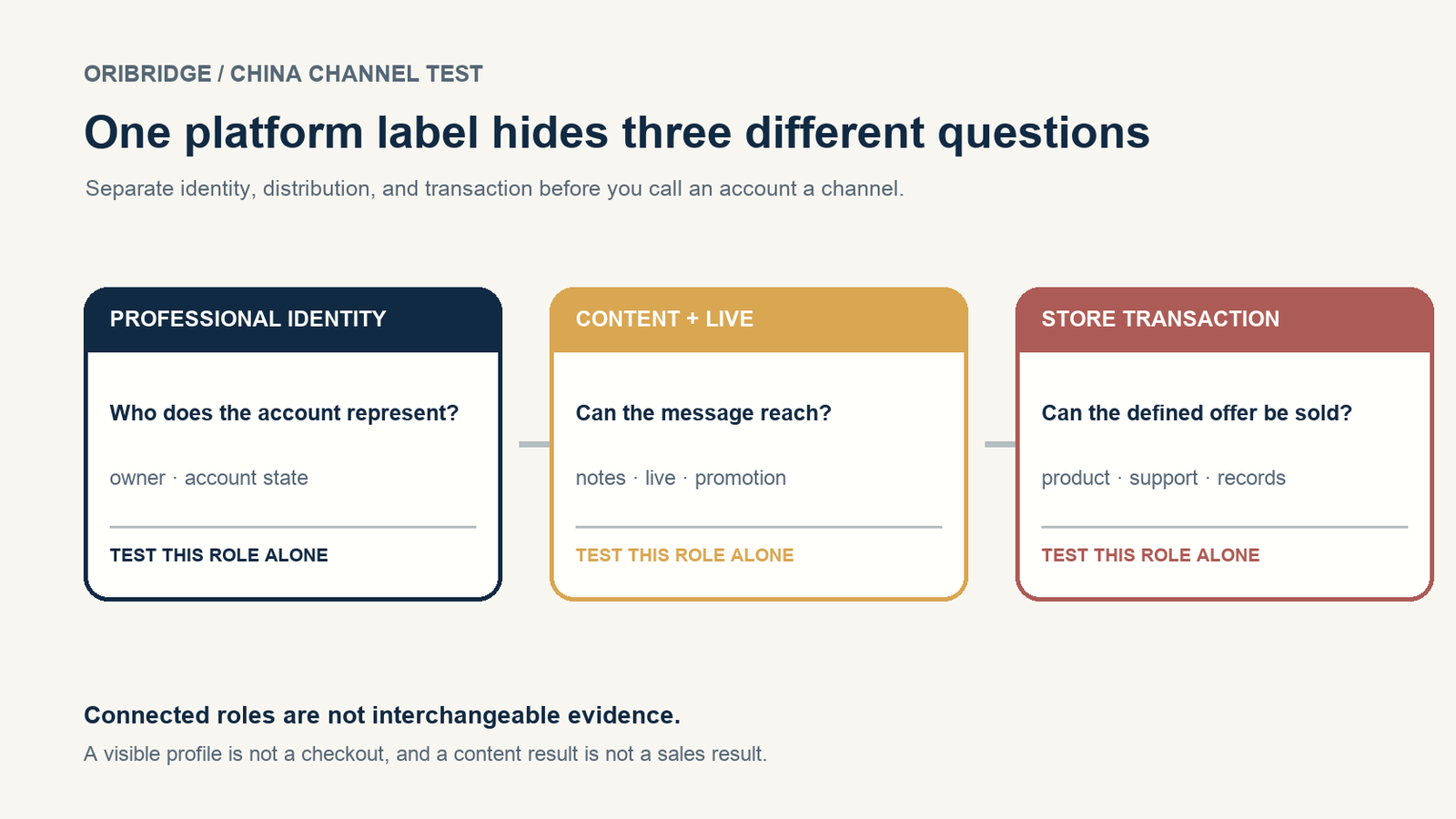
A visible profile is not a transaction route. Before you test Xiaohongshu for an expert product, separate professional identity, content and live distribution, and store transaction into three different questions.
Is Xiaohongshu suitable for an overseas expert?
It can be suitable for a bounded content-understanding test, but the platform name alone cannot answer whether it is a viable sales channel. First decide whether you are testing professional identity, whether one educational idea is understood through a note or live session, or whether an approved product can use a store transaction route. Evidence from one role does not prove the others, and none of them by itself proves demand.
The profile looked ready. The route was not.
Imagine an overseas expert preparing a short China-facing content test. The team completes a professional-account step, publishes a few useful notes, and sees a path that appears to lead toward live selling. Someone then says, “Good—we have a Xiaohongshu channel.”
That sentence hides three different claims:
- the account can represent the expert or business;
- the content can be discovered through notes or live activity; and
- the proposed offer can be published, sold, settled, and supported through a store route.
The first claim does not prove the second. The second does not prove the third. A channel test that records only “the account exists” is measuring setup, not demand or commerce.
Use three roles instead of one platform label
The official Xiaohongshu e-commerce learning page describes professional accounts as an identity entry point for commercial activity. It separately describes commercial promotion, note and live distribution, and the store as the place where products are published and sold. The page also describes account-review and account-status consequences for some store and content functions.1
That is a narrow product-document fact, but it is useful. It gives the team a better unit of analysis:
| Role to test | What the role means in this article | What one observation can tell you | What it cannot prove |
|---|---|---|---|
| Professional identity | Who the account represents and which account state is being used | Whether the intended identity and operating owner are recorded | That the account is eligible for every category or commercial feature |
| Content and live distribution | How notes or live activity are used to create attention or explain an offer | Whether the content route can deliver the intended message to the defined audience | That the platform will deliver traffic, leads, or buyers |
| Store transaction | Where an approved product is published, sold, and settled under the relevant route | Whether the exact product, subject, and operating party can complete the defined transaction test | That a profile, note, or live room is itself a checkout or a compliant sales route |
The layers are connected. They are not interchangeable. The diagram on this page is a design aid, not a claim about a particular account’s access.
The overseas analogy: a profile is not Stripe
An overseas expert may be used to thinking in a simpler sequence: create a public profile, send people to a landing page, and let a payment processor handle the order. That mental model is useful for comparison, not for assuming that every Chinese platform has the same boundaries.
On Xiaohongshu, the official page’s role distinction makes one practical question unavoidable: which action are you actually testing? Are you testing whether a Chinese reader understands the expert’s point of view? Whether a note or live session can carry a defined next step? Or whether a specific product can enter a store and complete a transaction under the relevant account and category conditions?
Write the answer in one sentence before opening another setting. If the sentence contains “content,” “promotion,” “live,” “store,” and “payment” all at once, it is probably four tests.
A small route brief
For a first test, record these fields:
- the named expert or business the account represents;
- the exact content or live action being proposed;
- whether the action is organic, promoted, or connected to a commerce route;
- the product category and the promised user outcome;
- the person who controls publishing, messages, customer service, and records; and
- the stop condition if the next role cannot be verified.
This is not a permission checklist. It is a way to keep an unanswered platform question from being mistaken for a business result.
The route-specific question tree in Do I Need a Chinese Entity or Local Partner to Operate Social Accounts? is useful when the proposed action includes an operator, partner, data handoff, or fulfilment. The Douyin article, How to Market an Online Course on Douyin Without Turning It Into Cheap Edutainment, is a comparison point for a platform whose official learning surface also separates different operating tasks. Neither page proves that Xiaohongshu, Douyin, or a particular account will produce buyers.
A counterexample: when a store is not the next test
Suppose the immediate question is only whether a defined Chinese professional audience understands one idea in a short note. A store test may add account, product, support, and transaction variables that the team does not need yet. A content test can be the smaller route, provided the team labels it honestly as a content observation.
Now change the promise: the expert wants to sell a paid workshop through a live session, collect buyer information, and provide follow-up support. The store, identity, customer-service, payment, and fulfilment questions become active. The earlier content observation cannot be reused as proof that the transaction route works.
That is the difference between a channel experiment and a platform assumption.
What this article cannot prove
This article does not establish that an overseas person or entity can open, verify, promote through, sell on, or settle through any Xiaohongshu route. It does not establish category approval, platform traffic, buyer demand, payment success, refund handling, legal compliance, tax treatment, or commercial return. Those require current account-specific checks, an authorized route test, and professional review where applicable.
The official page is a role map, not an outcome report. Recheck the current rule before an authorized production test.
The useful next step is to define one role and one observable action. If you want a route review, request a scoped validation review with the proposed identity, content action, transaction action, and stop condition.
Sources and limits
-
小红书电商学习中心, “小红书专业号和店铺关系规则解读”, checked 2026-08-16. The page supports only the stated role distinction and related account/store relationship notes. It does not establish overseas eligibility, category approval, traffic, payment, fulfilment, legal compliance, or commercial results. ↩