
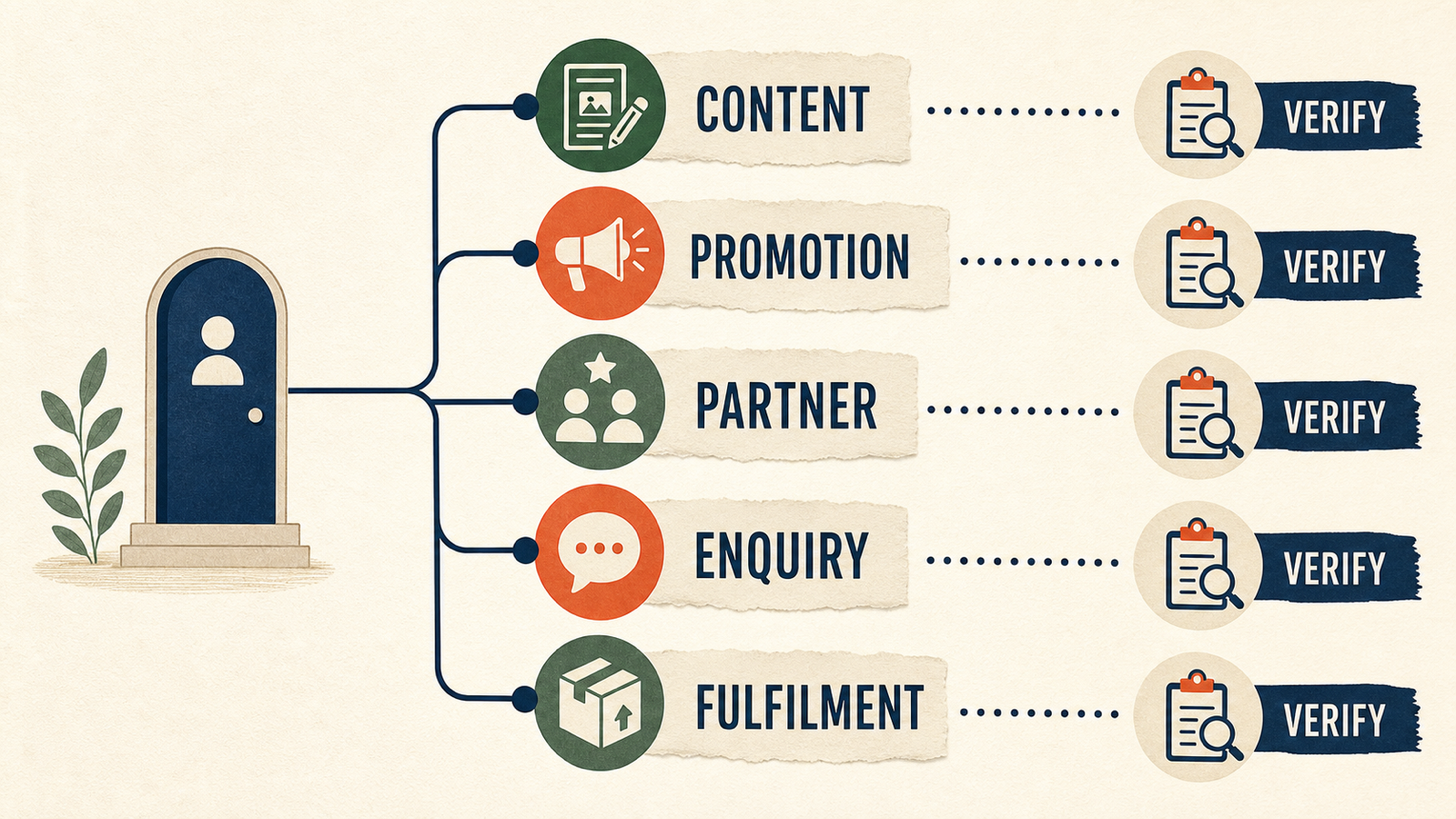
There is no responsible universal yes-or-no answer. “Operate a social account” can mean publishing a post, buying promotion, working with a creator, collecting an enquiry, taking payment, or fulfilling an order. Each route carries a different set of current platform, account, entity, data, contract, and delivery questions. Decide the route first; verify its conditions second.
The question usually arrives too early
An overseas course owner sees interest in China and asks, “Do I need a Chinese entity or local partner to open a social account?”
The instinct is understandable. The question is also too compressed to answer safely.
Imagine an illustrative team preparing three short teaching clips. At first, they only want to publish an attributed profile and learn whether the topic is understandable. A week later, someone suggests paid promotion. Then a local operator offers to introduce creators. Then the team wants to collect leads, sell a workshop, and route payments through a new page.
That is no longer one account question. It is a sequence of different operating routes. Calling all of them “social media” makes the important differences disappear.
Treat the account as the front door, not the whole building
The useful model is a route-specific question tree. It does not tell you which route is permitted. It tells you what must be known before anyone claims that an entity, a partner, or an account structure is required—or sufficient.
What are we asking the account to do?
│
├─ Publish attributed organic content only
│  └─ Check: current account route, identity/role rules, content rights, access owner
│
├─ Buy promotion or run paid activity
│  └─ Check: current advertising route, account eligibility, contracting party, approval process
│
├─ Collaborate with a local creator or operator
│  └─ Check: attribution, authority, account access, content approval, records, handback
│
├─ Collect enquiries or move people off-platform
│  └─ Check: destination, data handling, response owner, consent and record path
│
└─ Take orders, payments, or provide fulfilment
   └─ Check: the relevant commerce, entity, payment, tax, customer-service, and delivery rules
The branches are not a checklist of permissions. They are a way to stop the team from using an answer about a profile to justify an answer about advertising, commerce, or fulfilment.
Why one platform page is already more than one question
Douyin E-commerce is the commerce layer associated with Douyin, a short-video and live-content platform. Its official learning centre is not a general legal guide, and it does not answer whether an overseas expert qualifies for any particular route. What it does show, on the page checked 2026-08-13, is that the operator’s work is split into distinct areas: onboarding, account management, short-video and live operations, marketing promotion, creator collaboration, customer service, order management, and other fulfilment topics.1
That visible separation matters. A team asking only whether it needs “a local partner for Douyin” is probably joining several unverified decisions together:
- Who is named on the account, and who can change its access?
- Is the intended activity simply content, or does it include promotion?
- Is a partner producing work, representing the expert, introducing creators, or handling customer contact?
- Where does an enquiry go, and who may see or answer it?
- Does the proposed route reach commerce or fulfilment functions with their own current rules?
The learning centre’s menu does not establish eligibility, approval, or a suitable setup for any of those actions. It is evidence for a narrower insight: the route is multi-part, so verification should be multi-part too.
Delegating a China-facing account is not one permission. Record four separate questions for the exact route: who may publish approved material, who may answer or moderate, who may read data, and who owns the commercial or delivery handoff. Verify each answer against the proposed platform’s current written rules. A public creator surface does not prove that a particular overseas expert, agency, account, payment route, or product is eligible.
The overseas analogy is about roles, not transferability
Google Ads describes administrative accounts as a way to manage access and relationships among accounts.2 That mechanism does not apply automatically to a Chinese platform, and it says nothing about Chinese platform eligibility or regulation.
It is useful for one smaller reason. Even in a familiar advertising environment, “who manages the account” and “who has access” are operational variables worth recording. The same discipline is sensible before an overseas expert gives any operator, agency, or collaborator control over a China-facing account: name the account owner, the permitted role, the approval boundary, the evidence trail, and the handback route. Then verify the actual platform’s current rules for the actual proposed action.
An account password is not an operating model.
A local partner can solve a different problem from an entity
“Chinese entity” and “local partner” are often treated as interchangeable answers. They are not even the same category of question.
An entity question may concern the named party for a particular platform or commercial function. A partner question may concern language, production, creator relationships, customer response, local operating capacity, or a bounded distribution role. Neither label tells you who owns the account, what the partner may say, who receives enquiries, or whether the next commercial step is viable.
Before appointing a partner, separate the bottleneck from the label. Overseas Platform or Local Partner? Start With the Bottleneck explains why a local partner is not a default cure for every market-entry problem. If the actual question is whether the route can deliver a course experience, use a controlled route test rather than assumptions about platform names: How to Test a Course Platform in China Without Guessing.
If the proposed route now includes selling a course, the next question is not automatically company formation. The bounded China course-sales guide separates buyer, offer, access, payment, delivery and decision points so the formation question stays tied to a named route. It is not a conclusion that a particular seller can operate without an entity.
The counterexample: when the full tree is unnecessary
Suppose the same illustrative team is not selling, promoting, collecting enquiries, or asking anyone to represent it. It is only deciding whether an approved, clearly attributed teaching clip is understandable to a defined audience. It may not need to resolve every commerce and fulfilment branch before it can formulate that narrow content question.
But the moment the team adds paid distribution, partner-managed messages, lead collection, payment, or fulfilment, the unused branches become active questions. That is why a universal answer is risky: it is usually true only for a route the team quietly changed two weeks ago.
What to put in the route brief before seeking an answer
Write a one-page brief with the proposed action in plain language. “We want to operate social accounts” is too vague. “We want to publish three approved clips from an attributed account, with no paid promotion, lead collection, sales, or partner access” is a route that a platform and appropriate advisers can evaluate.
Then add the facts that change the answer: platform and feature, account type, named account holder, country or region of each party, whether money changes hands, whether someone else handles messages, what data leaves the platform, and what the customer receives. Keep every unknown visible. Do not fill a gap with “a local partner will handle it.”
This is also the right point to ask whether the route has a buyer logic at all. How Overseas Experts Can Reach Chinese Buyers Without Building Every Channel separates reach from a usable buyer path, while When Topic Popularity Is Not Buyer Demand cautions against treating attention as commercial evidence.
What this article cannot prove
This question tree cannot tell you whether a particular overseas entity, individual, account, local partner, advertisement, payment path, data flow, or fulfilment route is allowed, available, suitable, or commercially sound. It does not establish platform approval; it does not substitute for the platform’s current written rules, account-specific confirmation, or qualified legal, tax, payments, and data advice.
No controlled account, entity, region, device, or end-to-end route was tested for this article. Platform pages and rules can change.
Next step: Before you create or delegate a China-facing account, send OriBridge the proposed route in one paragraph: what the account will do, who will operate it, what data or money will move, and what the user is meant to receive. We can help turn the vague entity question into the specific questions that need current platform and professional review.
Sources
-
抖音电商官方学习中心, “学习中心首页-抖音电商官方学习平台”, checked 2026-08-13. The public page presents separate operational areas including onboarding, account management, short-video/live operations, marketing promotion, creator collaboration, customer service, order management, and fulfilment-related topics. It does not establish eligibility, approval, or a permitted route for any particular overseas entity or operator. ↩
-
Google Ads Help, “About administrative accounts”, checked 2026-08-13. Used only for the narrow point that account management and access relationships are operational variables. It is not evidence about Chinese platforms, Chinese law, or account eligibility. ↩