
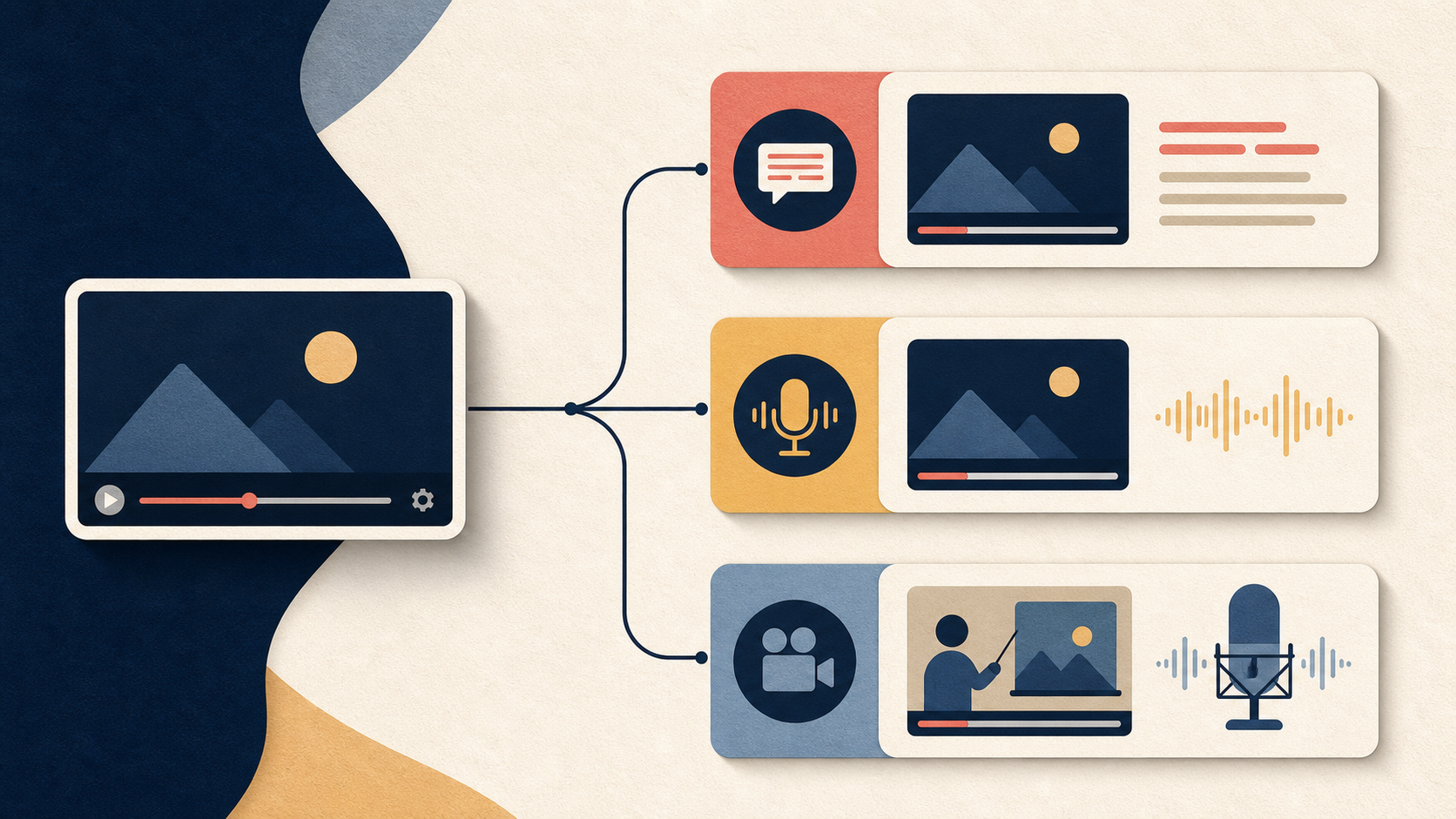
Subtitles, AI dubbing and a Chinese-language re-recording are not three quality levels on a slider. They change different layers of a lesson, create different review obligations and preserve different parts of the instructor’s delivery.
The practical choice is not “which sounds most local?” It is: which learner action must survive the release? If the learner must inspect a screen, subtitles may preserve the original demonstration and add a text reference. If the learner must follow spoken pacing without reading, a dubbed track may help. If the lesson depends on trust, timing, examples or guided performance, a re-recording creates a new instructor performance that needs its own review.
One lesson, three artifacts
Use an illustrative software lesson. The instructor tells viewers to pause, read a policy screen and then perform an action in a tool. The original video has a quick demonstration and a joke that makes the transition memorable.
With subtitles, the voice, timing and screen remain the same. The Chinese text becomes a new learner-facing layer. With AI dubbing, the audio changes while the screen and edit may remain. Pauses, emphasis and the relationship between voice and cursor can shift. With re-recording, the Chinese speaker may change the pace, examples, gestures and even which screen is shown.
None is automatically superior. Each produces a different release record: source version, transformed layer, human checks, known limitations and intended learner action.
What the production documents show
Tencent Cloud’s one-stop video-localization documentation describes separate subtitle and dubbing functions, including subtitle extraction, translation, burn-in and AI dubbing, with prerequisites for using the workflow. Its MPS product documentation describes captions for live and offline video, terminology or hotword configuration and rendering options.
These are useful operational sources. They support the statement that subtitle and audio workflows can be separate processing jobs with separate outputs. They do not prove that an overseas creator is eligible to use a particular service, that a route is available to a particular account, or that the generated voice is accurate enough for a specific lesson.
The CAC Interim Measures for Generative AI Services include a marking requirement for generated image or video content for providers within the measure’s scope. That is a boundary to check with an appropriate reviewer; it is not evidence that a particular dubbing route is approved or that a creator has met every obligation. Keep the source’s scope visible in your release record.
Subtitles preserve the source performance
Subtitles are often the smallest first experiment for a lesson whose visual demonstration carries the method. They let the learner inspect the translated wording and compare it with the original audio. They also expose whether a term is stable enough to teach: a caption review may find that one English word maps to three Chinese expressions depending on the task.
Their limits are equally concrete. Reading competes with watching a cursor or diagram. Long lines can hide an instruction. A subtitle can be technically faithful while using a phrase that changes the intended learner action. The review question is therefore not “is every sentence translated?” but “can the learner perform the step after reading it?”
Create a sample with the densest section of the lesson, not only the welcome video. Record the original timestamp, subtitle text, key term, expected action and reviewer decision. If the sample fails because the screen moves too quickly, that is a pacing or edit problem, not an argument for automatically ordering a dub.
AI dubbing changes the audio contract
A dubbed track can help a learner who cannot comfortably read while following a demonstration. It may also make a long lesson feel more conversational. But the voice is now part of the teaching artifact. The review must cover pronunciation, names, numbers, emphasis, timing and whether a spoken instruction lands before the relevant screen disappears.
An AI voice can sound fluent and still be wrong for the teaching moment. A translated sentence might be grammatical but imply that a tool action is optional. A pause inserted for natural speech might arrive after the cursor has moved. A voice that resembles the source speaker may also raise a separate consent and rights question; this article does not determine that question.
The smallest useful test is not a trailer. It is a short, instruction-heavy segment with a glossary and a human sign-off line for every action that matters. Keep the source audio, generated audio, transcript and reviewer comments together. If the route uses a platform task that is asynchronous, keep task/result identifiers in the internal record; do not describe the processing page as proof of learning quality.
Re-recording is a new performance
Re-recording gives the editor the most control over pacing and local examples. It also creates the largest change. The new presenter may clarify an idiom, replace a screen or change the order of the exercise. That can be a strength when the original performance depends on context that does not travel.
The risk is treating re-recording as a voice swap. Once the delivery changes, compare the original and new learner actions. Does the Chinese presenter ask the learner to pause at the same point? Are the prerequisites still true? Is a demonstration still reproducible? Which claims are translated, and which have been adapted?
Use a version table rather than a single “localized video” label:
| Version | Changed layer | Must be checked | Evidence retained |
|---|---|---|---|
| S1 subtitles | On-screen text | terminology, line length, learner action | source video, subtitle file, review log |
| D1 dubbing | Audio | timing, emphasis, pronunciation, consent boundary | source audio, generated track, transcript, review log |
| R1 re-recording | Performance and possibly edit | method, screen, pacing, examples, action | script, raw take, final video, comparison notes |
The table is a production control, not a promise that one route will convert better.
Choose by the job, then by the risk
Start with the learner action. For reference checking, captions may be the sensible first route. For a screen-led walkthrough, preserve the screen and test subtitles against the action. For a listening-led explanation, test a dub on the sections where pacing matters. For a workshop-like demonstration where the instructor’s judgment is part of the offer, a new recording may be justified, but it should be reviewed as a new performance.
Then ask what could make the release misleading. If the lesson uses fast UI changes, any audio or text layer may drift. If a term has a contractual or safety consequence, route it to a named subject reviewer. If the lesson is a short promotional clip with no instruction, none of the three may be necessary; a translated description can be the lower-risk demand test.
This is also why a full course should not be transformed before a bounded sample is observed. Pick one lesson with the highest density of terms, actions and context. A successful sample does not prove the entire library is portable, but a failed sample can prevent a much larger production mistake.
Version records are part of the release
For every localized sample, retain the source URL or file identifier, source-language transcript, selected route, tool and date checked, glossary, human reviewer, unresolved issue and intended audience. Mark whether the asset is internal, review-only or approved for a specific release. Do not silently overwrite the source or present an internal draft as a published version.
The same discipline applies to disclosure. A YouTube AI Label Is Not a China Release Record explains why a label or platform field cannot replace a release record. For dependency mapping, see Localizing an Expert Product for China. Dependency and Terminology Inventory helps identify the screens, accounts and terms that the video route must preserve. If you are testing only a small market signal, Second-Market Test Without Full Translation is the relevant scope boundary.
The honest conclusion
There is no source here that proves Chinese subtitles, AI dubbing or re-recording will improve completion, trust, demand or revenue. The operational conclusion is narrower and more useful: each route changes a different learner-facing layer, so each needs a different review record.
If you cannot say which layer must survive, you are not choosing a localization format yet. You are choosing a production habit. Test the learner action first, preserve the version history, and let the evidence decide whether the next lesson deserves a larger route.
OriBridge can help turn one source lesson into a bounded comparison brief with explicit release evidence and authorization boundaries. Request a China validation discussion before ordering a full library transformation.
Sources and evidence boundary
The Tencent Cloud one-stop video localization and MPS product functions, checked 2026-08-23, support only the documented subtitle, caption and dubbing functions and prerequisites. The CAC Interim Measures support only its stated scope and marking requirement for providers within that scope. None proves overseas account eligibility, legal sufficiency for a particular release, voice accuracy, learner outcomes, demand or commercial performance.