
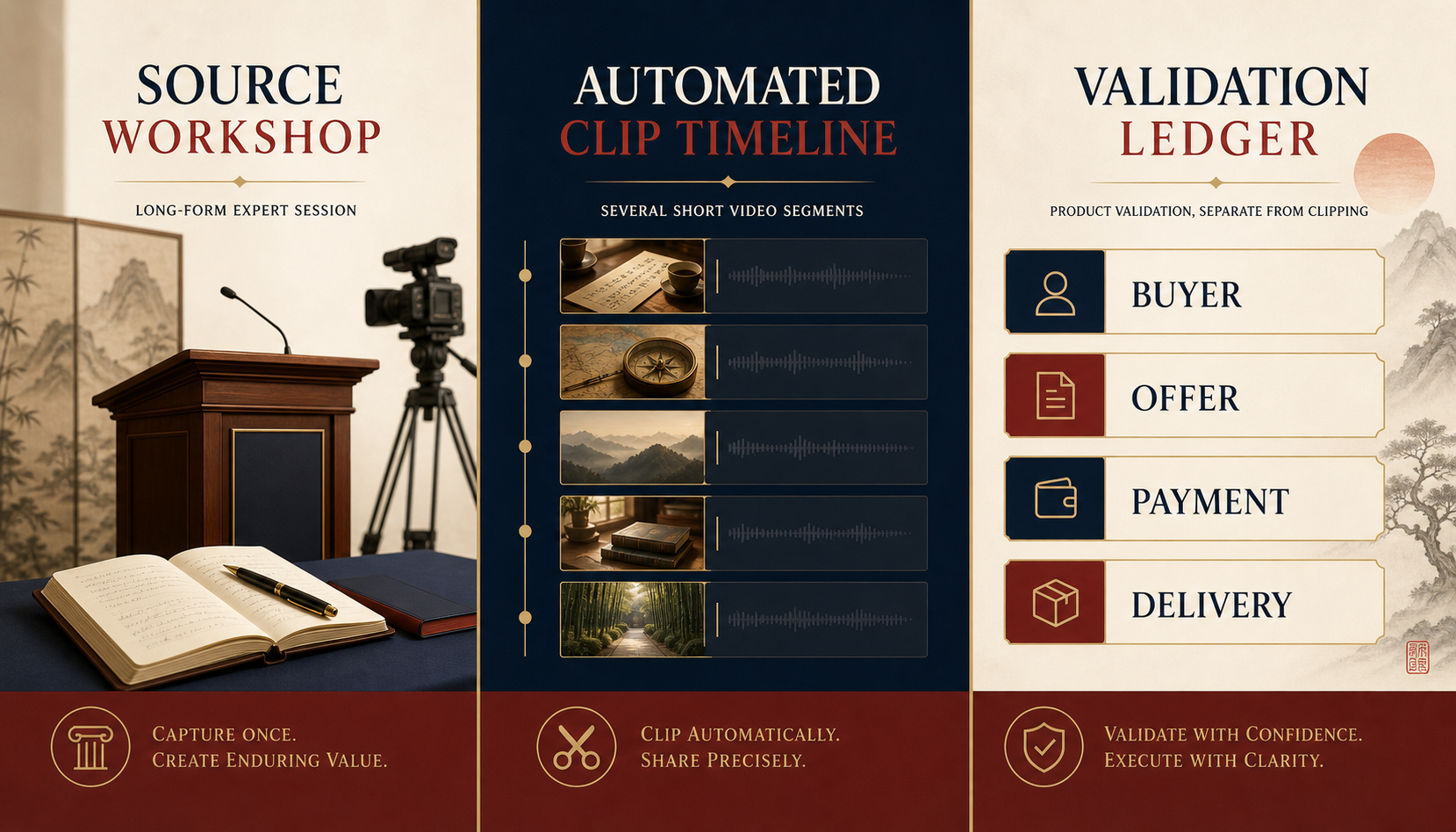
Turning a workshop into ten Chinese video clips proves that a production workflow generated ten clips. It does not prove that buyers want the full expert product, understand its promise, accept its price or can complete its delivery path.
That is the direct answer. A clip test is an expression test unless the team writes down a separate, observable buyer question and records the result without borrowing a conclusion from the editing process.
The production result is easy to count
An automated media workflow can make a long recording feel operationally tractable. Tencent Cloud’s media-processing documentation lists functions such as intelligent subtitles, summaries, tags, orientation conversion and media analysis. Its Media AI integration documentation describes distinct paths for subtitles, AI dubbing, video localization, summaries and clip extraction.
Those pages support a useful production inventory. A team can ask which function was used, which output was produced and which processing conditions were recorded. They do not support a claim that the clip will be recommended, watched by the right buyer, converted into a course sale or accepted as a valid China delivery route.
The count “ten clips generated” is therefore a production metric. It should not sit in the same column as “buyer understood the offer” or “buyer asked for a defined next step.”
Four questions a clip cannot answer by itself
Does the buyer have the problem?
A clip may make a problem look familiar. Familiarity is not evidence of urgency, authority or budget. A viewer can recognize an AI workflow without wanting a workshop about it.
To test the problem, describe the intended audience and ask for an observable response: a qualified question, a request to inspect a defined format, a stated workflow constraint or another predeclared signal. Do not count every view as a buyer record.
Is the offer understood?
A short clip can communicate one idea while hiding the product boundary. Is the underlying offer a self-paced course, a live workshop, an advisory engagement or a demonstration? What does the learner do next? What support is included?
If the clip is intentionally only an educational fragment, say so. A clear clip can still be useful without pretending to explain the complete offer.
Will the buyer accept the commercial path?
The clip does not answer price, procurement, payment, authorization or service scope. Even a positive conversation may leave those questions open. Keep them in a separate validation record.
Can the learner receive and use the product?
A clip can be accessible while the course path remains unresolved. Account, access, live delivery, support, replay, payment and entitlement are separate parts of a learning route. A media output does not close them.
The correct ledger for a clip test
For each clip, preserve two kinds of information. First, record the production facts: source timestamp, original file, selected transformation, language, terminology, processing date and reviewer. Second, record the experiment: intended audience, proposition shown, channel or context, observable response and what remains untested.
Keep the distinction in the field names. “Clip rendered” should not be called “validation.” “Question received after the clarified offer” should not be called “sale.” “Viewer watched” should not be called “buyer intent.”
This naming discipline may make the dashboard look less exciting. It makes the next decision more honest.
A scenario that looks like proof
Consider an illustrative scenario. A team takes a two-hour AI workshop and automatically creates ten Chinese clips. Three clips receive comments asking for more examples. The team concludes that the course has China demand and begins translating the full workshop.
The comments are useful observations. They might show that a particular explanation prompts a question. They do not identify the buyer, establish the offer, confirm the delivery path or justify a full translation budget. The next test could be a bounded workshop brief that states audience, outcome, format and support, followed by a predefined response rule.
The scenario is not a client case and does not report real performance. It illustrates why a production event and a market observation need separate labels.
What the media sources can and cannot prove
Tencent’s documentation can support the fact that media functions such as clipping, subtitles, tags, summaries and other processing surfaces are separately documented. It can help an editor design a processing record and avoid treating every output as the same artifact.
It cannot establish that a particular account can use a route, that a generated clip is accurate, that a platform will distribute it, that viewers are buyers, or that the underlying expert product has demand. It cannot create content rights or prove a compliant delivery path.
Do not add a platform logo or a recommendation claim to the visual just because the source page belongs to a platform. Keep the article about the evidence distinction.
A three-stage test that does not overclaim
Stage one is expression. Can the editor produce a clip that preserves the intended claim, condition and learner action? Review it against the source and mark unresolved changes.
Stage two is comprehension. Can a person unfamiliar with the original course say what the clip is about and what the next learning action would be? This is a narrow reading observation, not a learning-outcome claim.
Stage three is commercial or delivery validation. Only if the first two are clear should the team test a defined buyer question, offer boundary, payment or delivery condition. The clip remains an input to that test, not proof of the result.
The stages can stop early. If the clip changes the method or drops a condition, fix the source or stop the transformation. If the viewer understands the clip but not the offer, clarify the offer. If the offer is clear but the route is unresolved, test the route separately.
Existing guidance that should not be collapsed
When Topic Popularity Is Not Buyer Demand gives the general attention-versus-demand boundary. This article makes it specific to automated clips: production speed creates a particularly tempting false positive.
Localizing an Expert Product for China addresses the broader adaptation debt behind a learner journey. The present article is not a format comparison. It asks what a clip can prove about the product.
For the creator relationship, see How Overseas Experts Can Reach Chinese Buyers Without Building Every Channel. That article addresses route scope. A clip test can precede a collaboration without proving the collaboration will distribute or sell anything.
A limited counterexample
If the stated research question is only “Can our editor turn a long workshop into short files with consistent terminology and a defined format?”, then the clipping output is relevant evidence for that narrow production workflow. It still should not be labeled market validation. The team may learn that a certain clip length, language layer or review step is feasible; that is a different conclusion.
The decision after the clips
Do not ask, “Did the clips work?” Ask, “Which proposition did this test actually touch?” A good record might say: “The workflow produced three reviewable clips; one preserved the learner action, two need correction; no buyer, price or delivery proposition was tested.” That sentence is less dramatic than a growth report, but it tells the next operator what to do.
OriBridge can help separate a media-production experiment from a bounded China product validation plan. Request a China validation discussion before turning a folder of clips into a full-course launch decision.
Sources and evidence boundary
The Tencent Cloud Media Processing product functions, checked 2026-08-23, support only the listed media capabilities and processing work units. The Tencent Cloud Media AI integration documentation, checked 2026-08-23, supports only the documented access paths. Neither source proves recommendation, reach, buyer demand, payment, delivery, authorization, revenue or learning outcomes.